Please Move On
Posted by Richard Rothstein
January 21, 2007 11:24 am

Like many of you, I have a hobby. It’s not an unusual avocation. I take photographs. I was born on Manhattan island and have lived my entire life in this astonishing feast of visual diversity and eccentricity. And as a native of this town rather than a tourist, I enjoy the luxury of time allowing me to see far beyond the skyline, the great buildings and the rich tapestry of glamorous tourist attractions. Since childhood I’ve carried a camera. I’ve always been fascinated with the minutia of this city, those details that few notice: shapes, colors, light, broken windows, architectural and design quirks and the strange visual synergy of so many cultures on one tiny river island.It has been my habit for many decades to occassionally spend a very private and spiritual Saturday roaming some corner of Manhattan, using my camera to capture a reflection in a puddle, the intense juxtaposition of colors and architectural styles on a street corner or sometimes a funny moment in someone’s life. The experience has always been very private and a very special few hours allowing personal reflection and a very special kind of connection with my hometown.
I rushed out this morning, Saturday, January 20 simply because it was the coldest morning of the winter, a winter that has been bizarrely and constantly warm, warm enough to keep my seasonal hay fever active far beyond November. A crystal clear frigid Saturday morning would surely deliver funny coats and hats and wonderful games of light and color. Between taxis and my feet, I covered parts of the Financial District, Chinatown, Little Italy, Soho, Noho and Union Square. But for the first time in my life there were many parts of these neighborhoods that I could no longer cover and where my camera and I were no longer welcome. I was tempted to post my photograph so that you could determine for yourself just how much I resemble a threat to democracy and freedom–but that’s probably not wise. Suffice it to say that I am a 58-year-old very white, bald, Jewish, Gay New Yorker with a very neatly trimmed silver beard. I was wearing an $1,500 Italian dark green leather and fleece coat, a black cashmere scarf and a matching black pull on cashmere cap. I looked like your typical over-paid and perfectly stylish self-indulgent New Yorker on his way to or from a chic brunch. Today’s weapon of choice was my Canon Digital Elph with optical zoom.
However, to members of the New York City Police Department, several doormen and a couple of security guards, I looked like none of the above. I looked like a terrorist threat. Clearly, a lone man photographing details of buildings from various angles and wanting to enter lobbies of city landmarks to photograph cherubs, statuary and mosaics is now assumed to be a threat to the safety and security of our fair city.
I’m a photographer. I’m an artist. But such explanations no longer fly. I was denied entry to the lobby of the landmark and fantabulous Woolworth Building. I was asked for photo ID in front of a Soho luxury condo. Two of New York’s finest approached me in front of a Prince Street church and asked me to please “move on.” I explained who I was and what I was doing. The response was a second “please move on.” Two security guards asked me why I was photographing crowds shopping the stalls on Canal Street. Why is it any of their business, I asked? “Please move on.”

Perhaps on my next outing I’ll rent a wife and a child to walk with me so that everyone just leaves me the hell alone. But the terrorists are probably already employing that ruse, so I might get shot.
The sad truth is in the details. How has 9/11, Homeland Security and George W. Bush changed our lives? Ask a guy who just likes to take pretty pictures for his own pleasure. Ask a guy who has lost the freedom to spend a Saturday by himself in the peace and beauty of his own world, a world that is now ridiculously interrupted by officious men in uniforms and requests for photo ID.
Photographing the details of Manhattan used to be a very enriching hobby, now it’s a awkward negotiation through a maze of uniforms. I know. It seems to be a small price to pay for our freedom. But this morning I found myself asking, “What freedom?”
You’ll find more examples of my freedom-threatening work here.
Richard,
Edward Gibbon, in Decline and Fall of the Roman Empire (1776) speculated that part of the reason that the Roman world fell into tyranny was that the Romans gradually lost their traditions of freedom and acquired habits of servitude. An insidious restriction of rights is perhaps the most dangerous, because it is the least apparent.
Not to belittle the political dimensions here, your photos create for me this huge homesickness for New York. The first image has a dizzying quality of the city itself, the second forms a fascinating contrast.
Richard,
I find your post heartbreaking. As my husband said a few years ago, “They’ve taken my beloved country away from me.”
I find this a sad story. This is a such a sympathetic man and he makes beautiful photographs. It is not only what happened on Saturday, but everything behind it. I looked at the photo blog. I find the pictures the witness of a very sensitive soul. He has an eye for beauty and for drama. I find the colors also interesting. I am curious about how these images are made. Are the colors enhanced?
June,
A few years ago things seemed in order compared to today.
We don’t seem to discuss political art here much. Richard’s photos are political in context, but not in original intent. Do you think that poltical art is a dead genre?
Richard, do you think your recent experience will affect your future goals in photography?
Karl, it is better to wait till April to visit NYC.
Hanneke: Some are enhanced on the computer but others are not.
Karl: you make an interesting point and ask an even more interesting question. I am a very poltical person and blog on politics and issues quite extensively on some of the major political blogs–as you know; but my photography has been a very personal island of tranquility, a loving relationship between me and my city. No matter where I am in town, I find beauty with my camera. It’s a very intimate relationship that I’ve enjoyed sharing with others through my photography. The photos are, for me, an escape from the political and social turmoil in which we live and struggle. So the intrusion of politics/uniforms on my time with the city felt like a violation and an invasion of my personal privacy and personal space.
Today, I’m feeling more passionate about capturing New York’s beauty whereever and whenever I see it. I didn’t fight back because I was very much into my own world and just wanted to be left alone. Part of the problem I suspect is that I rarely photograph the famous landmarks or the tourist areas, so my actvities are more obvious and likely seem rather strange. When I see something beautiful I will take many shots, edit, discard, circling my subject, trying different angles—it must truly look like I’m “scoping” out the place for some odd purpose. So will this affect my future goals in photography? At this point all I can say is that it has made me feel much more committed to my art. But you may be on to something. Next on my agenda: Wall Street and the Manhattan court and government buildings.
Next on my agenda: Wall Street and the Manhattan court and government buildings.
Richard,
That should make you really popular with the authorities!
Maybe you can get a press pass or something like that?
I’ve gotten to know the feeling of getting involved in making photos since I started devoting time to it each day. It is like entering a different mindset, a different world. Sometimes I find myself standing in the middle of the street looking for the right shot. Doug Plummer describes it as meditation which I found a surprising but apt description.
It is very much a meditation. And I have almost been hit by taxis a few times. Lost in my own world. The problem is that I just don’t want to talk to other people when I’m engaged in the process, partciularly some officious and arrogant neanderthal. Forgive the crude analogy, but it’s like conjuing up a really intense fantasy in your mind during masturbation and being interrupted by a ringing cell phone which you stupidly forgot to turn off. Kind of ruins the mood if you see what I mean. New Yorkers generally don’t intrude on one another in the streets, respecting each other’s space and privacy–so this is a relatively new and very unNew York phenomenon.
Richard,
I’ve never heard of a photographer being run over by a taxi while taking a photograph. I suppose as long as the drivers are not lost in their own fantasy worlds, you should have a chance to survive. I can understand why so many war photojournalists get killed though. At least the taxis in aren’t trying to hit you.
Richard, I really enjoyed looking over your personal Manhattan. I’m hopeful this climate of fear and suspicion will change with time, but to help ensure that, it’s crucial that people like you continue doing what you’re doing. I can well imagine the frustration and anger you feel at some of the treatment you’ve received. I hope you can find a response that not only helps you keep your cool, but perhaps helps others sense what they’ve lost, what they’re missing, and that there’s a chance of getting it back.
Karl,
“Do you think that political art is a dead genre?”
Nope. And this post shows we need it now more than ever, at least in this country. We are in a scary place! But it is tricky business to try to get an issue or point across in art and not hammer the audience on the head with it. I would love to hear responses to work that grapples with some tough content. we are as a lot pretty traditional painters, photographers, fiber artists , generally speaking of course. I would love to hear others’thoughts about art that addresses political issues. But maybe that is for another post…
Great, evocative post, Richard. And beautiful photos. Many remind me of the book “The Poetics of Space” because you find such unique spaces that we take for granted. Like Steve said, keep at it - it is critical.
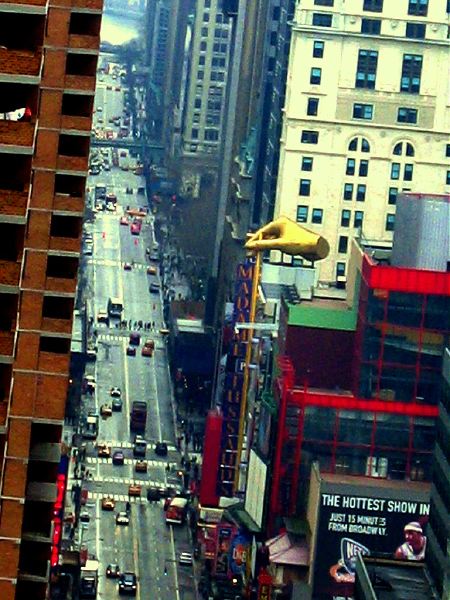
ps - I had to look at the first image a long time before believing it was a photo. Even the lettering on the sign looks very painterly. And what is that yellow hand?
It is frightening to me the freedoms we will willingly give up in order to have the illusion of safety from the now very loosely defined threat of terrorism.
911 was a tragedy but it will also be a tragedy if we lose freedoms such as this in America.
Bill,
Is art just something for decoration, or do you think art has some useful role to play in political culture as well? If the latter, how do you think that artists could use their art to defend their freedoms? Or would you say that artists should stay away from political topics in their art work, even if they are involved in politics in other ways?
Isn’t art by its very nature political in that a true artist is freely expressing his or her own vision without regard for the will of others? Surely, when one stands before honest art and the act of its creation, one is in the presence of freedom.
Oh, the floating hand is part of the facade at Madame Tussaud’s Wax Museum on 42nd Street just off Times Square. The view is from the roof of my building.
Is it a Yin-Yang phenomena? Did the tragedy in downtown Manhattan accelerate the revival of uptown Manhattan? Real estate in Harleem is booming. People are buying, restoring and living in its brownstones. Clinton has his office there.
For years, my favorite walk has been to stroll down Broadway from Harleem to Lincoln Center. I love watching all ethnic groups, ages, professions and sexual orientations mill and loiter there.
I have not been down to the site of the 9/11 tragedy. I did not even like walking there before the World Trade Centers went down. It felt uncomfortable to be in the shadow of such monster buildings with barely any life on the street. I prefer to roam through those parts of Manhattan where people live, starting with Chinatown and going up North.
To me, some places downtown are loosing their charm. When I moved to Manhattan, my favorite bookstore was in the village on 8th street. It is long gone. That street is now a tourist desert.
Does positive life occur uptown these days?
I was tempted to post my photograph so that you could determine for yourself just how much I resemble a threat to democracy and freedom–but that’s probably not wise. Suffice it to say that I am a 58-year-old very white, bald, Jewish, Gay New Yorker with a very neatly trimmed silver beard. I was wearing an $1,500 Italian dark green leather and fleece coat, a black cashmere scarf and a matching black pull on cashmere cap.
Several points, in no particular order:
1. You cite your description. Apparently you feel that middle-aged, white, bald, jewish wealthy folks should be exempt from scrutiny. I’m sorry, but as a society, the United States seems to be pretty strongly resistant to the entire idea of racial/ethnic/social status profiling. Why, exactly, do you think that racial/ethnic profiling is a great idea, given the widespread dislike of it especially amongst the urban population in the US?
2. You write of being asked by security gaurds why you were photographing crowds, and your response was “Why is it any of your business?” The obvious answer would be that it’s their business because they’ve been hired to protect that crowd, and they’re just doing their job. Perhaps if you had, instead of giving them snark, had explained to them what you’re photographing, why, and shown them examples of your work (perhaps carry a pocket portfolio of small prints?) you’d find them more accepting, and less likely to give you the bum’s rush. I’ve had excellent success photographing on construction sites when, instead of responding to the initial hostility of the workers with snark and my own hositility, I explained what I was trying to do, answered questions about it, showed them some prints, and on subsequent visits, gave the crews free prints and brought coffee and donuts. On the last visits to the sites, the crew was routinely coming over to explain their plans, offer to move equipment and materials if it would improve my options, and generally assist me in any way they could without endangering me or themselves. At little friendly talk and helpful attitude will get you a lot more than a steadfast in your face “I’ve got rights, you uniformed asshat” response.
3. If you’re getting the ‘move along’ from law officers, I’d suggest you avail yourself of the the various resources that will explain to you exactly what your legal rights are. Anyone who can afford to dress in a $1500 Italian leather/fleece coat, cashmere scarf, and matching cashemere hat can presumably stand to part with a little cash to secure legal representation.
4. It seems disingenuous to claim that it’s the fault of Bush and Homeland security when you get excluded from private buildings. I’ve been photographing for decades and certianly was routinely denied photographic access to private property all along. Private property owners have every right to exclude whoever they please for any reason (or no reason), and this will continue until the fascists outlaw private ownership of real estate. The usual response amongst the artists I know is to open a dialogue with the owner of the property, explaining what your goals are, what photographs you want to take, and straightening out any legal issues (liability on the part of the owner is often a concern).
Paul,
I think you make some good suggestions. The issue is, what is the best way to make photographs, if that is the goal. A diplomatic approach may be better in certain circumstances. This relates a bit to Doug’s recent post — should the photographer consider him or herself a witness or a participant?
The point about photographing on private property is well taken also. I got stopped recently photographing in a store (I was taking a series of pictures starting before and continuing after the store visit). As a first experience, I felt annoyed, but I think with time it is best to build up set of discussion points to try to win good will.
Paul, have you experienced any change in restrictions on your work? I realize you don’t live in the big city, but maybe you have noticed a change anyway. I think the change was part of what was bothering Richard, that things weren’t like they used to be.
Karl-
The restrictions I face in my work now (as opposed to several years ago) are generally that as I set up, the property owner/farmer comes over to find out what the heck I’m up to.
I’ve learned coping strategies, of course. The first thing to do is assure the farmer that (a) I’m not from the media (because the media are controlled by urban interests and are always out trying to paint the farmers as ignorant nitwits out to rape the earth), (b) I’m not associated with the government in any way (because the farmers are having their lifestyle regulated out of existence), and (c) I’m actually a rural resident, and not an urban yuppie out to take pictures of the quaint but ignorant lifestyle of a bunch of luddites.
Often, the reaction I get when I explain what I’m about is bemused good humor. Things often change when I drag out the portfolio of prints and SHOW the work. I’ve gotten lots of good leads on things to examine photographically from chatting with property owners, who are not at all averse to looking at my photos, pondering for a moment, and then suggesting that if I’m interested in THIS (points to print) then I ought to go to a particular spot the next time conditions are a certain way.
That’s been unchanged from before 9/11. The biggest change recently has been that with the growing regulatory pressure on rural residents and the passage of broader legislation affecting rural residents, I have to be particularly quick to assure folks I’m not associated with the government in any way. I recently declined to enter images in a show sponsored by the county government because I didn’t want my name or work appearing on government publications, because I don’t want the rural residents to stop thinking of me as ‘that eccentric guy with the camera who drives the red Subaru Forester’ and start thinking of me as ‘that photographer whose photo was on that county report on pollution from farms’.
Paul, I agree that you make a number of excellent suggestions, but you’re a little off the mark on two issues. First of all, I regret if I failed in my attempt at sarcasm and irony with regard to racial profiling in New York City. Perhaps I should have added that if I’d been black I might have been shot 50 times and then questioned later.
Secondly, I am not a professional photographer. I’m just a man who has been photographing his city for years as a form of meditation and private time…and over the decades I’ve never been interrupted or bothered. Until now.
Oh, and regarding private property, one of New York City’s most magnificent treasures are the lobbies of our office buildings. One used to be able to tour these, show them to friends from out of town and photograph their beauty. I was simply noting that it is very sad that one now needs to make appointments, assuming access is allowed at all. My essay was partly about changing times–and not for the better. I wasn’t looing for solutions to problems.
In fact, I’ll wake up early on a Saturday morning and just head out spontaneously and head in whatever direction looks and feels right. New York and its residents are more than accustomed to be being photographed, painted and admired, but it is only since 9/11 and thanks to the relentless warnings from the White House that we now think of bombs.
Paul,
I never thought of these issues before when I looked at your work. But of course, this is land that people care for and depend upon. If they feel threatened, it is only logical to make an effort to calm their suspicions — good to focus on seeing things from the other person’s point of view.
Do you think these issues ever affect the way you make your photos? Do you need to make a mental effort to block out the distractions of the social context? Or, are is just “part of the scene,” so to speak?
I’ll need to look at your site again carefully with this in mind. Perhaps you are making a reference to these larger issues that I have missed. A quick review, plus my memory, tell me that people are not your focus for the most part. Have you in the past been interested in photographing people as a main project? Do you see it in the future?
First of all, I regret if I failed in my attempt at sarcasm and irony with regard to racial profiling in New York City. Perhaps I should have added that if I’d been black I might have been shot 50 times and then questioned later.
You didn’t fail in your attempt at all. You quite clearly implied that you thought anyone who assumed that a white, bald, Jewish, middled aged guy dressed in the trappings of affluence was a terrorist was nutso.
Well, that’s racial/ethnic/social profiling. I’m still interested to know why you think this is a good idea.
I can’t answer you Paul, because I can’t imagine where you got the idea that I think that racial profiling is a good idea. It’s not at all what I said.
Karl-
Do you think these issues ever affect the way you make your photos? Do you need to make a mental effort to block out the distractions of the social context? Or, are is just “part of the scene,” so to speak?
Well, these issues are, both figuratively and literally, part of the landscape. Recently, the county I live in (King county, WA) passed very extensive, broad regulations called the ‘Critical Areas Ordinance’, which imposes far reaching and fairly invasive regulation on virtually all land use in the rural area.
That regulation affects my daily life, both in terms of my mental attitude and in terms of practicum. I expect that my attitudes about this naturally end up in the photographs I make.
More literally, when the land use changes because of the regulation, and I photograph that place, the changed use appears in the photograph. It’s not that it’s ‘part of the scene’, it’s literally the scene.
Beyond that, I don’t make an attempt to block this stuff out. It’s there, but that’s it. I neither try to ignore it nor try to make it the focus.
I don’t actively try to exclude humans from my landscape work. In some cases, people have expressed a desire to not be photographed, and I always honor such requests. In other cases, it’s more a matter of there simply not being very many people about when I’m photographing.
My dad is not bald, but he is Jewish and, well, advanced middle age. If someone thought he was a terrorist, I would think he or she were nuts. I’m sorry Paul, maybe that makes me bad, but it’s the truth.
If Richard says he was trying to write irony, let’s give him the benefit of the doubt for the moment. Perhaps it’s a matter of doing a rewrite. We have see a lot of great suggestions on artwork made on this site, and seen those suggestions implemented. It’s good to have criticism, but also an opportunity to try again. You put Richard’s comments into a harsh context in which it is almost impossible for him to give a reasonable answer, unless he breaks the context of the question.
Paul, there is constant change in the landscape here in Holland as well — as everywhere I suppose. It used to get me really down when they cut down a nice grove of trees to build apartments. It still does, but not to the point where I avoid those areas. I think starting to work with the camera has helped me in this. The camera a least lets me record that which will soon be gone.
By the way, some time ago you recommended making up to 500 photos of a subject. What I’m finding is that even with digital photography, the sheer mass of images takes a huge amount of time to study. Do you spend more time processing or looking at images than making photographs?
Hmmm… I understood Richard’s description to say that he looked like many New Yorkers, and it sounded reasonable based on my (brief) experiences in New York. Not like the least affluent, obviously, but not anything to be singled out for whatever reason.
I’m curious about the timing. Was it just coincidence that these challenges happened so recently, and other times since 9/11 you have not been challenged in that way? Had you not been in that part of town before, or was it statistics in action?
Partly, I think the problem was related to the fact that the light was rather unusual that day and it was also extremely cold and the streets were empty. So I was more obvious than usual and I was also so fascinated by the light and colors that I was spending an unusual amount of time on each subject, shooting and deleting over and over again. And I think it was also statistics in action. This has happened to me before but not more than once during any given excursion.
My god, you photographed the building and apartment I used to live in! There is no mistaking the architecture of Manhattan Plaza and I used to live in the “D” line of apartments which you included in your shot…
It’s always good to find ways to join rather than fight the local community.Disguises are sometimes useful. When I was doing the eastern Oregon work this fall, my best prop was my National Park Service shirt and volunteer badge. In the area that I was working, city slickers are very suspect, particularly when they drive red Honda sedans instead of dirt covered pick-ups. But once identified as part of the Park Service, suspicion was generally replaced by friendliness. The locals like the Park and rangers and turn up regularly for exhibits and presentations at the visitor’s center. In fact, the rangers were able to arrange for us to have access to otherwise inaccessible areas — and also to get us advice on such small details as how recently “cat” (or rather “Cat”) tracks had been sighted.
In the months after 9/11, photographing here in Portland Oregon set off all kinds of alarms — both my husband and I were approached and able to reassure the approacher. But it did disturb the process. Now Portland has stopped accosting the casual photographer, but we live a long way from NYC and the Towers. I must say that an easel and bucket of paints allay anxiety almost instantly, in whatever situations.
And Karl, you asked if I thought political art is a dead genre, and my answer is stout “no.” Or at least, I hope not. I would hope that human activities of all sorts are fodder for making art, and that that would include that seemingly least artistic (although with TV maybe the visuals become more important) activity, politics.
Having said that, I would add that I can’t do poltical art. My rational brain deals with politics; some other part of my psyche deals with art. The two don’t seem to meet.
June, are you actually a member of the Park service?
Or are you just faking it, to fool those tiresome locals, who feel that ‘city slickers are very suspect’?
This reminds me of examining ponds for local leech species some thirty years ago in millionaire’s country on Long Island’s North Shore. Parking is not allowed on any of the country roads. As we parked, owners of the estates came to ask our business. But instead of chasing us away, they smiled as soon as they learned that we were collecting leeches for the prestigious COld Spring Harbor Laboratory. Many of them support the laboratory financially via the Long Island Biological Association.
Instead being city riff-raff, we had transformed ourselves into scientist. Not that they want scientists in their local country clubs. But we made nice objects of charity.
Maybe I missed it, but has anyone mentioned the fact that much irrational attention, in the name of “security”, is being paid towards photographers (amongst others) as a result of a paranoia that is fostered by political interests in order to further their political agenda?
Mark,
Yesterday we discussed practical approaches for a person to make photographs despite these irrational restrictions (or call them rational, it doesn’t change the issue in this context).
You make the point that much attention is paid to a variety of people, including photographers, as part of a political agenda that is unrelated to real security. What should be the photographer’s response to restrictions, seen in this light? Should photographers use their talents to highlight the problem? Or should they stay with their original artistic intentions and try to sweet-talk the cops?
Karl,
I don’t know that photographic talent can provide an answer to this problem. On the other hand, I don’t know that it can’t, but I think the solution is going to involve a test case that winds its way up to the Supreme Court, much in the same manner that the noted American artist (and fellow Au Sable Forkian) Rockwell Kent took on the McCarthy Commission and won.
The American Public is being harassed by the law enforcement establishment and opportunistic private (corporate) security interests in a manner not dissimilar to that of the private/public collusion of the early 20th century industrialists and law enforcement/government officials.
As June’s husband lamented, “They’ve taken my beloved country away from me.” I don’t know which “they” he meant, but, IMO, “they” are not the terrorists.
I was aching to comment on this post since it appeared, but alas, I am now running out of adjectives to describe how little time I have. But tonight, I got off work early. I have a whole extra half an hour. It feels like a vacation.
Great post, Richard. Dashingly written, witty, interesting in every detail; moreover, you thoughtfully bring to play a great theme: Freedom.
Thank you.
Karl beat me to Gibbon’s take on current events as seen through the eyes of those who have been there, done that, so all I can do is second that observation. I can see that with the exception of a little bizarre bit of straw dog burning, everyone seemed to grasp what you were saying very well.
I’ve had similar experiences. I used to get harassed by security guards at airports a lot. It took me some time to figure out how I was triggering them. Finally, I saw that I was carrying into civilian life the attitude and mien from my time working for the military. I had to learn to imitate the downcast, submissive, poor eye contact, fearful attitude of the general population.
After that, no more searches.
One security guard actually told me that “they” send through people to test security, and I looked and acted like a cop.
What delicious irony.
Ah. My laundry’s calling. Some of my costumes need attendance…
Paul,
Nope, I’m not a park ranger, although there are worse things to be. In the late 60’s, We tried to get fire tower assignments but Jer’s beard immediately made him persona non grata. Fire tower personnel have to meet the public, doncha know? Now every other gray-haired guy in the country is a gray-beard.
What I was in September was an artist-in-residence at the John Day Fossil Beds. The shirts came with the designation, as did a neat little pin with my name on it. When they found out that Jer was calling himself my assistant, they signed him up formally and gave him a cap and shirt and pin.
I was a little surprised at the friendliness of the ranchers and village people, since I’ve known parks where the locals don’t think all that highly of the rangers and crews. But in the John Day area (John Day is the name of a river and a town as well as a set of fossil beds and a long-dead person), the rangers are well-liked and the park is seen as a real asset. The Park is doing stream restoration with one of the tribes along a local river, and they seem to be heavily involved with the few communities that the park abuts.
I understand that they they had had to negotiate with a lot of people to get the acreage for the park, which only came into being formally in 1975. So someone did a good job.
And we loved the area, the park people, the ranchers, the old hippies, the young hippies, the people who ran the general store (known as The Merc), the firefighters who camped in the fields around us as well as in the apartments beside us — well, it was a swell experience.
Are we headed for fascism? I had to learn to imitate the downcast, submissive, poor eye contact, fearful attitude of the general population.
Facism or not, the airport security scenario does create a situation in which virtually all of our constitutional rights are suspended and we are completely at the mercy of uniformed goons. They can go from shoe removal to a full body and cavity search without having to offer any explanation. Sure, you can resist, but then you end up in detention and miss your flight. These “guards” have been authorized in the name of security and 9/11 to do things that under any other circumstance would be deemed unconstitutional and illegal. To paraphrase Ben Franklin, “He who would trade liberty for a some temporary security, deserves neither liberty nor security.”
Richard,
Thank you for providing this guest post, I really am glad for the chance to see your work and consider the issues that came up.
I’m wondering how the experience was from your end? Did you have any particular expectations? Were they met or not? Did you feel you received some value from your effort? Any surprises? Any other “meta” comments? (If you would rather not answer publicly for whatever reason, any one of us would welcome an email on this subject. But we don’t shy away from public controversy here!)
Steve,
Are you asking me about my experience with ‘Arts & Perceptions?”If that is the case then I would say that I’ve very much enjoyed the dialogue. As for expectations, I had none. Of course, I’m very much enjoying sharing my work and experiencing people’s reactions. Mostly, my goal with my work has been to do PR for New York and share what I see: the incredible beauty in the details and the rich stories implied by this complex melting pot of human activity, imagination and emotion.
Thanks, that was my question, and I was curious because I don’t read that many art blogs, especially not ones with lots of emphasis on the comments as we have here, and I wanted to know about your motivation to guest post and what you thought about the response. I’ve enjoyed your color observations and particularly like the sea of red brick in Hell’s Kitchen currently at the top of your blog.
You mention implied stories, which echoed a comment by Rex on my last post. Some of your photos have an expectant stage feeling, for example Christopher Street, which even has a similar atmosphere to the one Rex commented on. But like my photos, most of yours have no people, or the people are so tiny they don’t count the same way. Do you deliberately avoid figures in your pictures to focus on the design and color? Do you want to keep the implied stories vague, more intellectual than one’s reaction to a depicted figure doing something?
Steve,
Thanks for pointing out Richard’s photo, first of all. Second, this theme of people in cityscapes is fascinating to me, in part because I just noticed the lack of them in your respective photos. I didn’t feel people were missing, but clearly the lack of them must have an important impact on the work. I am reminded of Richard Estes’ photo realism paintings of New York. He rarely painted people in his images, at least the well known ones. I admire Estes’ as a painter. What do you think of him as a photographer?
I remember liking Estes many years ago, but haven’t seen anything recently. I like the image at your link a lot, but there are no further images accessible from there, and I haven’t looked yet.
I was just going to let you know about a recent discussion regarding people in pictures of the Hurricane Katrina aftermath in New Orleans. A good place to start is this post on Alec Soth’s blog.
The people question fascinates me because I see hy photos in a completely different way that you might think. Every photograph I take is rich with people. After all, every bit of the city has been built, damaged, used, decorated or in some way influenced by people. In every building, in every color, in every style you are experiencing the work, imagination, style, indifference, passion, etc. of people. That’s part of what fascinates me about the city, as opposed to nature–it’s what man has made, it’s his signature, his persepctive, his aspirations…
The Christopher Street photo is all about what could happen on the dark street, what’s happening in those buildings, the history of that corner(Gay Street and Christopher Street) and the many people who have come and gone over the decades.
Sometimes I’ll include a person if he/she adds to the implied story, but too often I find the addition of a person distracts from it. I also include people sometimes because they add to the composition in some way.
Perhaps this will seem to be a strange analogy, but the implication of what was and what is and what could be is so much more exciting to me than the question answered. I went through a period in my life of activtely fulfilling a number of sexual fantasies. Of course, the reality was never able to live up to the fantasy. And once I acted out the fantasy, it no longer held any private pleasure for me.
Am I making any sense? :)
Richard,
Well, now that you mention it, of course!
You are photographing the traces of human activity. A city is made by people, is rich with people even if they are not physically present when you take the picture. You are right that extraneous people in a photo can somehow ground it in a mundane reality, taking away the possibility of what could be.
On the other hand, people in an image can make an interesting story of possibilities as well. That is what I was thinking when I made these photos in San Diego at the end of last year.
I agree, Richard, the implied stories can be more powerful for more people than what you get if you narrow the possibilities by putting actual people doing specific actions. On the other hand, sometimes people do things or enter into fortuitous situations you’d never imagine! My own work is more like yours in this regard, but I admire street photographers with eyes for intriguing gesture.
And speaking of finding and photographing people who have entered into a fortuitous situation…
So, yes, I do sometimes photograph people…
http://rjr10036.typepad.com/photos/archives/details_073_1.jpg
Just a cross-reference: readers interested in a discussion of property rights and the issues for photographers might want to check out several posts on Paul Butzi’s blog starting here.
[A bunch of urls to a junk site in Italy munged by Rex but kept so David’s following joke makes sense]
spamoni :)
You should have become an editor.
Hows the show?
Oh that wasn’t editing, it was clowning around.
The show’s shaping up. We hang it Monday. Opens a week from tomorrow. Steve and I are doing an interview, appearing at some point here on A&P.