Art and Isolation
Posted by Karl Zipser
February 26, 2007 3:48 am

The art world of today is not evil, it is simply inadequate.
If the art of today is lacking, it’s not only the dealer’s and collector’s fault…it’s everyone’s. –Edward Winkleman
If Painting A Day is the most important art movement of our time, then I think it’s safe to say there aren’t any important art movements at present. –David Palmer
Art is and has always been only one thing: the representation of what people find important. In the distant past, Western art portrayed religion. The artist was a craftsman employed for this purpose. Some artists did their job so well that the work became important in itself, quite apart from the subject of the work.
This progression of artwork gaining importance in its own right (separate from the subject of the work) eventually led to the point where art itself became a form of religion — and of course, a worthy subject of art.
As in any religion where there are not rules against it, artists attempted to portray their new god. But what does the art god look like? Art is of course an abstract concept, not a god created in the image of man.
The portrait of art as a god is most explicit in so-called “abstract art” — an attempt to represent art itself. That is why the question, “is it art?” is so important and far more literal than we normally realize. The question “is it art?” is important when, if the answer is “no”, the work has no claim to value — like a mediocre portrait that is not even a good likeness of the subject. If Jackson Pollock’s work is not art, it is nothing but rubbish, little different from a house painter’s drop cloth.
The art world, if one can apply the term retroactively to the past, was once a world of idealism and wonder. Today, the art world today is a world of anomie. Anomie is, at the social level, instability resulting from a breakdown of standards and values. At the personal level, it is unrest, alienation, and uncertainty that comes from a lack of purpose or ideals.
Why should the art world be a world of anomie? The answer is simple: no one believes in the art world anymore, the religion of art has been discredited. Imagine Christian art made by people with no belief in Christianity. That is much like what our art world is today. Yes, there is money to pay the actors, there are the museums which are the temples, but the religion is dead.
The reaction of the different actors in the drama is of course different. The dealers and curators, priests of the dead religion, continue with their empty rituals and try to pretend that nothing is amiss. For the artist, the reaction is the retreat into private spirituality — the only escape from anomie. You can read the same statement again and again from artists: “I make my work for myself.” For whom else should the artist work?
As Ed says above, this is not the failure of one group of people. We can’t blame the dealers for our problems. We are facing a failure at a broad cultural level, a failure of the entire religion of art. I don’t mourn the loss — “art for the sake of art” was always an absurd notion. But until art is applied to another purpose than glorifying itself, artwork will be nothing more than the separate longings of isolated individuals.
This is an exceptional issue: what are the arts for? That is political power has waned is a sad fact. Stallabrass, Virilio, and Rita Hatton with John Walker (focusing on Charles Saatchi) have all written on this subject - and in a more eloquent fashion than I could ever do!
Is there still space though to escape this?
Best, Sean.
If nobody believes in “the art world” any more and artists are working for their own satisfaction, where’s the problem? Why does “art” have to have some collective purpose? Artists may not have a common purpose like religious depiction, but that doesn’t mean they are isolated from any artistic or larger community.
How much damage has the obsession with tech and gadgets done to art? Is consumer technology the new “art”. The affluent societies: North America, Europe, Japan, South Korea, etc live for the latest advance in tecnologies, our visual lives are focused on cell phones. Music has been reduced to downloads and ipods.
If nobody believes in “the art world” any more and artists are working for their own satisfaction, where’s the problem?
Steve,
For the answer, consult this post: Don’t quit your day job.
Richard,
Art is and has always been only one thing: the representation of what people find important. No one said the representation had to be man- or woman-made. From the point of view of the buyer, representations made with or by tech gadgets (like the camera) fulfill the real purpose of art. Artists are obsessed with making “portraits of art” for the simple reason that it is the one area where they still have a monopoly. Nothing wrong with that, but it is a mistake to think someone would prefer a portrait of art to a photo of themselves or someone they care about. To those outside the art world, the portrayal of art is more or less irrelevant.
Art solely about art is suspect, but so is art about religion, or art that exists to glorify the wealthy and powerful. Art has long served to represent values best not seen as absolute. (Today, art is often represents the values of the market.)The best thing to do, as far as I’m concerned, is to remain agnostic. Concentrate on what you find valuable and politely ignore the rest.
And as far as I’m concerned, art about art has generated a lot of powerful ideas and work–yes, including Pollock’s (two o’s). So I think it was worthwhile, even if the movement has played itself out.
You can read the same statement again and again from artists: “I make my work for myself.” For whom else should the artist work?
My experience has been that you can always find other people who are interested in the same kinds of things you are. So making work for yourself does not necessarily entail a retreat from art’s social value. Of course, not everybody is going to get it. The days when an artist could claim to speak for an entire (homogeneous, traditional) culture are mostly gone. But this is a good thing, albeit with numerous pitfalls. The artist has more freedom. Of course, freedom can be abused. Nevertheless, I look at some of the work being made today and it looks like a good time to be alive.
Karl,
Couple of questions on the paintings before going into matters ‘more cerebral’…
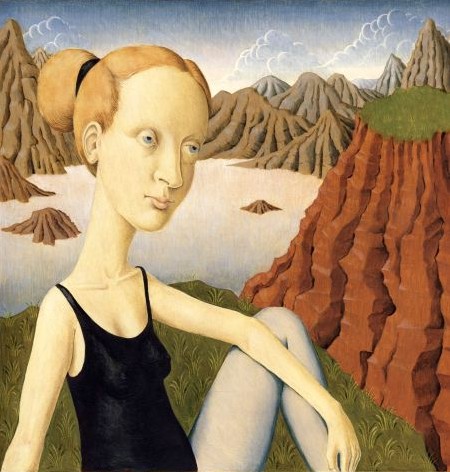
Why is the colour of her legs a light blue as opposed to her upper body? Is this all of the painting (or is there more?)? What does the jagged brown ‘mud cliffs’ represent?
On the subject of your post:
By the way, I do art for my own satisfaction (even though I use art to portray social issues, people in today’s world do not have the time to ponder too deeply on important subjects). As long as they have the micro-waved meals from 24 hour supermarkets with American Idol/Desperate Housewives type shows on the tube while thumbing their blackberries, could care less about wars being fought and lives lost to malaria half a world across. We live in a culture of insulation (appropriate insulation that will keep all of us detached from actual reality (it starts with the iPods on our ears blocking out all else in the subways). Art is pretty much the same; it is a culture of insulation that promotes the ones who have managed to clamber into the rarefied world of dealers and curators who have certain inscrutable rules for themselves that we sometimes try to fathom without too much success.
How many times have you seen real art that shakes our sense and jolts us into thinking a little more about the terrible wars that are fought across the globe? Not too many, I would dare to say and I think that it all boils down to insulated lives we all lead…
Sunil,
I too was thinking about the painting. The blue tone of the legs must reflect stockings that the dancer wears.
Karl’s mountains have puzzled me until this morning, when I realized that he must have been imprinted with the bare mountains in the southern Californian desert.
Pollock’s (two o’s)
Thanks Arthur,
there was something fishy about the text, thanks for pointing it out.
How many times have you seen real art that shakes our sense and jolts us into thinking a little more about the terrible wars that are fought across the globe?
Sunil,
In fact, I see this all the time. It’s called photojournalism. It replaces the type of painting that Goya made, and Leslie quoted.
The American soldiers at Abu Ghraib made some of the most powerful images of our time. They are not considered artists, their work is not considered art. Yet at the level of the image, their pictures changed history.
I would like to point out that “art meant to represent art (the god)” is something different from “art about art.” Pollock, in my argument, attempts to represent art the god. Leslie, in her paintings, is doing something quite different.
I also do not mean to attach a value judgment to either approach. It depends, of course, on the work itself.
Photojournalism as an art form - hmmm. I do not think photojournalistic pictures can be considered an art form (strictly my personal view) as they were primarily designed to shock and titillate audiences such that the associated news story appeared at the top of ‘popular news’ and hence to popular websites or attains highest ratings on TV.
Artists on the other hand have the power to harness the collective sentiment and produce art that conveys a message that lasts the vagaries of time and tells of stories that changed the course of world or events. I do not see that kind of art too much (or maybe I am not going to galleries enough). That said, I agree with you that the pictures from Abu G were iconic – although the soldiers taking the pictures simply wanted to decorate their pocketbook with mementos rather than have an artistic bent to capturing the scenes unfolding…
Karl, I find it amusing that you’ve quoted me for your post, along w/ a quote from a cultural icon :)
I’d like to clarify what I meant when I made the quoted comment. We were talking about Painting A Day, and someone had said it was the most important art movement of our time. I don’t have anything against the PAD folks, but I don’t see them as an art movement. I’m also not sure that there really are any significant art movements going on at present. But I don’t think that’s necessarily a bad thing. It doesn’t mean that there’s no significant art, just that there are many directions being explored at present.
I also think that the term “art for art’s sake” is misleading, as is the concept of artists doing work for themselves. There are aspects of the art experience that could be classified as contemplative or transcendent, and that have no other social or political agenda attached. I think that these are often termed “art for art’s sake”, but what is really meant is that the art experience is not meant to sell the viewer something, whether it’s a new car or a religious ideology.
As far as artists doing work for themselves, it’s another paradox. An artist can do a survey of the market and create something calculated to sell (which probably means they’re copying something that’s already selling) or they can follow their own curiosity and fascination and try to discover something new. It doesn’t mean that they don’t care about their audience. If anything it might signal a higher regard for them than if they were just feeding the audience more of what they’ve already got.
The best thing to do, as far as I’m concerned, is to remain agnostic.
Arthur,
I wanted to respond to this comment. I referred to Wikipedia on agnosticism and it left me completely confused as to how to interpret your statement.
Sunil,
I think your interpretation of what is art is quaintly traditional. It is the same view which I long had, and which most people have, probably. It would be like saying, egg tempera is art, but oil paint (a painting form which reached maturity later) is not art.
There is no meaningful way to delineate the art of painting from that of photography from that of photography by robots, except by medium and agent. Is one medium art and another not? Is a robot not simply another tool, like a camera or a paint brush?
David,
You might have found it even more amusing if I had also included this quote from a prominent 19th social scientist which I felt was relevant:
Our concepts of what art is were handed down to us, but we accept them as though we had invented them. These concepts shape our work and define its limits.
Karl,
You seem to be taking on a bunch of issues at once, including the hoary “what is art?”, rumors of whose death have been greatly exaggerated. Your title seems to point to isolation as a theme, but responding to my comment you pointed to (I guess) the issue of financial compensation for artists. I would agree that higher compensation might be related to a higher level of consideration/connection with society at large, but the causality goes both ways. Sure artists would like to earn more, but it’s not clear whether they or society would otherwise value the closer connection.
I’d also like to add that other mediums have largely replaced many of the earlier societal functions of painting and sculpture, most notably film. Movie directors are generally pretty well compensated for their work.
If nobody believes in “the art world” any more and artists are working for their own satisfaction, where’s the problem?
Steve,
If artists are working for their own satisfaction, who will be paying them to be artists? If that is not a problem, I don’t know what is.
As for “what is art?” I simply say it is what it always has been. Technology puts more things into the category (passport photos made by machine, for example) and there is no sensible argument to exclude them except by appealing to some imaginary art religion which is exhausted and has few if any devoted followers.
The breakdown of any common idea of what a purpose for art should be (the obvious one being ignored) leads to isolation of artists. They lack common ground, they lack connection to the public which in the case of successful artists is through the “art world” intermediary.
Art the religion, the god, is dead, I am saying. Artists working today need some argument besides vanity to explain why their productions are more important than those of the remote control video camera or the photocopier.
I’d also like to add that other mediums have largely replaced many of the earlier societal functions of painting and sculpture, most notably film. Movie directors are generally pretty well compensated for their work.
David,
I agree entirely. Rubens would be a director or producer, not a painter, if he were alive today, I am sure.
This is the key point: traditional art has no special status, except in the minds of some eccentrics (e.g., painters like us). That is not to say that painting is not a powerful medium. But we have to realize we are competing with everything else that technology has offered to replace painting.
When we realize this, and consider the isolation in which artists work, and the shabby art world infrastructure which they have to supposedly support them, it is little wonder that most sensible people choose a different line of work.
That’s why Arthur’s statement of agnosticism and Steve’s question, “where’s the problem?” baffle me. To excel in a traditional art form requires a huge amount of belief, as you know. Belief in what? To probe that too deeply is the worst thing an artist can do, as you referred to the other day. There is the danger that the answer might not be there.
To probe that too deeply is the worst thing an artist can do, as you referred to the other day.
I’m not arguing against probing things deeply. What I’m suggesting is that trying to know in advance what you’re going to do can shortcircuit many of the things an artist might discover during the process.
There is the danger that the answer might not be there.
A worse danger might be that the artist comes up with an answer (to the question “what am I trying to say”), and ends up trying to make a “statement” rather than exploring new territory.
Karl,
I meant, primarily, agnosticism towards what you call “art meant to represent art (the god)”. You can recognize that this idea has inspired some remarkable art without swallowing the line whole. Art, I think, can be about anything and serve different values at the same time.
Likewise, I think the notion of art embodying an entire culture’s religious or other values is largely a thing of the past. These shared values, to the extent they still exist, are probably best served by the mass-media. (Of course you could say that these are in some sense art, but I doubt thats what most of us have in mind).
Belief is important to art, but it doesn’t have to be belief in something big. It can just be belief in the importance of whatever it is you happen to be doing.
Arthur,
Art of the past was mass media. Why mass media of the present should not be classified as art I do not understand. The materials of “artists” have remained the same (oil paint, canvas) but their function has passed to others (those who make television shows and movies).
If all traditional art making were to stop today, the world would hardly even notice.
So I agree that belief is important to art, a belief against overwhelming evidence that drawing, painting, etc. have some value in our world. I do believe that, but it is sometimes a tough belief to hold onto. I say the art world is inadequate because it does nothing, as far as I am concerned, to support my belief in art of the traditional kind, or the belief of anyone I know. As far as I can tell, people regard the art world as a sort of necessary evil, but not a source of inspiration of any kind. Lisa Hunter’s tips for artists, when they appear, will be of the form of survival tricks, not inspirational or encouraging messages of wonderful opportunities.
Karl…this is a fascinating post.
Sunil…
you don’t think photojournalism has “the power to harness the collective sentiment and produce art that conveys a message that lasts the vagaries of time and tells of stories that changed the course of world or events”?
I think if you take a closer look at the works of photographers Dorothea Lange, Gordon Parks, Robert Capa…and more recently Kevin Carter and
James Nachtwey, you might change your mind. Or better yet, take a look at these images.
Thanks Chantal.
I recognize many of the images but I did not know all of the photographers by name. Here are some links I looked at:
The reaction of the different actors in the drama is of course different. The dealers and curators, priests of the dead religion, continue with their empty rituals and try to pretend that nothing is amiss.
Yikes. That’s a bit harsh, no?
I can’t speak for other dealers or curators, but I don’t think the rituals are empty. Some of the work we exhibit is better than other work, just like at any space, but all of the work we exhibit is infinitely better than 90% of the work we have submitted to us (there are some truly horrendous artists out there, I don’t mind saying, and they all want a piece of the pie).
I’m beginning to think that the problem isn’t we don’t have good art, but rather that we have so much frickin’ art, it’s impossible to focus on anything long enough to discern what’s better than the rest. There’s also a collective societal knee-jerk rejection of anything that’s not spectacle or entertainment. Throw a big shiny bean into a plaza and you’ll have a hit (that’s perhaps a bad example, I kind of like the bean), but ask someone to watch a longish thoughtful, moving video and you’ll get comments in your book like “Zzzzzzz” (true story). I don’t think it’s that dealers aren’t smart/spiritual enough to want to work with artists doing important work, as much as folks will viritually rip painted pornography off a gallery wall, and there are bills to be paid.
HOWEVER…there are examples that virtually serve as manuals for how artists can retake control of what’s considered important and we’re just not seeing that happen. Why? is a very good question, but it’s not due to galleries or curators trying to stop them IMO.
These are tough questions about support for artists. I don’t know the system well and I’m sure there are many things wrong with it. But playing devil’s advocate, I would also say that not everyone who wants to make a living at art necessarily should. And I would further say that, in my small corner, I see a lot of great art being made and shown by artists who probably feel under-supported, but do not feel isolated or alienated. Around here teachers are also underpayed, so it’s hardly just artists.
Along these lines, I recently read in The Jackdaw a rather harsh, tongue-in-cheek, but thoughtful essay on the disconnect between museums and the museum non-going general public. What it comes down to is, if artists want to earn more, other people have to be convinced to pay them. I think what you’re saying (in part) is that artists have traditionally left all their marketing and sales to some “art world” system that, perhaps not surprisingly, has taken advantage of them. If artists refuse to suggest an answer to “Why art?”, then why should they get better?
I don’t think it’s that dealers aren’t smart/spiritual enough to want to work with artists doing important work, as much as folks will viritually rip painted pornography off a gallery wall, and there are bills to be paid.
Ed,
This word pornography is a tricky one. Are you in the “porn is evil” or “porn is good” school? I mean, without knowing that, I can hardly even interpret the word when you use it. From my experience here on A&P, most people see porn as non-art by definition. I was doing an interview for A&P about pornography and art with a Dutch porn executive (she went to art school, like most off the people working at the company) but I think she got turned of by the general anti-porn attitude.
I mean “pornography” in that it’s titillating… “designed to arouse”. There’s certainly good art that does that, but when that’s primarily what someone is buying/selling, you have to wonder about the motives of those folks.
I don’t think porn is good or bad, morally speaking. I think it’s something people would make for themselves if it wasn’t easy to buy, human sexuality being what it is.
Personally, I feel pressure to exhibit more titillating work from time to time, seeing how well it sells in other spaces. If that were not the case (if tougher, more thoughtful, less sexually provocative work sold better than images of half naked boys or girls), then I believe you’d see more “important” work in galleries. Galleries are there to sell, after all.
Some galleries balance both ends of that spectrum well, representing the full range of human experience. Others unquestionably focus on the more pornographic side of the human experience. It might just be me, but those ones seem to sell pretty well.
Porn might actually be good for you (again, I don’t judge…to me it’s just human), but too much of even a good thing isn’t good for you.
Karl,
I find myself wondering what is meant by “the art world” when I read essays like your “Art and Isolation.”
What you seem to be describing is what Arthur Danto called the end of the story of art — a story that insisted that “real” art was a single thing, had a narrative (superimposed by humans, to be sure) that ran like a taut wire through accounts of art through the ages. Danto sees it falling apart — or perhaps I should say opening up to many stories — with Andy Warhol, of course.
I myself like to think of the Art World (as it was in 1960) as having come to grips with a certain kind of democratization, a realization that the story that the white anglo-european male told us was really just his particular slanted and peculiar point of view.
You talk about a loss of standards, but for some one like myself, working in the medium I work in, this “loss” is a gain. A total life saving gain. In 1960 it would have been impossible for me to imagine myself working at art — I was a gurl before guerilla gurls existed. In 1960 no one who wanted to be thought serious as an artist would go near textiles. No one who wanted to be thought serious as an artist would wish to be of the female gender (although many, in spite of themselves, were).
So what you see as a loss of standards I see as an opening up of possibilities I could not have dreamed of when god in his big white beard kept women barefoot and pregnant in the kitchen.
I rather like it that there isn’t a nice clean Art World that is going to tell me to lay off the textiles and get with icons of Jesus. Or lay off the textiles and bring Him some coffee.
What puzzles me about your angst, Karl, is that you are in general an open human being. You have invited into your blog and you welcome us all and have made me, at least, feel valued and a part of the group. And we are — as you are — The Art World. Maybe not a very important part of it, but here we all are, plunking down pigment on canvas and stitching on silk and laying out photographs on good paper.
Now if the issue is one of payment — that’s a different problem, and I’m rather fond of Edward’s stand on pornography (it sells…..). But if your real beef is with “standards,” well, I’m afraid I have to say that I’m rather fond of the current agnostic state (sorry Arthur) of the arts. I can slip into the scene without having to scramble through barbed wire.
I’m even a lot less isolated since I found Art and Perception. I’m not making any money in my art, but then neither did Van Gogh. I’m located on the wrong coast, in the wrong media, of the wrong gender, and I still don’t feel sad and out of it and as if I’m struggling against some unknown tide. I just think I’m swimming in a very big pond.
I’m located on the wrong coast…
June, it’s not right coast and wrong coast. It’s right coast and left coast :)
June,
I think you are hitting on the absolute key insight here: we are the art world. If we believe in that (it does require belief) then everything changes, and everything becomes possible. Great art has always been the product of relatively small groups or societies that believed they were the center of the world, or didn’t care about the rest of the world. I experienced that feeling of being at the center of the world when I was a teenager with Leslie Holt in Walter Bartman’s art class — one of the most successful high school art classes in America in the late 20th century. None of us have found that magic again, I think, but I never stop looking.
it’s not right coast and wrong coast. It’s right coast and left coast
David,
What a typically American view of the world. Which coast am I on?
Ed,
What I find most fascinating about your comments is the suggestion that the buyers may in fact have an impact on what is shown in galleries, that the consumer may ultimately be the arbiter of “what is art.”
Recently I’ve read about fifteen variations on the statement “pornography is not art, by definition.” It seems the collectors beg to differ.
If the practical reality is that “folks will virtually rip painted pornography off a gallery wall,” as you say, then it would seem an interesting challenge for artist and dealer to be “smart/spiritual” enough to make that work “important” as well as sellable.
I am totally blown away by the fact of this woman of the picture doesn’t have eyebrows… I cannot stop thinking about it!
Angela,
Maybe you should add them yourself.
David, What a typically American view of the world. Which coast am I on?
You’re right coast adjacent.
June,
“So what you see as a loss of standards I see as an opening up of possibilities”
I totally agree. To me, it is more like now it is the artists’ responsibility to create and meet their own standards. And the opening up of the participants and the media and the subject matter of art is well worth the “loosening of standards” in my mind. when I hear talk of standards or “quality” I recoil just a bit — it often comes from a more classical tradition (white western male tradition) and can be about mourning the “loss” of exclusivity adn exclusion. This is not what Karl is lamenting, but I have heard such talk around this subject and it scares me to hear from fellow artists. That famous Whitney Biennial that was pure political art (1980’s or early 90’s?) caused such an uproar about quality and standards. I say the risk to break the standards is well worth the inclusion and debate it inspires.
Arthur said it well:
“I think the notion of art embodying an entire culture’s religious or other values is largely a thing of the past.”
Karl,
“one of the most successful high school art classes in America in the late 20th century.”
Wow, Karl. Quite an absolute declaration! I met plenty of folks who have had amazing (and different) high school art experiences all over the country. Maybe you have not partly because you did not study art in college?
Other high school programs or students may not have sought out the recognition of a competiton like the Presidential scholar but still generated really talented artists (and who were not “branded” with the signature “Bartman style,” which is a major criticism of his program, as you may be aware of. Not everyone left high school with that style, but many did and when I went to Washington University many profs were frustrated with Whitman students’ rigid use of that style).
I actually discussed the truly competitve spirit of our HS program with Bartman over Xmas - it had its plusses and minuses. Bartman also recognized the unique socio-economic situation of his students which made for a motivated, relatively privileged student body with engaged parents who could buy limitless art supplies. So many factors converged to create that community, not to diminish Bartman’s incredible teaching adn talent to create a community. But the big bad world is a lot more complicated, eh?
What you can generate with young minds to create cohesion becomes a much more complex challenge for creating community amongst adults, yes? I don’t think we can use that same model for our lives (nor would I want to).
Karl,
Your response to Angela’s observation of the eyebrows - “Maybe you should add them yourself” - is interesting to me because it makes me think that perhaps your global thinking about Standards/Adequacy is too personal. Are you being flippant towards Angela or your own work?
Nostalgia and Dismissiveness are an easy way out.
I won’t speculate about Karl’s flippancy, but the comment suggests that maybe we’re ready for a collaborative art?work. Angela will do the eyebrows, I’ll paste in the Torrey pines that are missing (you’re right, Birgit), David can add drill holes all over it, June can liven up the textile aspect, …, and Arthur can critique it for us.
Is it really fair that I get to do the fun part all by myself?
D.
You never cease to misinterpret me, which is a pleasure because sometimes your interpretations are much more interesting than reality. However, in this case I think Steve is more on the mark. I’m not sure about the drill holes (I must have missed something somewhere), but I’d be thrilled to see what others could do with the picture. My response to Angela was in fact a continuation of a thought I had expressed earlier to her in an email about the concept of some sort of “virtual collaboration.” My idea was to start with a blank sheet, but when she mentioned the eyebrows (or lack thereof) in her comment above it seemed the most natural and friendly thing to say, “Maybe you should add them yourself.”
Other high school programs or students may not have sought out the recognition of a competiton like the Presidential scholar but still generated really talented artists (and who were not “branded” with the signature “Bartman style,” which is a major criticism of his program, as you may be aware of.
Leslie,
I think Bartman’s most successful students (like you) all created their own unique styles — the more remarkable because they tended to treat similar subject matter (Maryland landscape in particular.)
As for branding with the Bartman style for some students, that is to me more an indication of Bartman’s own success as an artist. Rembrandt’s students also had to struggle mightily to define their own styles after learning with him.
Bartman did not generate talented students. The students came to him with a normal range of talents. His contribution was to allow his students to realize their talents.
Your question about younger versus older students and their receptiveness to community is interesting because Bartman now mostly teaches older people since he retired from his job at Whitman high school. We could ask Bartman to describe the differences. My impression from the interview is that creativity and community are not restricted to younger versus older groups.
If I wanted to criticize Walter, the only place I would do so is in his focus in teaching the art of observing the world over working from imagination. One of the most memorable statements from the interview discussion (comment 20) was where he said
I think this is one of his most important lessons. The irony is that you can take a photograph of many of the subjects that Bartman and his students paint — landscapes for example. That is not to belittle his focus on working from life, only to question why he did not put a greater emphasis on working from the inner world. I seem to remember one assignment to make an imaginary artwork, but I can’t remember anything about it.
To me a remarkable thing about Bartman is that he has always continus to grow as an artist. I don’t think he has said all he want to say with his work. I wouldn’t be surprised to see him start something completely new one of these days.
The most famous portrait of the World; Mona Lisa, don’t have them either…
…no, but she did have whiskers.
I think its interesting that commerce is a subject that artists tend to have an uneasy relationship with, and this, for me, comes out in the discussion we have here.
The I find the phrase “I make art for myself” rather disingenuous, and I’m a bit sceptical when I hear it uttered (and you are right that it is uttered a great deal).
If one makes art for oneself, then why exhibit and get involved in the “art world” (sic)? Really we want the whole thing - the creating, pondering, the exhibiting and the sale, and it always astounds me how much artists try to kid even themselves that their motivation doesn’t, in some form, include financial recompense. Maybe people think that if we’re honest about that, we’ll break the “spell” - like a magician revealing the secrets.
But to get back to the point, I think that the commerce is a factor, a part of the pull, and does enter into the equation to varying degrees. How this affects quality of work for the better or for the poorer is, I suspect, very hard to quantify, but you know and I know, that the commercial gallery is a shop. That’s its function.
Anomie is, at the social level, instability resulting from a breakdown of standards and values.
The word “standards” has stimulated quite a bit of discussion above. I think the points made by June, Leslie and D. are quite valid, but they have absolutely nothing to do with what I had in mind when I was typing out the dictionary definition of anomie (which you can see directly if you click the link in the post). What I was thinking about as more relevant to the concept of a “breakdown of standards” is expressed by Lisa Hunter in her description of contemporary elite collectors manipulating the market:
Perhaps collecting has always been like this (in which case the breakdown of standards is not really a breakdown so much as a continuity in lack of standards), but that is a separate topic.
commerce is a subject that artists tend to have an uneasy relationship with
Mike,
Commerce — or more broadly, the social context in which an artwork is made — is probably as fundamental to the outcome as the choice of pigments, painting medium, landscape or model. Leslie refers to this, and we talked about it earlier as well. I think you are right that artists have an uneasy relationship with commerce in particular, probably because it is a factor so much out of their control, but so controlling.
Karl,
I was not trying to say that you cannot create community with adult artists. It’s just a different ball game than doing it with young, impressionable high schoolers. I used to find it in a figure painting class I took at a community college with a mix of older and younger students. I don’t feel that critical of the Bartman style issue myself, but I hear that criticism from other people. Learning his style was a good jumping off place for me.
As far as the word “standards,” I did click to the definition of anomie when I wrote my response adn I am guessing June did too. The whole notion of standards is as loaded as the notion of cultural. Whose standards are we talking about? And what are the “rules?” I am okay with instability due to the breakdown of standards if the standards are not ones by which I want to live. But maybe I am just mixing up the pot again, as i am not sure we are understanding each other.
I am not sure what you are getting at with the Lisa Hunter reference except that the collectors are creating inflated standards?
I also don’t feel like I lack purpose or ideals as an artist, so maybe I don’t fit into this model of being an artist that you have put forth. The separate longings idea does nto ring true for me either. The uncertainties that I feel soemtimes cause isolation and alienation, but more often than not, others share the same uncertainties and they can be a point of connection rather than isolation. Doubt is natural in my mind, and more “true” for me than certainty. Just as the only constant is change…
Leslie,
Sorry, I should explain better. The Hunter quote indicates to me that the collectors have a breakdown of standards in that they don’t really care about the art, as long as they have the art with the correct name attached.
As for lacking purpose or ideals, I don’t think any of us lack those as individuals — otherwise we would not be doing what we are doing. The point is more to imagine an art world were a number of artists shared similar standards and values, imagine how powerful that could be — think of our time as a community of artists as teenagers (and thinking about it more, I think age had nothing to do with it; I remember my painting expeditions with Ben and others and I would love to repeat the same type of experience all these years later.)
The idea of the standards and values being dictated by some external authority or convention is of course odious. That’s not what I meant at all.
…collectors have a breakdown of standards in that they don’t really care about the art, as long as they have the art with the correct name attached.
Karl, that’s been going on for as long as people have been buying art. There are some that care about the work itself, and some that are trying to elevate their social standing through their possessions.
It’s not that they have a breakdown in standards. It’s that art for them is a status symbol. When you’re buying status symbols, the name is everything.
PS, Karl, you’ve read Cennini. What did those old Renaissance-era patrons do when they wanted to show off? Hire a star, and include lots of gold and ultramarine blue.
Actually David,
The name seemed to be astonishingly unimportant . Here is a historical source to illustrate that point (”whomsoever you find–-I care not”). True, the materials were an important consideration, but so was quality of workmanship.
Karl,
Aha! I think I get what you are saying now.
“The idea of the standards and values being dictated by some external authority or convention is of course odious.”
Odious and yet pretty common, especially in certain art schools! Just as we on A and P debate about what art is and is not, what is good art, what purpose artists and collectors serve, so do academicians/
critics/galleries/collectors/curators, with the added power that they may have over artists. You could decide not to give those folks power over you as an artist, but that can be challenging, depending on your situation…
Is it really fair that I get to do the fun part all by myself?
I’ll take a turn with that drill…
Arthur, I’ll make sure the extra battery is charged.
True, the materials were an important consideration, but so was quality of workmanship.
Name recognition is the new quality of workmanship :)
Karl and Chantal,
Thanks for really ‘opening’ my eyes to the ‘art’ side of photojournalism. The sites that you sent have some of the most moving images and are thought provoking and are definitely ‘art’.
Yes, I am definitely a traditionalist when it comes to art but like Karl and Chantal said, (and I should remind myself) art can be realized through multiple means - be it through the photographers lens or image manipulations on the computer or painting or any other coherent forms that communicate a message.
Beckham has flair (and his moments) but has anyone seen the film, Zidane: A Portrait of the 21st Century? The quality of workmanship is Magnificent.
And Karl,
My (mis)interpretation is wrong because…? I am still curious about your decision to post this painting with the topic of Inadequacy and Isolation.
Karl,
I’m with D. — I don’t see the connections between the various ideas you are putting forth. Maybe that’s because I was never connected with the “cultural” world, for the reasons I’ve stated above. So I can scarcely feel isolated from it. And when I think of the classical painters, say Rembrandt, I don’t think the fact that he was painting in an era in which religion and values seemed to hold cultural sway made him any less isolated. And of course, 16 and 17th century Holland was in the midst of a breakdown of cultural values that must have felt just like we feel today — economic swings, wars, religious bigotry and fights, isolation because you hooked up with the losing side… well, you get the picture. And yet I can imagine some people feeling nostalgia for 17th century northern Europe.
No, I don’t think it’s the culture that’s caused your nostalgia. My friends here in Portland yearn for the NY City of the 1950’s, when lofts were cheap and New York was the bee’s knees of the art world. When I think of NYC in 1952, I think of a club of out-of-control males, running rampant, pissing in fireplaces. Nostalgia for that, I don’t have.
I fear that I keep thinking of the Doris Lessing phrase: “false lying nostalgia” — the nostalgia the harkens back to a golden era that only the nostalgee can remember and which never really existed except in your (present) mind. I guess I hold to the present, whatever it is, because even the good parts of my past were good only for me, not for some mythical protestant mid-American culture of 1955.
Maybe you should start a painting school of your peers to break the hold that the past seems to have on you.
I’m probably way out of line here, and you are welcome to tell me to go away. And you may just be trying to get a rise out of all of us. I can’t tell. But I also can’t resist saying, “Kaarrrrrrllllllll!!!!”
Leslie,
I think when we debate on this site about what art is, it is not to establish authority and conventions over others, but rather to attempt to get the issues into our own hands, perhaps struggling against external authority in the process. You write, “You could decide not to give those folks power over you as an artist, but that can be challenging, depending on your situation…” I agree with you. One approach is to choose isolation. Another approach is to engage with the art world, but in a self conscious way. The latter is what I think this website is all about.
Arthur,
Don’t forget to unplug the monitor first, or you might get quite a shock.
David,
I’ve been thinking a lot about that post on buying artwork in 1373 that we discussed above. It shows that the “art world” of the past (although the term is a bit absurd to apply to the past) was something entirely different from today. You wrote “Name recognition is the new quality of workmanship :)” and I think you are correct. In the 14th c. example, the important names were “Our Lord” and “Our Lady”. The name of the artist was irrelevant, as the document shows, only his ability matters. In our contemporary art world, the name of the artist is what matters. This makes sense, because now artists are the saints and demigods of the religion of art.
D.
This painting I made in 1999 in a period when I intentionally isolated myself from the contemporary art world as I knew it. That world said nothing to me and gave me no inspiration; it was to me inadequate. As I have been discussing with Leslie, I had previously found great inspiration in an artistic community as a teenager. Likewise, I find our little community here most inspiring. What should an artist choose? Isolation or community? Whatever the answer, it will drastically affect the work.
June,
I don’t feel nostalgia for the 17th century, except I think the landscape was probably much more beautiful then. I have no desire to go back to some golden era, not even the Dutch Golden Age. The type of work I do would land me in prison if I had done it then, and I don’t much like Rembrandt anyway. Nonetheless, it is hard to dispute that some past eras had greater creative energies, more productively used, than we have today. This discussion has been about what might have been some of the factors. If Rubens painted great artworks because of his strong Christian faith and the enthusiastic support of the Catholic Church and the elite, it does not mean we should attempt to recreate the same conditions and beliefs of that time. But it is still interesting to look at what motivated and encouraged artists of the past, and to imagine what would be relevant forms of motivation and encouragement for our time — and to imagine what we might be capable of doing if we had even more of the right kind of motivation and encouragement.
My goal in looking at the past is to appreciate it for its own sake, or to try to get a better understanding of the present. My goal is not to revel in nostalgia or a desire to return to the past. Nostalgia implies appreciating the past not for its own sake, but creating illusions of the past — an interesting pursuit, but not my artistic focus.
Karl,
Isolation or Community?
I choose both.
And as for looking to the Art World for inspiration: Why? To be part of a Movement? Such currents are too rapid.
I think Bob Martin’s post (following) speaks well for inspiration: LIFE. From my view, his success is not determined by the paint but by, as you concurred, the Touch.
…now artists are the saints and demigods of the religion of art.
I don’t think what you’re seeing is a religion of art. I think it is a religion of celebrity.
There are celebrity artists, celebrity actors, celebrity musicians and celebrity athletes. There are also celebrity chefs, celebrity CEOs, and celebrity criminals.
But the top tier of all is celebrity celebrities! They’re people who are famous, but we have no idea what, if anything, they’ve ever done.
Karl,
I do like your idea of [looking] “at what motivated and encouraged artists of the past, and [imagining] what would be relevant forms of motivation and encouragement for our time” What encourages me, I guess, is that I find enormous similarities in the common psyches. Angst and troubles and feelings of desolation and isolation are part of our human baggage, as are joy and delight and communal desires; human nature hasn’t changed all that much over the small time we’ve been like ourselves — 30,000 years or so is a blip in the greater scheme of things.
Have you a painting that comes from the opposite of your “art and isolation” one? How do they differ, aside from how you felt when you were doing them? Were some of the paintings that you’ve posted before done in a different zone?
I guess I don’t believe that the feeling of isolation that you express so well is really tied to the culture (there are many who would vociferously disagree, of course) but rather to the human condition. But that doesn’t mean we can’t learn from how people in our peculiar form of living managed their own angst and exhilarations. I’m thinking of Augustine and Gerard Manley Hopkins and Bronte and O’Keefe and Sappho and so on and on. I see their struggles and successes, through various devices that they improvise or work with.
David,
Your “celebrity celebrities” makes me chuckle. The reality that I exist in is me, here. I’m learning from Karl who also seems to be “here” in my presence. Luckily I don’t seem to hang around with celebrities, let along the celebrated of the celebrities. However, I could be mistaken — maybe someone on this list is really a celebrities celebrity and I’m too isolated to know.
Luckily I don’t seem to hang around with celebrities, let along the celebrated of the celebrities.
Me either, but if you go to the grocery store you can’t avoid them. Every time I go to pick up some bread or toothpaste I learn about their tragic love affairs, their new diets, and their cosmetic surgery (whether I want to know or not).
Which is it usually?
It’s always not :)
Have you a painting that comes from the opposite of your “art and isolation” one? How do they differ, aside from how you felt when you were doing them?
June,
The best example of a painting that is the opposite of the painting in this post is a large collaborative work I made with Hanneke which I will show one of these days.
Thanks for the question, it is thought-provoking and raises more interesting questions for me than I can answer at this moment.
There is isolation and there is isolation.
Isolation for the artist who retains the influences of art in his life is not an artist in isolation, but a failed artist, wondering why he’s failed.
Thinking about what other artists are doing, talking about art on the internet,looking at art in museums and galleries,reading about art in art magazines,looking at art history, looking at one’s own art and wondering how to improve it. And last and most important, complaning about the state of art, and trying to reach out to others who also feel isolated. These practices undermine what the artist in isolation is trying to do, and that is, tap into something revolutionary.