[ View menu ]

Monthly Archive March, 2007

Is the Art World a side-show? [not a slide show]

Posted by Karl Zipser

March 31, 2007 3:57 am

Art is the visual representation of that which people find important at an emotional level. Making art used to be a specialized profession that required years of training. Today, making art is no big deal. Anyone with a camera can make art; take a photo of your kid, it’s art. It’s that simple.

The so-called Art World has successfully appropriated the word ‘art’ and created a lot of confusion in the process. We can resolve the difficulty simply by recognizing what Art for the Art World really is — a brand label. Let’s call it ArtTM.

The players in the Art World would like you to believe that they are the natural and rightful heirs of a great cultural history. Artists like Michelangelo, supported by patrons like the Medici, devoted themselves to the representation of that which people found important at an emotional level. Everyone knows that the players in the contemporary Art World are not the real descendants of the likes of Michelangelo or the Medici, of course. But the lack of an obvious competitor supports the illusion of rightful inheritance of something important.

ArtTM — that which the Art World deals in — is something that most people don’t understand or like. This is one reason that making ArtTM is generally not a viable profession, despite the huge social effort put into training artists at art schools and universities. People tend not to spend much money on ArtTM, because it does not represent for them anything important at an emotional level. In other words, ArtTM is generally not even art.

What is the real art world? It’s all around us, of course, so ever-present that we hardly notice its presence. Look at the internet, magazines, TV, bill boards. Art is everywhere. Drawings, photos, sculpture — cheap, low quality for the most part, but art nonetheless. We usually think of it as advertisement, or department store mannequin, or porn. These things are more art than ArtTM.

How to be a successful artist today (in the traditional sense of an individual making creative representations for profit)? A daunting challenge, to say the least. Dropping some illusions, distinguishing between ArtTM and real art would be helpful.

The Art World is inadequate to support its people. Artists tend to subsidize collectors. The real art world on the other hand is so powerful that it doesn’t even need to use the brand label. The question I ask is, how can an individual artist be a player in the real art world and still retain identity as an artist?

Favorite art books

Posted by Steve Durbin

March 30, 2007 1:19 pm

Over the last few months, several posters have mentioned books that have been important to them. Karl considers Cennino Cennini to have written the best how-to book for painters. Doug gave us a report on a concise and readable book about photography by Steve Edwards. Lisa Hunter talked about her own book, “The Intrepid Art Collector,” in an interview. Rex cited in one post a motivational book for painters (the correct title is “How to Make a Living as a Painter,” by Kenneth Harris). David, in a comment, recommended “Seeing Is Forgetting the Name of the Thing One Sees: A Life of Contemporary Artist Robert Irwin.”

What is your favorite art book?

Photograph by Ted OrlandOne of my mine, I just discovered, has popped up in comments a couple of times: Art and Fear, by David Bayles and Ted Orland (that’s Orland’s “One and a Half Domes, Yosemite” at left). As it happens, they are both photographers, but the book is not at all confined to photography or even visual art. As you might guess from the title, it’s a frank discussion of issues that are faced by artists that relate to making public creative work that can be very personal. Even if you’ve never been the slightest bit nervous about putting your work out there, I still think the book is helpful as an unusually readable treatment of what artists do and how they do it. It will help you think about your own process. Just read it.

Over to you: help me add to the list!

Right frame of mind

Posted by Sunil Gangadharan

March 29, 2007 7:09 am

I was recently asked to loan one of my paintings for a company art lobby and I went into a frenzied state of deciding the right frame for the picture. I searched for about a week without too much success until I was lucky to chance on a dark wood frame. One of these days I will have to lug the painting, frame and all to the corporate building where it will hang for a year. 

This set me thinking on the following: 

-Do you decide beforehand the ‘right’ frame (that in your opinion is the most suitable one for a particular painting/photo) or do you ask your client for suggestions or is it a mixture of both? 

-Is the whole framing thing passé now? I was in a couple of Chelsea galleries last week and not a single oil was framed (the artists did not even bother to hide the fact that the edges were dirty from all the wear and tear)? Is that a new trend?

I would be very interested in your thoughts…

Karl always asked me about the relative size of my paintings (the internet does not do a proper job of projecting the size..) This is a picture of my three year old son posing next a couple of my ‘unframed’ paintings.

emptiness

Posted by David

March 28, 2007 12:43 am

emptiness

Still and falling water

Posted by Steve Durbin

March 27, 2007 7:43 am

7179-400.jpg

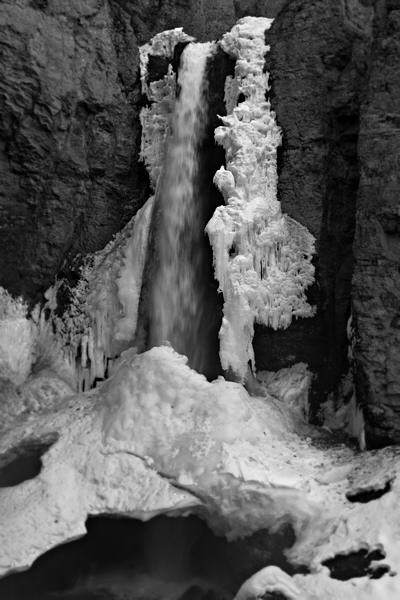
Richard reminded us recently about the painter Clyfford Still, and it seems I’m still under the influence. Not of Still, but of whatever it is that makes me make pictures that look like Stills. Last Saturday in Yellowstone we hiked in to Tower Falls and I made the photograph that heads this post. I did not have Clyff in mind while on location, but I find the result strikingly similar to these:

Continue reading Still and falling water

unusual perspective

Posted by Birgit Zipser

March 26, 2007 9:45 am

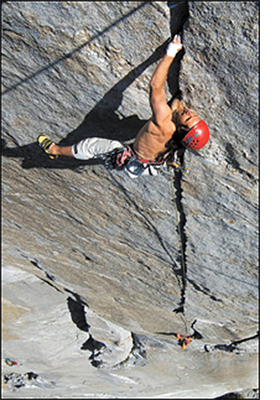
The German weekly Die Zeit published this photo of the brothers Thomas and Alexander Huber climbing El Capitan in an article discussing ‘voracity for fear’. The occasion for the climb was a documentary ‘Am Limit’ by Pepe Danquart’s that opened on March 22, 2007 in Germany. (photo by Heinz Zak, published in Die Zeit 22.03.2007, Nr. 13).
zak.jpg

Being a junkie for perspective, this photo caught my eye. Do you have any photos or links for photos of interesting perspectives?

HIV: When Your Muse Is An Evil And Dark Master

Posted by Richard Rothstein

March 25, 2007 11:19 am

From the mid 1970s until the late 1990s, the Times Square area hosted three completely illegal, outrageous and brazen gay whore houses:  The Gaiety, Show Palace and Eros.  Show Palace and Eros survived until the late 90s, The Gaiety hung on–thanks to the patronage of many influential and prominent Manhattanites–through March of 2005.  But even with the patronage of icons of the New York performing arts world and several entertainment industry moguls, the Internet ultimately proved to be too fierce of a competitor and Denise the very professional and always courteous Greek lady who owned this establishment shuttered the doors, collected her Drachmas and retired to Lesbos (not actually Lesbos, but you get the idea) after 30 years of peddling boys to men.

The cover story that allowed the authorities to turn a blind eye to these whorehouses was simple.  They were not whorehouses; they were burlesque houses where boys would strip, dance and display their merchandise.  No liquor was served and the”theaters” fell under the protection of Off-Broadway regulations.

Continue reading HIV: When Your Muse Is An Evil And Dark Master

Chirping among the birds

Posted by Steve Durbin

March 24, 2007 9:08 am

Evening
Evening by June Underwood

We can banter about crows all we like, but if a subject has weight for us, then likely it has been touched on in our art. What have we said in that way? I decided to have a look at A&P contributor web sites, broadening the subject a bit from just crows to birds. I present to you the interesting variety I found. What do these works have to say to each other?
Continue reading Chirping among the birds

whiffs of north american modesty

Posted by Birgit Zipser

March 23, 2007 1:00 am

In the 1960’s, parents were admonished to keep their toddlers in bathing trunks by a sign on Jones beach created by Robert Moses. In contrast, healing diaper-sore bottoms on the beach is luxury for European children. ‘Nakedei’ is an affectionate German term for a naked toddler.

childrenart.jpg

Continue reading whiffs of north american modesty

Why we are here

Posted by Bob Martin

March 22, 2007 8:46 am

Now that I am over much of my computer issues and can focus on art I came across a couple of photos (hidden on my PC) that I had forgotten about. Over the last ten years or more I’ve had an opportunity to be taught creativity by pre-school young people. When I am around a bunch of kids, I learn all over again that art like life is to serious to take seriously. There is so much joy in watching kids paint flying dogs for Valentine’s Day or green hearts for Mother’s Day

When ever I get an invitation to work with young people, I say sure, why not, I’ll be there. Then I experience an unimaginable fear as if I were meeting the Queen and I wonder why I did I say yes. The answers comes within two seconds after meeting the kids.

Odi Profanum Vulgus

Posted by Sunil Gangadharan

7:14 am


Title: Odi Profanum Vulgus

Medium: Oil on canvas

Size: 4 feet high X 3 feet wide

The technique used here involved the initial manipulation of a digital photographic image described in some detail here. After I achieved the desired, I proceeded to work on the canvas using oils (mostly primary colors) poured onto the brush directly from the tube (using the digitally transformed image as a guide). Very little mixing. Any mixing whatsoever was on the canvas directly. Finished the background by using a drip of cadmium red deep with linseed to improve flowing.  

The image used was that of George Walker Bush.

Scrying

Posted by Angela Ferreira

March 20, 2007 3:57 pm

Scrying

Title: Scrying

Medium: Pencil & Oil on canvas

Size: 140 x 78 cm

This painting was made with a technique I have discovered by reading posts from both Karl Zipser’s and Hanneke’s methods.

I have drawn directly from a combination of life and imagination on to the canvas, shading to some extent and completing it mostly.

When the drawing was absolutely right, then I covered the picture with thin layers of oil mixed with diluents to show some of the transparencies.

I finally overworked to the top leaving some parts of the pencil showing through and some other parts built up with colour and tone.


Scrying Study