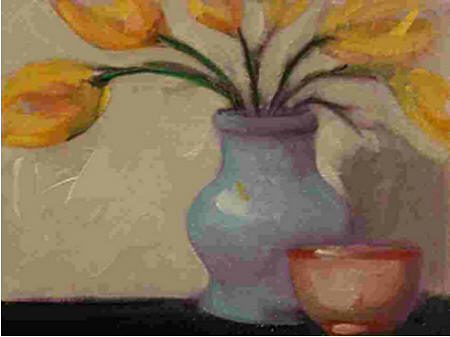
Yellow Tulip by Bob Martin
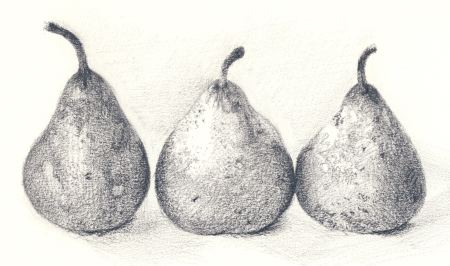
three pears by Hanneke van Oosterhout
I’ve been reading Fernando Pessoa, the quite unusual Portuguese poet. I really like the following poem from “The Keeper of Sheep,” translated by Richard Zenith.
Sometimes, on days of perfect and exact light,
When things are as real as they can possibly be,
I slowly ask myself
Why I even bother to attribute
Beauty to things.Does a flower really have beauty?
Does a fruit really have beauty?
No: they have only color and form
And existence.
Beauty is the name of something that doesn’t exist
But that I give to things in exchange for the pleasure they give me.
It means nothing.
So why do I say about things: they’re beautiful?
…
How hard to be just what we are and see nothing but the visible!
Are the two works above about just the visible, or more than the visible?


Seeing Hanneke’s Three Pears again makes me feel that I am greeting old friends.
Plump and shiny, each has its individual personality and behavior.
Bob’s Yellow Tulip is very special.
The vase has the same spiritual colors as the clothing of the man and boy in his painting shown here on March 1st. There is some red and black to ground us to the earth. The yellow tulips are evanescent and gorgeous.
That they are not fully portrayed may suggest that we are not yet prepared to fully embrace the joy of life.
So with his abstraction of the tulips, you could say Bob is giving us less than we could actually see. Do you mean to suggest that, in a sort of compensation, we are getting more of Bob?
Yes, we are getting more of Bob. Following the progression of the bowl, vase and tulips through the picture, evokes three very different emotions in me that make me speculate about who Bob is. I hope to meet him some day.
I like how Bob’s empty bowl sits more on the bottom edge of the canvas than the table and how the tulips try to squeeze themselves into the limited space. They’re having sort of a hard time.
On the other hand, Hanneke’s pears seem remarkably upright, from the same tree.
D.,
Nice observation about the tulips. I also like this composition because it means the picture is not so much about the tulips themselves and their beauty or not (it seems we’re expected to find flowers beautiful), but just about a scene that Bob sees. In that sense it seems quite in accord with the poet’s thinkng.
I have seen this type of cut-off composition described as photographic. One didn’t find this (at least not as much) in art from before photography. The “odd” cropping apparently became more acceptable with photographs, and then came to be used as a device by other artists as well. Does that fit with your knowledge of art history?
Many of Karl’s self-portraits from his high school years did not show the top of his head – all his hair. I had thought that he started painting his feet and then ran out of canvas when he got to his head. Perhaps, he cut off the top of his head on purpose?
I love Pessoa’s thoughts about beauty. Beauty is not the visible. Beauty is the degree of emotional, intellectual or spiritual pleasure that a human experiences through any one of his or her senses: sight, touch, smell, taste and hearing. The more we are pleased through sense, the more beautiful we perceive an object to be. When we assign beauty to something, we are simply revealing intimate details of an internal experience of some form of chemical pleasure.
Cropping in art fascinates me. I do it in my photography and in my writing. There is something very exciting and arousing in what is not seen in relationship to what is seen.
Richard,
Yes cropping is a key way to alter the impact of an image, and photographers are fortunate it’s available to them long after the raw image is captured. It would be interesting to do a post on this with examples.
Steve,
“…cropping apparently became more acceptable with photographs, and then came to be used as a device by other artists as well. Does that fit with your knowledge of art history?”
Beyond art history, I think new media has cropped our lives.
Jeez, ask a simple question, get a profound response. You make me think of Procrustes. Your analogy is brilliant, but I’m still interested in hearing about the art history aspect, from anyone.
Steve,
Yes, Procrustes!
And another aside: I have several friends who teach painting and each one, as a rule, will not allow students to physically crop their work. I think they think it is too often an easy way at resolving whatever compositional issues that arise.
I thought I recognized this tulip painting. Painting objects like bowls, flowers etc. have always been a challenge for me. The challenge with the tulips, was that I made them up and they seem to keep getting bigger and bigger and then I fell in love with the what I was doing with the background and this became the painting for me.