[ View menu ]

Monthly Archive April, 2007

Why is it so difficult to be an artist?

Posted by Karl Zipser

April 30, 2007 8:19 am

To be an artist today is to confront continual uncertainty. There is economic uncertainty, and also uncertainty of purpose. Modern society seems to value art — art is preserved in museums, and purchased for large sums by “collectors.” And yet the typical artist is strangely disconnected from the top levels of success. Compare this with other professions. A competent pilot, trained at a good flight school, is more or less assured of a successful career. He or she might not get the opportunity to fly the biggest and newest commercial planes, or fancy jet fighters; but a stable career is a reasonable expectation, certainly compared to what an artist can hope for.

The profession of art has not always been so uncertain. For example, Cennino Cennini discusses the motivations of those entering the profession in his time (the 14th c.) “There are those who pursue it” he writes, “because of poverty and domestic need.” In 17th c. Holland, parents would encourage a talented son to pursue art as a profitable and respectable occupation. But nowadays, “poverty and domestic need” would better describe the results of becoming an artist, rather than causes for becoming one.

There is far more wealth in the world today to purchase art than in any time past. The difficult position of artist today is therefore something of a mystery.

If there is a general appreciation of art, and money to buy art, then why is it so difficult to fulfill the role of artist?

Art Deco: The Gay Lodestone?

Posted by Richard Rothstein

April 29, 2007 9:02 am

Are the Empire State Building and the Golden Gate Bridge queer?

In response to my “tribute” to the Empire State Building, Karl asked a simple question that caused me to do an extraordinary amount of thinking.  This post is the answer and it’s hardly a simple one.

I was gushing over my life-long fascination and love affair with the Empire State Building and its powerful iconic nature. Karl asked: “How much of your attraction to the building has to do with the architectural style itself? At first I couldn’t’ see how to separate the two but after a while it dawned on me that there was much more to the question than was immediately apparent.

Continue reading Art Deco: The Gay Lodestone?

How I Spent my Winter Vacation

Posted by Rex Crockett

April 28, 2007 12:21 am

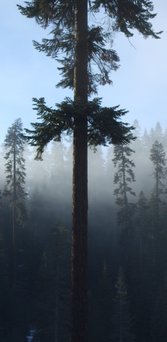
red-fir-clouds-behind-sm.jpg
Red Fir and Clouds

I do better work when I flow with rather than resist my passions. You are probably the
same. This winter my great passion was skiing.

I needed the exercise, for one. When I get out of shape, I lose my vim. When I lose my vim, I lose everything else. But exercise all by itself is boring, so doing something that is both fun and physically demanding is just the thing. This post asks no important questions. Probably, I should put it on my blog and not here, but I do share some photos for the first time, and I do get to an important theme to all artists at the end.

And yeah, this is a long post. But I’ve been gone. There’s some catching up to do.


Continue reading How I Spent my Winter Vacation

Abstract Expressionism, a personal confession

Posted by June Underwood

April 27, 2007 9:25 am

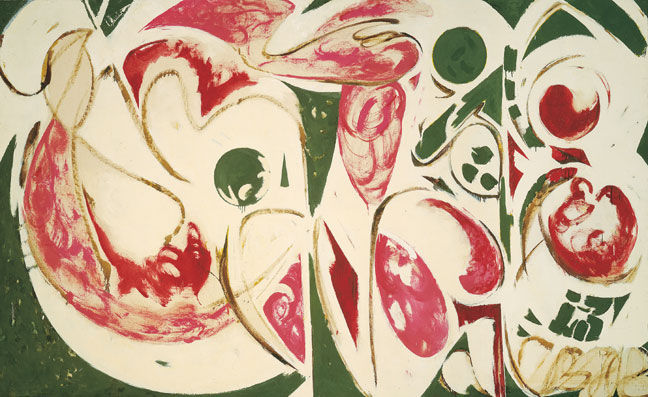
krasnersunwomanii.jpg

Lee Krasner, The Sun Woman II, 1958, 70 x 114 inches

I thought I’d begin my first official post with a confession.

I love abstract expressionist work. There’s very little of it that doesn’t give me enormous satisfaction.

Why do I love it? Continue reading Abstract Expressionism, a personal confession

A story about children…

Posted by Sunil Gangadharan

April 26, 2007 10:34 am

The last weekend of March was a cold and a dark one. Spending a lazy weekend at home is not my kind of relaxation. I decided to haul a couple of my cousins visiting our family for a quick trip to the Jane Voorhees Zimmerli Art Museum at Rutgers University (about 15 minutes from our home). It is a fairly good museum by New Jersey standards and we were fortunate to run into works by the Indian artist Natvar Bhavsar who was having a retrospective there. His work was characterized by very large abstract forms and shapes thickly overlaid by oil, encaustic and sand. My cousins were very excited on seeing the abstract art although they could not make much of it.. We also visited a hall that exhibited abstract American artwork (1960s - 1980s) and also imbibed some brilliant Soviet non-Conformist art of the 1970s. By the way, the Soviet art representation at this museum is outstanding…
They asked me a lot of questions on what each of the paintings meant and how we could read meanings into diffuse forms on the canvas. I am not so sure if I gave them proper perspectives, but from their faces they seemed a little confused. After about three hours at the museum, we headed back home all charged up on artwork and abstractions… They then decided that they were going to create a quick piece of artwork if I were to lend them a canvas to work on… (considering their original plans on watching a Spiderman movie that night, I thought the museum visit really set their creative juices flowing).
I told them the ground rules were that I would not participate in the painting process, but would offer suggestions and oil paints whenever needed. I told them to open their minds, forget what they learned at school and just express their thoughts on the canvas (easy words to say - I still cannot seem to practice it). They initially asked for color pencils and wax crayons and then proceeded to fill the canvas with words and phrases that they were taught at school with smaller pictures dotting the periphery and the centers of the canvas a la Basquiat style. I then handed them dabs of oil paints mixed with linseed and proceeded to give them disposable brushes with which to apply the oil at spots they felt would highlight aspects of what they had drawn into the background.
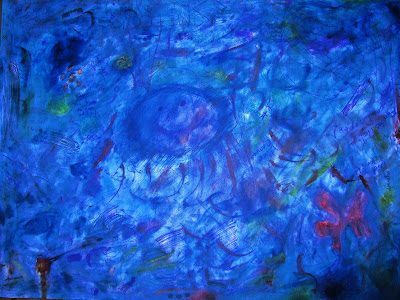
Title: Undecided; Artist: Aswin, Anusha and Hari; Material: Color pencils, wax crayons and oil on canvas; Size: 4 feet wide X 3 feet high (Click here for a higher resolution image.)
  
What they had created is pictured above. Of course the artwork was helped by bits of finishing touches added on by my three year old son (who had proceeded to hijack one corner of the canvas entirely to himself - the dark splotches at the top right corner was his handiwork). At the end of the exercise they felt elated, forgot about Spiderman and wanted to work on another canvas right away. It was about 10:30pm and I told them that it was late for bed and we could work on another one the next time they visited our home. I was very excited to see the activity and the energy that my cousins displayed on developing the artwork.
The next day, I remember feeling a little alarmed that I might have demolished some of the careful teachings in artwork that their teachers were imparting at school beginning with forms like drawing a house, sunrise and animals. In retrospect, I am not so sure if I did the right thing in exposing them to abstract art at so young an age but they sure had fun doing so. I would be very much interested in your thoughts… 
My cousin’s names were Aswin and Anusha. He was 9 and she was 8. My son Hari will turn 3 in a couple of months.

Artists and Non-critical Thought

Posted by Karl Zipser

April 24, 2007 12:37 pm

Guest Post by Mark Hobson

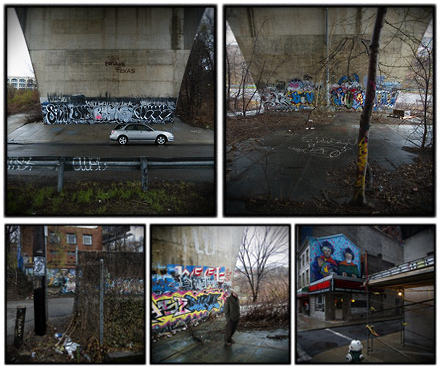
pghgraffiti.jpg

Some graffiti and a mural in Pittsburgh, PA. The mural, lower right, is of Pgh’s 2 Andys - Andy Warhol and Andrew Carnegie - getting their hair and nails done.The photos can be seen large on my blog

Recently, on my photography blog (The Landscapist), I posted a topic about graffiti - for purposes of this discussion, it might be helpful to read it.

The gist of it was simple - I had just returned from Pittsburgh, PA where the Graffiti Task Force had made what was being billed as the biggest graffiti bust in U.S. history. A lone graffiti artist with over 80 ‘tags’ to his credit is estimated to have caused over $500,000.00 in public and private property damages (keep in mind that, in this case, ‘public’ = bridge abutments and ‘private’ = abandoned structures).

Without going into great detail and for those of you not familiar with Pittsburgh, I will simply sate that the city is awash in visual eyesores which are the inevitable result of the severe economic devastation the area has experienced over the last quarter century. The city keeps trying to rise from the ashes of the end of big steel but it never quite seems to get it right.

The U.S. graffiti community considers Pittsburgh as a target-rich environment, quite possibly the largest ‘canvas’ in the U.S. Many travel here for the abundance of ‘opportunities’ the decaying public and private infrastructure present. The powers-that-be in the Pittsburgh body politic, to include law enforcement, have essentially declared this activity to be a scourge. The ‘miscreants’ need to be hunted down and punished with the full weight of the law.

No effort or, for that matter, consideration has been given to the notion of harnessing this situation for the enrichment of the community. No effort or consideration has been given to the fact that there is a difference between vandals with spray paint and artists with a voice. No effort or consideration has been given to the possibility of turning the area into the Sistine Chapel of the graffiti world.

That said, I am wondering what a diverse group of artists such as the one here on Art & Perception thinks about this situation.

Whitman on art: it’s about world building

Posted by Karl Zipser

April 23, 2007 8:07 am

Works of art create their own worlds, with their own rules. . . Internal coherence is more important than any resemblance the work might have to something outside of it.

–Arthur Whitman

I think this is one of the most insightful statements about what art is about, or supposed to be about, that we have had on Art & Perception so far. As Arthur points out, it is not so much a definition of art, as a statement of what is most valuable in art.

Arthur’s statement is not so useful for telling us what is art versus what is not (in that respect it is far too broad.) Rather, it is an interesting way to think about what a given artwork is accomplishing. I say “accomplishing” in the present tense, because an artwork, to be perceived, must have a parallel representation in the mind of the viewer (the mind being the greatest world-builder of all). Whatever world the artist has created in their artwork must be rebuilt in the mind of the viewer in order to be seen and felt.

I read something tantalizing in Arthur’s statement about world building, something that suggests to me that art is the externalization of an artist’s inner perceptual world, or a world synthesized through an interaction of the inner world of the mind and the materials and stimuli of the outside world. The problem is that to be more than simply tantalizing, we need to take what Arthur is saying a lot further.

Let me ask then, what are the implications of the statements that I quote at the beginning of this post? How can the concept of art as world-building enhance our appreciation of, and ability to create, art?
The Empire State Building: Breaking The Second Commandment

Posted by Richard Rothstein

April 22, 2007 6:06 am

EXODUS 20:2-14: “You shall have no other gods before me. You shall not make for yourself an image, whether in the form of anything that is in heaven above, or that is on the earth beneath, or that is in the water under the earth. You shall not bow down to them or worship them; for I the Lord your God am a jealous God, punishing children for the iniquity of parents, to the third and the fourth generation of those who reject me, but showing steadfast love to the thousandth generation of those who love me and keep my commandments.

I’m fascinated by the relationship between secular and religious iconography.  In particular, I have an intensely passionate emotional and intellectual relationship with one of the world’s most compelling and famous secular icons: the Empire State Building and it is through that passion that I’ve come to understand something more about religious iconography.

When it comes to religious iconography I am seriously handicapped as an agnostic, a cynic and as a Jew.  This subject is particularly challenging for a Jew, secular or otherwise. Even a secular Jew grows up “understanding” that iconography is simple-minded at best, blasphemous at worst. The truth is found within our hearts and minds and to seek the truth through images is false, intellectually lazy and in opposition to the absolute word of God.

But my life long relationship with the Empire State Building has defied my Jewish perspective and seditiously lured me into the world of image worship. (Just one of the commandments I routinely break.) Continue reading The Empire State Building: Breaking The Second Commandment

“Singing the Praises of a New Asia”

Posted by Birgit Zipser

April 20, 2007 1:00 am

Preamble:
This post was prompted by an interchange between Ginger and Doug

Comment by ginger — April 18, 2007 9:26 am
I also have to say that after watching the news yesterday and today I turned to this photo to remember “Unconfined Joy” and get out of myself and grief.
Comment by Doug Plummer — April 18, 2007 7:23 pm
Oh Ginger, your comment brings me to tears. Thank you.

and, then, Ms. Timmons’ article inspired me to one of my visionary flights that earthlings have difficulty following.

A correction, when I said ‘evil’, below, what I meant is ‘religious obsessions - Christian, Moslem or otherwise’.

I thought it an astounding development of our globe that Summers managed to convince Asia to invest in its own development rather than buy US treasury bonds and thus (my thoughts went) buy into helping to finance a bloody war.

In my naive thinking, I assumed that using resources for purposes other than war will lead to a blossoming of human culture, technologically (fighting emission, if you read Ms. Timmon’s article, you will find that Summers thought about that too), artistically (greater interchange between eastern and western art), you name it. Why shouldn’t the alternate use of money begin to transform human culture in the near future rather than only be observable 300 years from now? In the past, technological advances leading to cultural advances were often made by financing the war effort, if Summers’ further advice is also followed, similar advances will now be made by investing money into technologies that will help humanity such as fighting global warming.

What I am guilty of is entangling two different themes, (1) the enlightened idea to promote human culture by diverting money away from war with (2) poking fun at in-box-thinking (example: Nancy Hopkins; counter example: Larry Summers) and mentioning an enlightened woman, Isher Judge Ahluwalia, for company, so as not to be accused by my feminist friends to be a man in a woman’s body. Too many threads! Rule for the future, one theme per post.

There is hope for the world!

summers.jpgLawrence Summers presages that intelligence will dominate over incompetence/evil (NYTimes, 04/19/2007)

300 years from now, what will be seen as the most important event of these times will not be the end of the cold war, the terrorist attacks of Sept. 11, 2001, or the war in Iraq, but “the rise of Asia and all that it meant for people in Asia and all that it meant for the world system.”

Larry Summers has time now to think globally after wasting his talents as a Harvard administrator, thanks to Nancy Hopkins, office of the provost at MIT. Earlier, as you may recall, to provoke a lively discussion in a closed-door brain storming session, Larry uttered fateful words about women in science and math. Fortunately, what he actually ended up doing was to provoke Nancy to spill the beans to the Boston Globe that delighted in disseminating misinformation (according to my reliable sources, Larry enjoys working with women and actively promoted the hiring of women faculty at Harvard).

About Larry’s role in Asia, we hear from Isher Judge Ahluwalia, the new chairperson of the Indian Council for Research on International Economic Relations (ICRIER), who obtained her Ph.D. at MIT:

ahluwalia.jpg

“Larry is very stimulating intellectually and an ‘out of the box’ thinker”.

It is easy to imagine why Larry did not make the perfect administrator in stuffy academia

In Beijing this January, he asked hundreds of economists and policy makers at a Global Development Network conference to consider the fact that $2 trillion from developing Asia, invested in United States Treasury bills, was making a “zero real return.” Imagine instead, he said “all the opportunities in these countries for productive investment.”

The governments of China and India have both announced that they will invest their foreign exchange reserves in new areas, which will divert them from United States Treasury bills.

.

Why put this on A&P? Larry is doing his best to promote a shift in culture within the next 300 years.

Molotov cocktail.

Posted by Sunil Gangadharan

April 19, 2007 7:49 am

Harpers is one of my favorite magazines and a couple of months back I had the good fortune to run into some writing that resonated with the way I approach ideas for my paintings. The case concerns artist Joy Garnett of the ‘Molotov Man‘ fame. She is an artist who uses ‘found’ online imagery in the creation of her art and knowingly subverts photographs and images found on the web to suit the message that she would like to propound in her paintings. In her own words..

“I searched the web for images of figures in extreme emotional or physical states. I saved the most promising images in folders on my computer desktop, and I let them sit for a while so I could forget where I found them. I wanted my choices to be based more on aesthetic criteria than on my emotional attachment to their narratives. Eventually I would look through the folders again to see what struck me…”

To make a long story short, she was initially told by a lawyer representing the author of an image she used (Susan Meiselas shot one of the iconic images that Joy Garnett later painted) to secure permission before using the image. Naturally, Joy did not think it necessary to go through these motions as she had created ‘original’ artwork using the image as a springboard… and posted her predicament to Rhizome.org. The bloggers on Rhizome ran with it and produced hundreds of subversions of the original image challenging the lawyer to prosecute all of them.. The lawyers withdrew on seeing the shaky nature of their case in prosecuting Joy Garnett. You can read multiple points of view in two essays from Harpers hyperlinked at the bottom of this post…
 molotovman_susan-meiselas.JPG Susan Meiselas “untitled” 1979 Color photograph
 molotovman_joy-garnett.JPG Joy Garnett “Molotov” 2003 Oil on canvas 70 x 60 inches

My technique is to paint from photographs. Every once in a while when I explore an idea, I tend to go to the web and download compelling images from the web to act as a spark that will lead to the creation of a painting. In my view I am engaging in a dialogue with art that already exists out there and in the eventual subversion of the original image in my painting, I am merely enriching existing art. I sometimes acknowledge the source and sometimes bother not to (especially if I do not find it on the web – I do not go crazy trying to find the source)…  I do not regard this as plagiarism, but some people do…
 

How many times have you directly used images from the web in the creation of your art? How many times have you used web based images indirectly (as a spark generator and incubator) for an idea that you then use to create your art? If the former case is dubbed plagiarism by some people, then the latter case also should be… What are your views?
Like someone said, the cross pollination and extension of existing ideas is critical to human creativity, be it art science or commerce.

References:

On the rights of the Molotov Man - article by Joy G. and Susan M. in Harpers

The ecstasy of influence - an invigorating essay by Jonathan Lethem    

Fuzzy Concept (part 2) or Ambiguity?

Posted by Leslie Holt

April 18, 2007 10:50 am

grouch-2-web-2.jpg

Steve’s previous post made me think about mystery and ambiguity in art, particularly as they help to create meaning. And his image reminded me of this recent image I made as part of my “Unholy Gost” series. I use ambiguous spaces and images in this series of paintings.

I talk to my students about the difference between “deliberate ambiguity” and disorganized confusion. While I encourage the happy accidents that occur in the process of creation, it can sometimes be an excuse to leave a piece unfinished, unclear and incoherent. Beginning students often want to make images that deal with the idea of chaos, but end up making disorganized messes. Mysterious images can so easily be so ambiguous as to be unreadable with no entry way into the work.

These can be pitfalls of art making. How can you tell if ambiguity is purposeful or if it reflects lack of clarity on the artist’s part?

Have you explored ambiguity in your own work? What are the challenges you face when doing so? Do you have any favorite artists who use ambiguity successfully?

PS - I tried to make the image larger, I swear, and the best I could do was a thumbnail you can enlarge. Anyone can go in and fix it if they are so inclined. I apologize for my ineptitude.

What do I call it?

Posted by Doug Plummer

April 17, 2007 10:51 am

Camp Wannadance, WAI had a very successful Photo Lucida with my contra dance project. The consensus after 4 days of reviews, with some of the top people in the photography fine-art field, is that the project has legs and great potential. Now I need to name it.

Alec Soth has a post today on book titles. He loves pondering them, feels they define and sum up the nature of a work, and that they can make or break the success of a book.

I am considerably less gifted in this realm, despite my usual felicity with words. I am struggling to come up with an all-encompassing, pithy and memorable title for my contra dance project.

“Contra Dance in America: A Photographic Journey” is accurate, but really boring. My other working title, “Unconfined Joy,” is from the over-quoted Lord Byron poem, which goes,

On with the dance! let joy be unconfined;
No sleep till morn, when Youth and Pleasure meet
To chase the glowing hours with flying feet.
   ~George Gordon, Lord Byron, Childe Harold’s Pilgrimage

Any ideas out there? Here’s the link to my “yes-it-really-needs-updating” dance page. You can also look through the blog posts from Photo Lucida.