[ View menu ]

Monthly Archive May, 2007

Thoughts on a gallery visit.

Posted by Sunil Gangadharan

May 31, 2007 7:54 am

Every once in a while an artist comes along, pokes fun at our prevailing world order and gets away with it - even managing to sell the works exhibited – using satire as a scathing tool. In William Powhida’s work, he satirizes the ephemeral nature of the art world in an exhibition underway at Schroeder Romero in Chelsea. I had some time yesterday afternoon and decided to go by to Schroeder Romero to take a look at the commotion and I was not at all disappointed. William Powhida combines elements of painting (graphite and gouache is his medium of choice) and merges MAD comic style satirical musings on the art world in a tight graffiti format that really makes you think. I was reminded of Banksy’s writings when I came across his paintings (if you want to call them ‘paintings’). Of course I was also reminded of those list formatted chain emails which manage to look at life in terms of ordered lists…
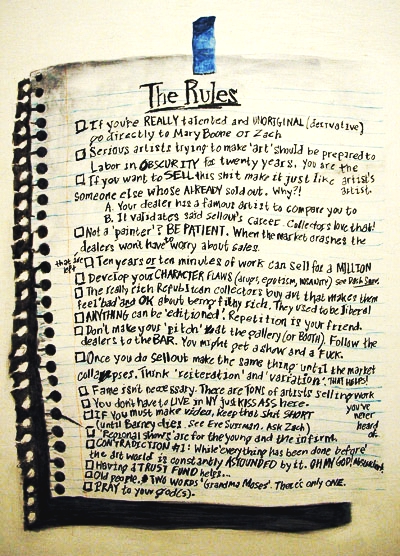
A drawing that caught my eye was the one where he laid out a set of rules for the artworld… Some of the ‘rules’ are reproduced below… (the punctuation/grammar has not been changed to reflect Williams’ work)

  • If you want to SELL this shit make it just like someone else whose ALREADY sold out Why?!  A. Your dealer has a famous artist to compare you to B. It validates said sellout’s career. Collectors love that!
  • Ten years or ten minutes of work can sell for a million
  • Anything can be ‘editioned’. Repetition is your friend
  • Don’t make your ‘pitch’ at the gallery (or BOOTH). Follow the dealers to the BAR. You might get a show and a FUCK.
  • Once you do sellout make the same thing until the market collapses. Think ‘reiteration’ and ‘variation’. THAT HELPS!
  • Serious artists trying to make ‘art’ should be prepared to labor in OBSCURITY for twenty years
powhida_the_rules.jpg 

William Powhida The Rules 2007 graphite and gouache on panel 24″ x 18″

Another highlight of the show was an imaginary rendition of the future cover (2010) of the New York magazine (and ‘drawings’ of the complete article) that chronicles William’s eventual rise to stardom in 2010.
 dsc09032.JPG 

William Powhida The Bastard 2007 graphite and gouache on panel 44″ x 54″ 

His artist’s statement contains a playful but keen taunt to the publicity and glam that surround the artworld:

my one man SOLO show, opens May 11th at Schroeder Romero.  Those bitches hos HOOKERS, excuse me, are ecstatic to present my new work, which is destined to confirm my GENIUS and secure my reputation as the greatest artist ever.  Now, I know that sounds a little presumptuous on my part, after all I haven’t been reviewed in The Times or sold anything to Saatchi, but it is true, I promise.” Read more here.
 powhida_pricing_guide.jpg 

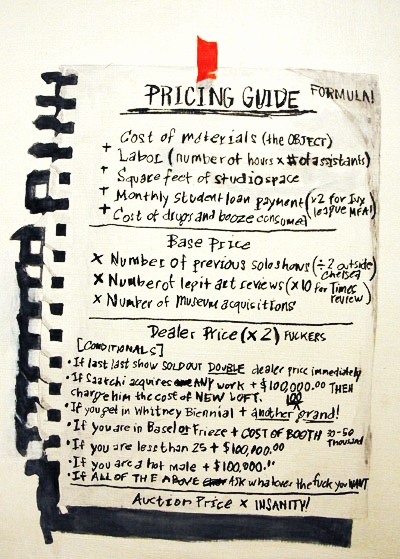
William Powhida Pricing Guide 2007 graphite and gouache on panel 14″ x 11″ 

By laying bare elements of the art world in such an unsettling manner to the viewer and having the courage to exhibit this is very brave - both on the part of the artist as well as the gallery. Most of the works were sold out - very well for an artist who is only in his 20’s.
On reflection, our world sure is a funny one. His art (which are in the thousands of dollars) and the perception it generates is interesting to think about – the former (his art) is nothing much to speak about, just a bit of carefully laid out graffiti on masonite. The perception it generates is affirmation of the fact that the artworld is indeed topsy-turvy with some of the ‘rules’ being brutally true whilst the fact that the works having been sold out also means that buyers do not really care the situation the artist was trying to satirize. Interesting indeed.

Making paper one’s own: tinting

Posted by Karl Zipser

May 30, 2007 2:56 am

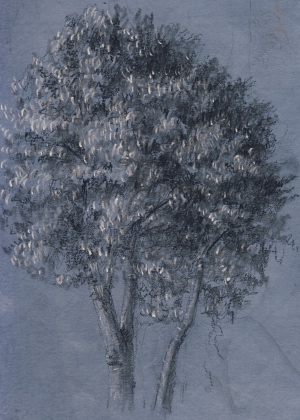
treeonbluetintedpaper_c-300.jpg

Tinting paper is the fastest and least expensive ways to ‘make’ paper. One begins with a ready-made sheet, but then makes it one’s own. Continue reading Making paper one’s own: tinting

Orientation

Posted by Steve Durbin

May 29, 2007 9:05 am

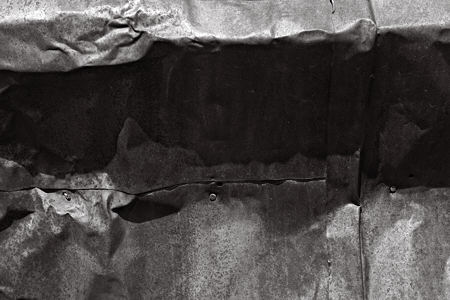
8024-450.jpg

I revisited one of the places I like to photograph and came back with, among others, the image shown above. No, it was not the scene of junkyard treasure, and this is not the side of a beat-up old car. It’s actually from my ghost town site, and it’s the side of a beat-up old outhouse. I guess I took it because I tend to like abstracts like this. Though that’s probably not the whole story, because this is the only abstract I made in hours of photographing in a place loaded with weathered wood, ancient mining equipment, etc. Perhaps I was drawn to it through mysterious workings of my unconscious. If so, I discovered why the next day — but maybe you can guess it now?

Continue reading Orientation

Why does art change with viewing?

Posted by Karl Zipser

May 28, 2007 3:00 am

drawingscan11cropjp-450.jpg

Drawings, paintings and photographs all seem to be more or less static entities. With luck, they can last more or less unchanged for hundreds of years. It is therefore interesting, if disconcerting, when artworks appear to change drastically from day to day. Continue reading Why does art change with viewing?

Resource pages

Posted by Steve Durbin

May 27, 2007 10:59 pm

I recently received an email from Jay Hoffman, which I may as well quote here.

Question: is there a category on A&P for the kind of comments that might be sparked by a topic, but which may have a broader informational potential? While scanning through posts and comments I remember coming across a question about preservation. It was only later that I recalled a local institution, The Intermuseum Conservation Association 216-658-8700, that deals with such issues and will discuss over the phone. By then I had forgotten within which post this matter belonged, and didn’t want to throw it out there wily nilly.

This brings up a point which has come up from time to time, but hasn’t been effectively addressed yet: how do we make the accumulating pool of useful stuff on A&P available without requiring that people wade through the ocean of, let’s say, less useful stuff. Not that I’m blaming anyone; in fact, the latest failure is mine (find it if you can). But Jay’s message sparked an idea that might be successful, mainly because it doesn’t depend on me or any other editor. Here it is:

Continue reading Resource pages

Conservation resources

Posted by Steve Durbin

10:59 pm

This is a resource post. Please add comments describing any useful information about conservation materials or techniques. Links to other online resources are welcome, especially if you say a word or two about what is available at that resource. Links can also be to Art and Perception posts with relevant information. If the information is in a comment rather than the main post, please link to the comment, which can be done by copying the link under the comment date (or the name of the commenter from the sidebar comment section).

Books

Posted by Steve Durbin

10:59 pm

This is a resource post. Please add comments describing any useful information about any art-related books you have enjoyed or found useful. Links to other online book resources are welcome, especially if you say a word or two about what is available at that resource. Links can also be to Art and Perception posts with relevant information. If the information is in a comment rather than the main post, please link to the comment, which can be done by copying the link under the comment date (or the name of the commenter from the sidebar comment section).

A Sense of Place

Posted by June Underwood

May 25, 2007 10:06 am

placefarmland.jpg

Farmland, 36 x 43, painted cotton

I have lived many places, and in each, I have always had a strong sense of the place itself — the trees and plants, the nature of the cultivated earth, the nature of the uncultivated earth, the sky, winds, air, light — I can describe all these with a fair amount of detail.

But I seldom had to try to recap in art what I know about a place where I no longer live. However, now I am doing so.

“Paint what’s around you,” seems to be a sound admonition, but what is around me is the opposite, environmentally speaking, of what I am painting. Continue reading A Sense of Place

Gallery representations and your thoughts

Posted by Sunil Gangadharan

May 24, 2007 8:50 am

It was with much elation that I read an email sent out by a fairly prominent gallery (which will remain unnamed in this post) in Chelsea, NY last week announcing that they were happy to represent my work. I had entered an art competition sometime back hosted by the same gallery and I guess I must have caught someone’s eye to be ‘noticed’ by the gallery’s director. This was about the same time that we were having our second child (we had a baby boy and all are doing well) and I did not bother to read some of the fine print that the same email carried. Once things settled down a bit over the weekend, I decided to check the attached legalese and found out that the gallery representation came at a cost: 

  • Basic One-Year Representation ~ $3K (10 feet of exhibition space)
  • Standard One-Year Representation ~ $5K (20 feet of space) 
  • Premium One-Year Representation ~ $10K (40 feet of space and review in some NY art publication) 

All of the above options include the following ‘perks’ 

  • Allow use of words “represented by Un-named Gallery” on resume. 
  • Director reserves right to establish prices for work. 
  • Representation on the gallery’s online site (~ 8 images) 

I remember being a little confused. I was under the impression that galleries who decide to represent an individual’s work do it out of two things: 1) An understanding by the gallery that the work would attract buyers and it does make economic sense to exhibit 2) Genuine appreciation for the artwork submitted… 

Maybe I am being too idealistic, but other than the gallery looking out to pay exorbitant Chelsea based rents in this case, I fail to see how ‘fee based tiered representations’ like the one described above would really help artists like me… 

What are your thoughts, experiences and advice? Are all galleries like this? Is this the norm to break into Chelsea (especially in a superheated art environment like the one that we are living in)? For some reason, I do not think so (but I am just an amateur with little experience venturing out into the art exhibition space)…chelseagallerysapce.JPG

Cartoon of an ‘Overheated art district’

In the absence of sand dunes

Posted by Steve Durbin

May 22, 2007 8:57 am

2384c-450.jpg

Funny how things come together sometimes. After casting about for a while, rejecting various topic possibilities, I finally settled on one I’d had in mind for some time, although I hadn’t prepared images or written anything. After typing the title and while I was uploading images, I noticed Doug had just posted on influence. In part, this post is about what I can do here in Montana that is as much as possible like those fabulous images of California dunes (Oceano, Death Valley) by the Westons and many others (see examples here and here). I’m not exactly striving to copy, but I am deliberately letting that influence wash over me and through me. I love the forms of those high contrast black and white images, both the three-dimensional dune forms and the two-dimensional shapes in the plane. I look at those images often.

But there is another goal with my series, although I had not quite formulated it sharply until Birgit’s recent post. In addition to the dune-like undulating fields in the foreground, most of these images have the Bridger mountains in the background. But the mountains are serving not so much as subject as to bring out the light-filled air of early morning.

Continue reading In the absence of sand dunes

How much influence is too much?

Posted by Doug Plummer

May 21, 2007 11:22 pm

Paul Butzi has a provocative series of posts on Musings, in his typically thoughtful style, about the necessity to seal himself off from influences, particularly the media. I have great respect for his thinking, but I offered a different take in a long comment on his recent post. I’m appropriating myself and posting it here.

Paul, 

As I understand you position, you’re saying that in order to protect the integrity of your experience, you have to deliberately isolate yourself from stimulus that might become a mediating influence, because it deters and inhibits the sense of being in the moment.

My retort is twofold, one about artistic influences, and the other about mass media (we won’t talk about the intersection of these two sets, which is an interesting arena that a lot of artists use to make some important work, and always have). I contend that isolating yourself from other artistic influences is a big disservice to one’s own process.

My feeling is, that the more I know about what has gone on before me, the more roots there are to feed my own work. I visit museums and galleries whenever I travel, and I make it a priority. I have arenas of art work that I like to look at and that I respect, and large swaths that I pretty much ignore. But I don’t prohibit it from feeding my process. Even work I argue with grows me.

Allowing Italian Renaissance art into one’s process is one thing. Mass media is harder to defend. But much of the art I adore was the mass media of its era. I am writing this while I am watching my guilty pleasure, “Dancing With The Stars.” I’m working on a dance project. I’m interested in the popular culture take on dance, and I love that this show highlights and rewards a kind of (well, vulgur) virtuosity. Because I make a living from my artistic process, I pay attention to the trends and patterns in how the media mediates our culture back to ourselves.

I don’t like a lot of what I see, of course. That’s beside the point. Anyone with a lick of self respect is going to be majorly frustrated with the culture we live in. The way I inoculate myself from the media onslaught is to pay attention to it. I deconstruct how it works, what it’s trying to say, and the meta messages within it. But sometimes the production values speak to some of the best artistic output of our era. Or at least, it informs me about what is the visual vocabulary of our time.

Chains (Jay Hoffman - guest post)

Posted by Jay

8:10 am

Picked up a piece of airport art at a garage sale. I believe that the lady said it was from Kenya. It is a chain, carved from a single piece of wood with a stylized head at each end.

a_004-450.jpg

Continue reading Chains (Jay Hoffman - guest post)