[ View menu ]

Monthly Archive October, 2007

It’s about time

Posted by Steve Durbin

October 29, 2007 10:39 pm

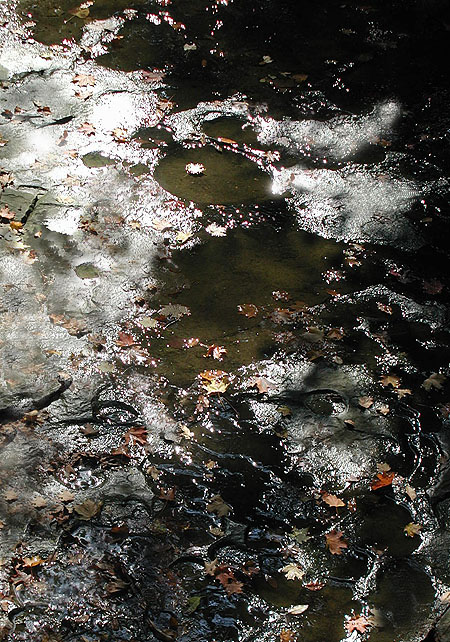
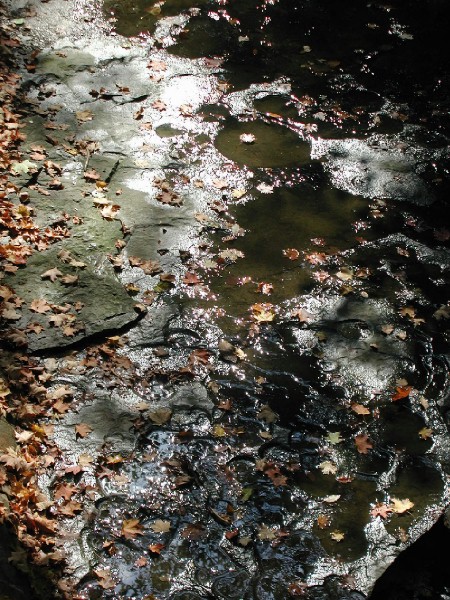
Sometimes, when you get hammered with something from all sides, it begins to sink in. Last week Susan Galassi (Curator at the Frick and Picasso scholar) discussed, among other things, Picasso’s concern with time, which was a new one for me. A few days later, while chatting with artist Glenn Bodish about his work, he told me that a major theme throughout his career has been time and the way it structures our experience through change and the opening and closing of possibilities (at least that’s how I read it; there was a lot of interesting stuff in there about quantum mechanics and chaos and four dimensions and Eastern philosophy). Then, the next time I had a camera in my hands, I was at a small waterfall seeing nothing of particular note — until I had the thought that a photograph there could be about time.

10596-400.jpg

Continue reading It’s about time

Uber Effeminatus

Posted by Angela Ferreira

October 28, 2007 3:57 am

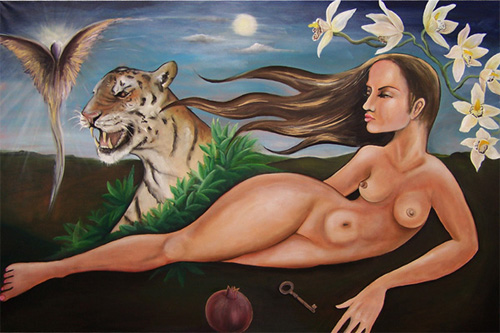
Oil on Canvas
Title: Punica Malum
Medium: Oil on canvas
Size: 78×170 cm
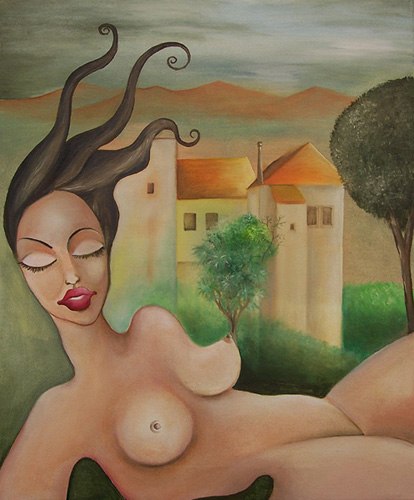
Oil on Canvas

Title: Profanum
Medium: Oil on canvas
Size: 60×45 cm

Where I Live: perceptions & preconceptions

Posted by June Underwood

October 26, 2007 12:03 pm

I’m maundering around Robert Irwin and the concept of perception. It was the Oct 14 NY Times article on Irwin that got me thinking — again — about what and how and why we perceive.

Irwin, in one of his exhibits, made a small but significant change to a San Diego Museum room that overlooked a wide view of the Pacific ocean. His exhibit consisted of cutting three rectangles into the existing windows. The Times quotes Irwin, “At first I didn’t realize the glass was tinted….So not only did my holes let in air and sound, adding another dimension to the experience, but they made everything seen through them appear in greater focus.” The reporter adds that Irwin “opened the window, that age-old pictorial device, letting in a cool rush of reality.”

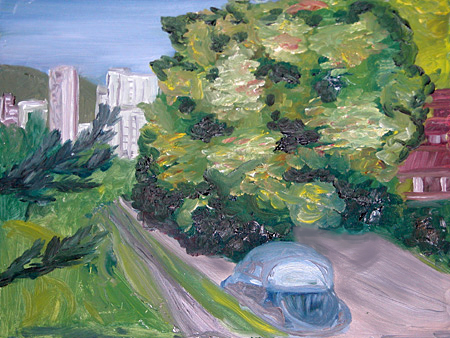
Alternatively, I think I spend much of my time in reality. So, to reverse Irwin, I’ve been painting “stuff” around my neighborhood base. No sweeping views of vales and rivers, of volcanoes and archaic structures. Instead, I’m trying to perceive, in a painterly fashion, the place I spend most of my time. As usual for me, it consists of much that is “natural,” that is, growing things.

As usual, it’s outside, where I can enjoy the sun (when it shines) and the air and light.

paintingsvwtree.jpg Volkswagen and Horse Chestnut tree, 12 x 16, Pleine aire

Continue reading Where I Live: perceptions & preconceptions

Depth versus breadth

Posted by Sunil Gangadharan

October 25, 2007 7:36 am

When artists decide to pursue different specialties of an art form (like portraiture or landscapes or still life in the case of photography) or try their hands at disparate art forms (like sculpture, music, painting, photography etc), they may sometimes be admired for their versatility but more often be considered dilettantes - dipping their inks in one bottle and using the still-wet pen to delve to other pastures.

Some people believe that artists should aim for clarity, focus and depth in ones work rather than develop a host of talents none sufficiently honed.

What kind of an artist are you? Do you subscribe to the view that one must focus ones actions in a chosen, preferred form while sharpening and contributing to the same? Or - Are you the one who likes to dabble in multiple art forms because you would rather choose the best possible (expressive) mode that develops your idea to the fullest?

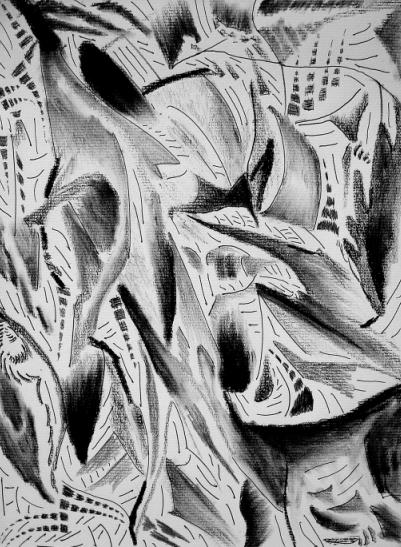
un_titled.jpg

Sunil Gangadharan, ‘Untitled’, Charcoal, ink and ballpoint pen on Strathmore paper, 9″ X 12″

Elusive Quake Lake

Posted by Steve Durbin

October 23, 2007 7:56 am

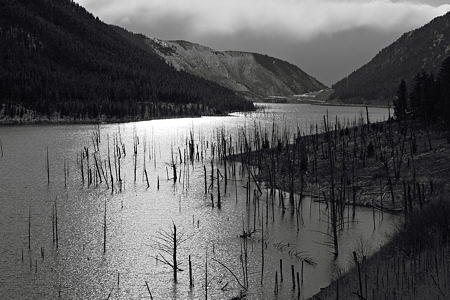
The biggest recorded earthquake in Montana history (magnitude 7.3) struck August 17, 1959, causing a huge landslide that dammed the Madison River (coming from Yellowstone Park) and created Quake Lake. Some 26-28 campers lost their lives, most of the bodies remaining under the millions of tons of rock. To me, they seem connected to the much larger number of trees that were drowned by the rising water, but remained standing bare, half-submerged.

3776-450.jpg

Continue reading Elusive Quake Lake

Two ways of looking at waterfalls (I)

Posted by Jay

October 21, 2007 7:20 pm

Steve received an e-mailed picture taken by me during a recent trip and suggested that we do a collaboration around the theme of waterfalls, and do so in the form of two posts. In the first, I hereby display some images and describe my path to them. We then discuss a reworking of one of the images by Steve. This will be followed by another post where he displays and I perform a makeover.

My Images

Ohio is the home of the gentle cataract. The peculiarities of geology and topography promote a stepwise progression of falling water. We stand in awe of any fall that we look up to. In the White Mountains of New Hampshire the water responds differently, the result of a hard geology that wears with effort. This results in smooth transitions, punctuated with boulders of various sizes.

These two environments present themselves very differently. Here one looks across the water for the most part, the included image notwithstanding, while the perspective is more vertical in the mountains.

This post features images taken at Buttermilk Falls, outside of Cleveland, and the Flume in the White Mountains. The Flume is essentially a slot canyon formed by the selective erosion of a basalt dike. Water falls vigorously through a steep succession of boulders and slopes.

A word about my approach: the camera captures a multiplicity of detail that the eye would tend to weed out on the spot. Photo Shop is a quick and dry sort of dark room and it allows for a further shaping of an image away from the contingencies of the moment. I can dwell on a given shot and try to articulate more fully whatever prompted me to take it in the first place. Sometimes this process clarifies and condenses as when I am working on a portfolio image. It can also lead me away from specificity toward something more personal. Then I often find the image assuming a novel identity. At times it can seem that I am changing it to match an internal template, as though I am looking at my own mind.

Buttermilk

The photograph below is an example of this process. It was taken from a small bridge just upstream of the falls themselves, and is typical of the flattened stream beds in these parts. I was attracted to a kind of role reversal: a few feet further and the water is white and foamy as it falls over darker rock. Here the water makes it’s way in dark pools and rivulets and the rock itself reflects brightly. Furthermore, it is a welter of suggestive features and subtle details.

The first image is as taken, and the second as processed.
buttermilk-_2-10-6-07-resized.jpg

buttermilk-_2-10-6-07-really-processed.jpg

The scene did not satisfy me as taken. There was something there that needed to be shaped. I began the process by cropping the image. Then I erased small artifacts, like glints and leaves, that detracted from the overall quality. The magic wand and the stamp functions were used to isolate areas for more attention and to transfer colors and textures from one spot to another. somewhere along the line I began to sink into my work and the quality of mind matching appeared.

Flume

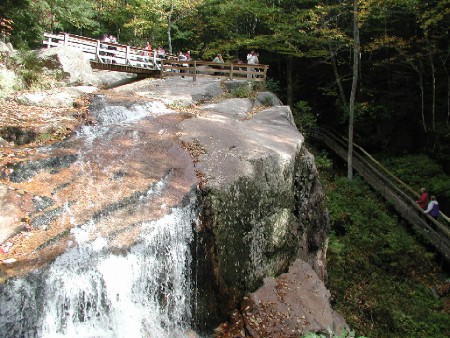
The waters of the Flume fan out over a ledge before assuming a quieter course down hill. The view had a lovely kind of breadth to it, but consisted of a patchwork of more and less interesting areas. I essentially transfered some of the better areas elsewhere in the image, creating what was for me a kind of dream scape effect: the view overall has a logical progression to it, but one which dissolves in places. The people on the bridges are insubstantial and perhaps wondering what just happened. Overall I feel a Westernized Orientalism in this piece.

The first image is the scene as shot; the second as modified.
the-flume-resizedjpg.jpg

the-flume-stamped-and-resized-jpg.jpg

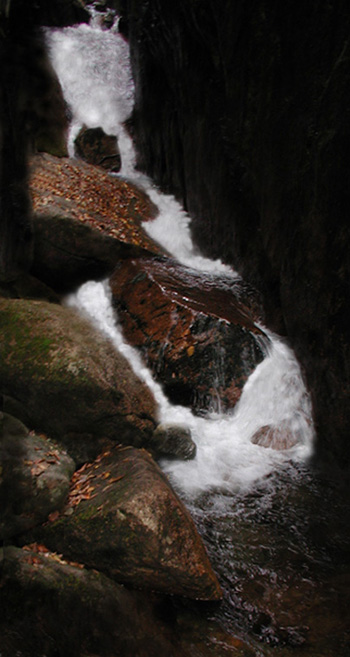
The next example is heavily modified. I spent time moving water highlights around, darkening walls, removing leaves and generally trying to simplify. I feel that it might be wearing too much lipstick.
yet-another-flume-image-processed.jpg

The Discussion

Steve’s thoughts

One thing Jay and I seem to have in common is an approach that involves continuing to learn from the image as we work with it. I found the “mental self-portrait” he uncovered fascinating. It’s a great example of what some might see as mere inanimate landscape coming to express something quite deep and personal.

One of Jay’s photographs that especially appealed to me was one of the Flume. Here is how I first saw it:

the-flume-_2-processed-and-resized.jpg

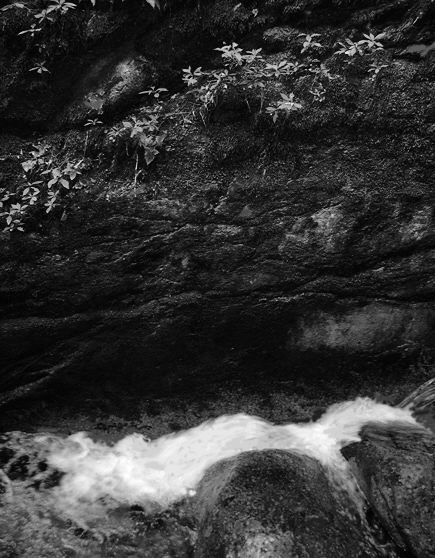
This image is probably most meaningful to Jay as shown here, not only an appealing picture but one recalling a place he enjoyed. But the memory aspect has little impact on me, since I’ve never been there, and in fact I am little interested in memory aids even of places I have been. But it did appeal to me very much in a more “abstract” sense, and I really wanted to see it in black and white, which often has the effect of decreasing the specificity and opening the door to further associations.
the-flume-_2-sd.jpg

I like the result for its play of tones, especially on the wet boulders (note that because of the high contrast, these depend quite sensitively on your monitor settings). I like the top half and the bottom half separately, which set me to musing on the juxtaposition of low (earthly) rough turbulence and high (spiritual?) delicate stasis, separated by intervening darkness. The plants and ground cover in the upper half are reminiscent of brighter stars against the Milky Way.

Jay Replies

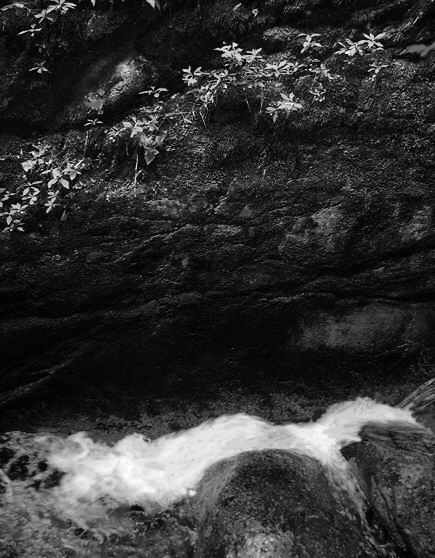
There’s an economy of coloration in the Flume. It’s as though every hue is hard won. I decided to accept what was presented, color and form. With the exception of some gardening in the upper portion and coiffing the rapid, I left the image pretty much alone. Steve’s version compresses the scene into a gray scale. At first his version bothered me until I re-read his explanation. While it is far more than a memento, the image for me has little symbolic value. Steve altered it to achieve a new synthesis to match his response. The water below and the string of foliage above are indeed in an evocative relationship. I would like to see Steve darken the intervening rock face to make it more of a void and give the foliage a more spectral and star-like quality. Also I think that the image would need to be re-shot on location in a larger format so as to allow for a much bigger print to be made. And the image seems to demand a sharper focus than I was able to achieve with my elderly Olympus.

We have been discussing appropriation on A&P, both in a practical and ethical sense. I accept appropriation in its many forms as being part of the overall compilation that we are here on Earth to perform. But this exercise did not go that smoothly for me. Everything in this collaboration was done with mutual consent, yet some instinct inside of me was growling at the intruder, come to snatch a child away. I believe that one best confronts an emotion like that. An effective therapy might be to have people modify my stuff in abundance, until my mental adhesions are Rolfed away.

Steve’s new versions

Since it is Jay’s image, I can’t do less than see what his suggestion looks like. Below, I’ve made adjustments that are not too dramatic — I’m not straying too far from naturalism — but have the effect of implying greater separation of lower and upper spheres.
the-flume-_2-sd-upcontrast.jpg

That concept could be carried even further by separating the two halves while keeping them juxtaposed, along the lines discussed in a previous post.
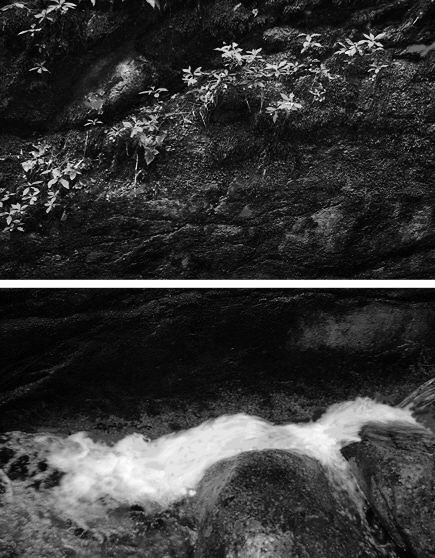
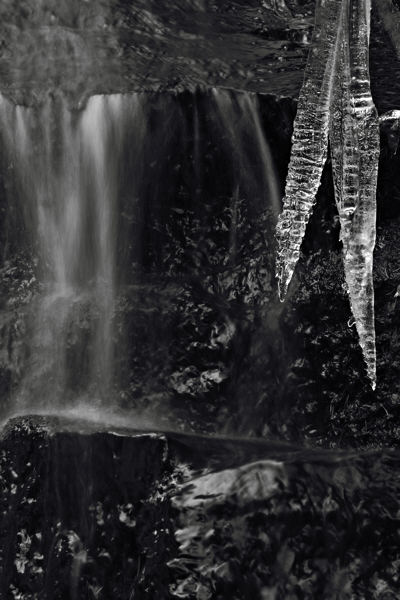
the-flume-_2-sd-upcontrast-split.jpg

Quotes for Saturday: On Seeing

Posted by Steve Durbin

October 20, 2007 5:06 pm

From The art of looking sideways, by Alan Fletcher.

I shut my eyes in order to see. - Paul Gauguin

It is only with the heart that one can see rightly. What is essential is invisible to the eye. - Antoine de Saint-Exupery

I paint what I know, not what I see. - Pablo Picasso

What you see is what you see. - Frank Stella

Seeing is not believing. Believing is seeing. - Robert Pirsig

9554b-400.jpg

difference in perception

Posted by Birgit Zipser

October 19, 2007 6:57 am

My friend Tolla from San Francisco came visiting the Dunes. Driving to the Lakeshore, he alerted me to a hawk. At the beach, I started doing my usual thing, imaging textures of sand, water and sky

texture.jpg

Continue reading difference in perception

Molotov Cocktail - II

Posted by Sunil Gangadharan

October 18, 2007 8:29 am

Some time back, I talked here on A&P about image appropriation and artists re-interpreting works of others to produce newer work. This week, I found myself in Gramercy looking over works of Sherrie Levine at Nyehaus. She has made a career that involves pure appropriation and raises questions on the nature and context around her appropriated perspective of original artworks. In her works, she transmogrifies an original, sometimes iconic piece of art into a somewhat exact replica subverting some form or theme in it to produce her own works. In a world of copyright protection, Sherrie’s works seems to be an in-your-face holler which screams that a piece of art once made may be the sole property of the artist and but it is available for further manipulation, exploration and expansion as soon as it is in the public realm. Although I will not quote the exact prices for the works at the gallery, I found most of the works that were priced in six figure ranges to be sold.

sl_after_mduchamp.JPG

Sherrie Levine, ‘Fountain (After Marcel Duchamp)’, 1991, Bronze, 14″ X 24″ X 14″

Oftentimes, I use ‘found’ images on the web. Even if I hate the use of the word ‘found’, I guess it seems appropriate for this discussion. I download them to my hard drive and let it sit and simmer for a period of time. I then permit my mind to lose/forget some of the image identifiers like who the image refers to, what was being conveyed in the image or where the image was taken etc. Three or six months later, I look at these images, re-interpret a select few in a social context that I find appropriate and paint from the image. In most paintings the contextual underpinning behind the painted face and original image do not have any parallels save the fact that the features match each other (to a certain degree). I continue to do so because the plethora of ‘found’ faces that I find online and off (magazines, books, sometimes my photographs etc.) gives me a vast sea of moods, expressions, emotions and countenances that I can then subvert to develop new perspectives (which may not have been intent of the original). Recently, I found a comment on my blog on this practice that asked me a question: “Is that right? Is this allowed?”  Even if I can glibly point people who ask me questions like this to the works of Sherrie Levine, Joy Garnett and Richard Prince, the real truth is that I am still searching for the answer. Comments?

Of course, here I am reminded of a one liner I stumbled upon online:

“Some people do, others Duchamp”.

Géricault’s The Raft of the Medusa (by Tree)

Posted by Steve Durbin

October 17, 2007 4:58 am

In June of 1816, the ship Medusa set sail with three other ships to the Senegalese port of Saint-Louis, which had been given to the French by the British as a show of good faith to the reinstated French king, Louis XVIII. The ship held nearly 400 people, including the new governor of Senegal and his soldiers and 160 crew members. The captain was Hugues Duroy de Chaumereys, a 53 year-old man who had not been to sea in twenty-five years and had never commanded a ship before.

Wanting to make good time, the Medusa stuck close to the African shoreline and quickly outpaced the other ships. Unfortunately, it was too close to shore and inevitably hit a sandbar. Attempts were made to throw overboard extra weight in the hope of raising the ship out of the muck and floating out with the tide, but de Chaumereys wouldn’t allow the crew to get rid of the cannons for fear of angering his constituents back in France.

Raft of the Medusa, Gericault

Continue reading Géricault’s The Raft of the Medusa (by Tree)

Which horses?

Posted by Steve Durbin

October 16, 2007 9:01 am

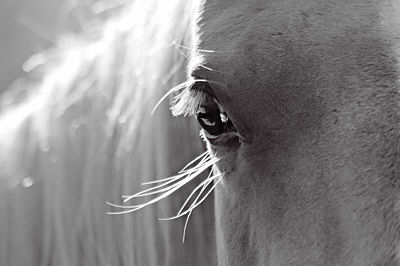
I’ve been continuing with my new project on horses, which has predictably wandered into a thicket of possibilities. I’m confident it will emerge at some point — though I daren’t say when — and when it does, it will necessarily be in some direction or other. Hopefully trailing a series with some coherence.

10130-450.jpg

But at the moment, I’m taking many different kinds of pictures. The very few I’ve put on my web site are a motley and incomplete assortment, determined more by (lack of) time available than anything else. The experience has me thinking about the nature of projects.

Continue reading Which horses?

Ready for Halloween

Posted by Jay

October 15, 2007 2:11 pm

That Damien Hirst is following me into my own house.

I decided to follow him a little and cook up something for Halloween, based on his diamond skull. The party store didn’t have anything in hard plastic, so I settled for a hockey mask, derived from some scary movie. I then spent too much on plastic rhinestones which I glued onto the mask during hours of granddad babysitting. It ended up like this:

damien-mask-with-me-10-15-07.jpg

Then I made a poster to hand out to treat or tricksters.
damien-umpteenth-poster-10-15-07.jpg
So, what are you doing for Halloween?

damien-poster-10-15-07.jpg