Posted by Sunil Gangadharan on January 30th, 2008
There is a certain cosmic element about large battles described in epics like the Iliad or the Mahabharata. Maybe the forces unleashed from the large seething masses of humanity numbering in the tens of thousands as they stand to square off in what could be the last day or night in their lives evokes out of control celestial bodies – or maybe it is the magnitude of destruction about to unfold while rational thought remains crucified at the battlefield entrance helplessly watching the bloodletting that ensues… I am not sure, but there is something other worldly about them that pricks our atavistic core. Childhood memories are fairly strong – or so neurologists say – it must be because our brain cells have not fully formed then and any available sliver of information is indelibly singed on our neurons… For some reason, to this day, I remember vicariously participating in the imaginary battles while the warring clans clashed under the overcast demeanor of Kurukshetra through comic books such as the Amar Chitra Katha…
One such scene from this epic tale unfolds with two very large armies about to face off each other over a vast battleground. Moments before the time of reckoning draws near and that first arrow rends the sky, one of the commanders experiences a sudden burst of self-doubt and starts a dialogue with his charioteer on the nature of humanity, the soul, our existence and filial duty. A striking tableau develops when his charioteer drives the chariot out to the midlines of the battle field and starts to explain the answers to some of the questions posed. The interesting exchange between the doubtful commander and his self assured charioteer is so powerful that it forms a separate section of the Mahabharata called the Gita. Though I would consider certain portions of the conversation between the two to be bit facile, a lot of the principles laid out in this conversation that took place thousands of years ago resonates even today.
Even if the words did prod my thinking in many ways, the aspect of the epic that was most retained in my mind from all those surreptitious nights of comic book mythology was the battle. This painting (below) is an attempt at trying to capture some those crucial moments before the impending battle. This scene is a familiar one and numerous Indian homes have a semblance of this tableau in some framed format. Owing to the scale and the gravity of the scene, I decided to try something large scale (though it was not really necessary) – I had not done anything so large before and the aspect of size in and of itself presented its own peculiar problems. Finished, the painting is about nine feet wide and six feet tall. I did make a mess of our basement completing the thing and am not sure how long that is going to take to clean the oil paint mish mash left on the floor. It took about two and a half months for me to go through the motions of the initial measurements, sketches, gesso ground and finally painting the canvas in three sections – the middle first, followed by the left and then the right side.

Sunil Gangadharan, ‘Everyman and the charioteer’, Oil on canvas, 101″ X 73″
Posted by Steve Durbin on January 29th, 2008
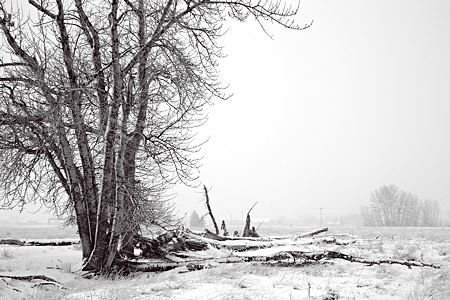
The cottonwood project I’ve embarked on is turning out to have some interesting differences from work I’ve done in the past. Which is a great thing in a project, something that I aim for but can’t predict. This one has has helped me not only to see cottonwoods (and other trees) in a new way, but also to be more aware of genre influences in picturing them. By genre I mean more or less familiar modes or types of photographing, such as landscape or portrait or documentary. Genres are similar in related arts, but painting, for example, has a different history of pictures made, and therefore we view a painted portrait differently than a photographic one.
more… »
Posted by Birgit Zipser on January 25th, 2008
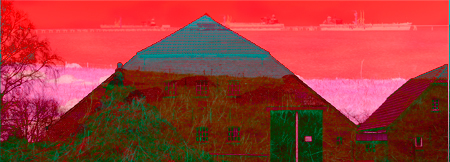
Recently, I spent my leisure time documenting where I lived as a child. As part of my day job, during that time, I used adobe photoshop to pseudocolor grey tone RBG images by cutting color channels in the ‘difference layer’ mode. Trying that trick on two of the Frisia pictures, I came up with the image above.
This, by comparison to the originals, garish image strikes a cord with me. I feel that it epitomizes my memory or feelings about North German Frisia and the coast line – brick farm houses with a hip roof line and oil tankers on a pier in the North Sea.
more… »
Posted by Steve Durbin on January 22nd, 2008
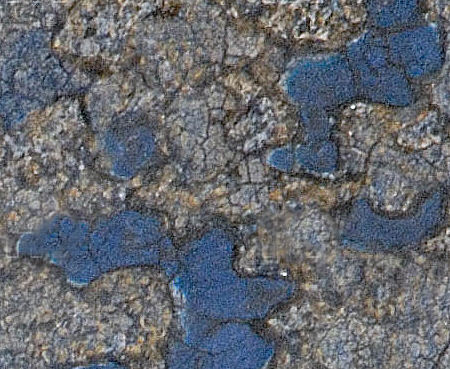
According to the saying, it’s either God or the Devil in the details. Either way, there seems to be an inherent fascination with closely observing the finest details in a subject. In museums, given opportunity, people will walk right up to a painting or photograph to examine it as closely as possible. This may happen even if the subject in itself is not so compelling. But when it is…
more… »
Posted by Steve Durbin on January 19th, 2008
I’ve recently read two fascinating books by cartoonist Scott McCloud: Understanding Comics and Making Comics. There is significant overlap, but I would choose the first for greater emphasis on art and graphic design, and the second for more emphasis on storytelling and practical matters. It was well worth reading both, even though I have no intention of drawing comics.
McCloud has a gift for simplifying without oversimplifying. For example, he neatly breaks down the choices to be made in writing with pictures into selection of moment, frame, image, word, and flow. He discusses these elements while keeping in mind the bigger picture, using them to help us understand what comics artists do and ways they can do it. They also serve in analyzing genre and cultural differences, as in his appreciation of Japanese manga. Especially interesting for me were discussions of closure–how we mentally fill in the transitions in a flow of discrete images–and the “masking effect”, the phenomenon of simple, abstractly drawn characters being more effective in leading us to identify with them, rather than observing them.
more… »
Posted by June Underwood on January 18th, 2008
On a windy frigid Wednesday this week, Jer and I visited the Archie Bray Foundation in Helena, Montana. The visit was frigid, fascinating, and raised some internal questions for me.
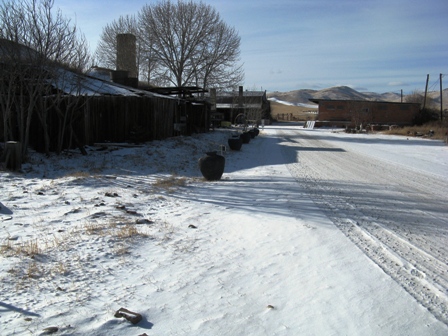
The Archie Bray is a ceramics workshop, foundation, and clay business, started by a brick manufacturer who was fascinated by art ceramics. According the website, the Archie Bray was founded “in 1951 by brickmaker Archie Bray, who intended it to be ‘a place to make available, for all who are seriously and sincerely interested in any of the branches of the ceramic arts, a fine place to work.’ Its primary mission is to provide an environment that stimulates creative work in ceramics.”
more… »
Posted by Sunil Gangadharan on January 17th, 2008
The United States Library of Congress put up thousands of archival pictures from the Great Depression to World War II on Flickr today. A classic collection of photos, they capture in full color an era generally seen and imagined in black-and-white.
The photographs convey a more innocent time when a country did not have to mount multi-million dollar campaigns to elect a president. These photos are in public domain and have no known copyright restrictions. The flickr library here.
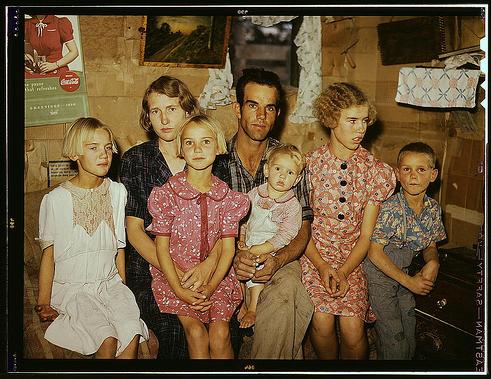
Jack Whinery and his family, homesteaders, Pie Town, New Mexico, Sept 1940, Photographed by Russell Lee
