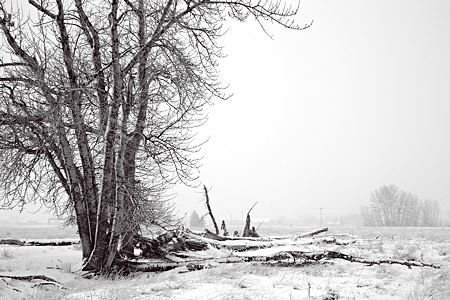
The cottonwood project I’ve embarked on is turning out to have some interesting differences from work I’ve done in the past. Which is a great thing in a project, something that I aim for but can’t predict. This one has has helped me not only to see cottonwoods (and other trees) in a new way, but also to be more aware of genre influences in picturing them. By genre I mean more or less familiar modes or types of photographing, such as landscape or portrait or documentary. Genres are similar in related arts, but painting, for example, has a different history of pictures made, and therefore we view a painted portrait differently than a photographic one.
The portrait genre comes up because cottonwoods here are often loners. Photographing one is altogether different from photographing in a crowded woods. The tree can be a very individual presence. Am I treating it disrespectfully if I don’t step back and show it in full? The image below is the widest I have at this location; somehow I seem to be resisting compositions with so much sky (definitely something to work on there). It’s not that I’m a pan-psychic concerned about the tree’s soul. It’s rather that the solitary setting makes me think about the tree differently, and I become aware that thinking of the photograph as the portrait of a tree tends to lead to different images than thinking of the photograph as a landscape that happens to feature a tree.
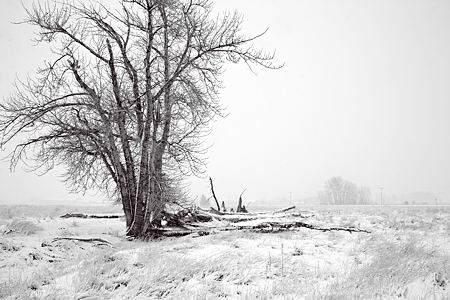
This particular veteran deserves not only respect but also pity, for it won’t be long before it goes the way of its immediate family on this seasonal creek (running–when it runs–just behind and to the left). I’ve passed this location almost every day for the last seven years, and at first there was a row of half a dozen or more trees there. They are now only remnant trunks on the ground. They’ve been gradually succumbing to lack of water, which is due partly to natural drought and partly to changes in upstream water usage. In a word, development.

Emphasizing the expected fate of the cottonwood moves the photograph towards documentary. Particularly in photography, there’s a long tradition of images showing environmental destruction, whether thoughtless (like soil loss in the Dust Bowl era) or intentional (like over-logging or suburban expansion). If one starts to see the photograph as falling into this genre, it casts the cottonwood as victim, tending to categorize and trivialize it, while directing ones emotional reaction elsewhere.
How do you see the cottonwood in the pictures here? Does one image seem better or more interesting? What genre feels most natural?


Steve,
I like the second image the best. The grass in the foreground emphasizes the filigree of the tree branches.
The poignancy of the third image are the juxtaposition of the ruined trees and the buildings in the background.
In times of hardship, I found solace in trees. Does it make me pan-psychic?
Steve,
The comparison with portraiture is apt and interesting. I like the first cottonwood best. Cottonwoods are fragile creatures — yet they live in the unfragile drought-ridden west. An interesting combination.
The vertical of the tree, with its tangle of limbs, against the horizontal of the downed wood, with all that detail, catches my attention and holds it.
The last photograph pulls me toward the housing development (?) in the background. While it looks like something of that is also present in the other two, it only jumps at me in the last one.
steve:
Arnold Boecklin comes to mind as your first and second photographs resemble something of his – or so I imagine.
I prefer the second. Maybe there’s more the sense of portraiture, air – a better balance of values.
While the well-taken photograph can encompass a number of intended meanings and emotions, I think that something obverse can also happen in that those qualities can be wrung out by the matter-of-factness of the image. The tree stands in a lightened environment, all gathered aesthetically and a feeling emerges from it, drawn by the reaction of your mentality to a stimulus. But beyond that we see a natural unfolding – a life and death cycle – that for me at least, has little emotional impact. I’m writing this at a wooden desk for goodness sake.
Jay,
No perception of natural unfolding? Does the fact that you write at a wooden desk rather than a plastic desk mean that you appreciate organically grown matter?
June,
Is your preference of the first image rooted in your preference for things large?
Birgit,
That’s an excellent point about the second having more of the grassy patches to play off the tree branches. I think I may be coming around to your preference. I liked the first because of the larger amount of detail visible in the down and standing trees, which may be partly the attraction for June, also.
Jay,
Thank you for your art historical perspective. I read a great deal — or at least looked at a lot of pictures in books — in the distant past, but it’s more fun and enlightening to go into it with a personal stake, seeing what others have done with similar material. Of course, there are limits to how far I can follow Boecklin, even if I wanted to. It’s not obvious here (though the strong atmospheric perspective implies it), but snowflakes are blowing nearly horizontal, so I would have trouble persuading any Diana to traipse lightly clad across the scene.
Birgit:
I do appreciate organically grown matter – especially at lunch time. My point about the desk is that a living oak was chopped down to make it, and the fact hardly matters to me. The entire framework of my local environment is composed of bits and pieces of murdered trees. Like pork or beef it’s all a commodity. It’s only when I see the commodity in terms of its self hood that an empathetic reaction comes up. This disconnect has always bothered me. I guess that I should have been a farmer, or a hunter who respects his prey, so better to mend this broken circle.
Steve:
The deal with Boecklin, who’s work is a marvel of integrated compositional variety, involves one image of a tree in a frozen landscape. I couldn’t google it up. Can you book a Diana in Bozeman? The university must have a dance program.
I will check as the culprit may be somebody with a name like Leuze.
Steve:
Maybe Leutze, The washington crossing the delaware guy. Something in Germanic snow depiction that rings a bell.
Haven’t mentioned the last image which I find carries best. The line of construction in the distance contrasts to the foreground rack in a number of ways – all of them good. To an extent it reminds me of Birgit’s superimposition.
it’s not photography but it is the original tree portraiture all the same: the first to conceptualize tree ‘portraits’ were John Crome of the Norwich School, and Constable. ‘plein air’ paintings are the closest thing to photography at this time, and they were very acurate to what they saw… at the same time in Germany was Caspar Friedrich, ‘oak in snow’..
Buckley,
Thanks for introducing me to Caspar Friedrich. His trees are fabulous, as well as his morning mists and scudding clouds
Thanks for the comment, Buckley, and for the pointer to Oak Tree in Snow
As it happens, it’s not the first time a tree of mine has reminded someone of Friedrich. Interesting, since I have tended to think of Friedrich in terms of wild, sublime spaces rather than more intimate tree portraits. But Birgit’s find a while back combines the two.
Birgit, Steve:
This is a painting I believe… I put it that way because, to me, it’s like a lithograph. It also has a strange variety in its appearance: the left side of the tree sports a straight limb which runs counter to the general curliness of the others. Would there be some symbolism here?
Jay, I don’t put much stock in any sexual symbolism here, I think it’s more about being a battered survivor than standing proud. Though the tree’s prominence is enhanced by the more intimate cropping, compared to nearly the same tree in another painting.
As far as believability, I find both of these rather too straight-trunked for oaks. More typical is another snowy portrait similar to my photographs.
Jay and Steve, I had forgotten about my earlier find of a Caspar Friedrich. Besides poor memory, my ambivalence about that picture may have contributed to my forgetfulness. Earlier, I had not so much appreciated the marvelous tree in the foreground but the view from the height over the water because I had been photographing similar views from high dunes over Lake Michigan.
My ambivalence about that picture, shown by Steve’s link, had to do with what I found to be an overpowering sweetness in color and design. The more moody pictures of mist and clouds from my recent google search, I found more appealing given my current sense of loss, leaving behind home and friends where I had spent the last 25 yrs.
All but one of the Michigan oaks reaching way up over the house that I just sold have tall, straight trunks. After loosing all upper limbs, hit by lightning or impaired by drought, I could imagine them to look like Friedrich’s oaks.
Steve:
As the patient said to the psychiatrist: “You’re the one showing me the dirty pictures!” Anyway, to sell the tree as a sex symbol, Caspar Friedrich would best gave shown it posing on silk sheets and with a garter adorning its trunk. Absent that, the atypicality of the offshoot branch makes me wonder. Time to peruse the exegesis I suppose.
Looked up Art Bozeman and there you are. A lot of artists in Bozeman, but i didn’t see you in the mix. And how did the stream-based project turn out?
Birgit:
I have an oak in the back yard that has withstood some serious slings and arrows over the years. However, it rises straight for at least thirty feet before bifurcating. And no curlicue business -no,no.
Hope you get re-established soon.