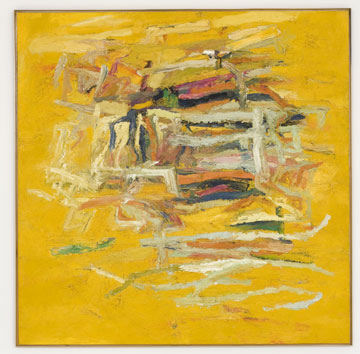
This post began life as a musing on Robert Irwin’s not permitting reproductions of his (abstract) paintings, detailed in a statement in the catalog of his recent show in San Diego. The catalog, of course, is loaded with photographs, including ones of his early paintings, though many could be considered installation views rather than “reproductions.” (As far as I can tell, Irwin has less objection to photographs of his more recent work, despite its contextual and perceptual nature, seemingly much less representable via photography.)
Continue reading Settling for inferior art
It appears I’ll be making good on my recent threat to re-activate my dormant Sourdough Trail project. But never fear, I do not intend to flood A&P with posts on that topic. In fact, because, through A&P, I’ve realized how blogs can be useful, I’ve decided to create a new one specifically focused on my project. I’m in no way attempting to create a popular or active site; I simply think the blog structure is appropriate to the nature of what I’m doing, namely a variation on the psychogeography project discussed here a few months ago (and which I still hope to carry out this year). This one has similar concerns, but will be in a familiar rather than a new setting, and will be over a longer time scale, months rather than days. In essence, I want to observe how my sense of that particular place evolves and how it relates to the photography I do there. But if you want to know more, visit Along Sourdough Trail.
Continue reading Sourdough Trail: a project blog
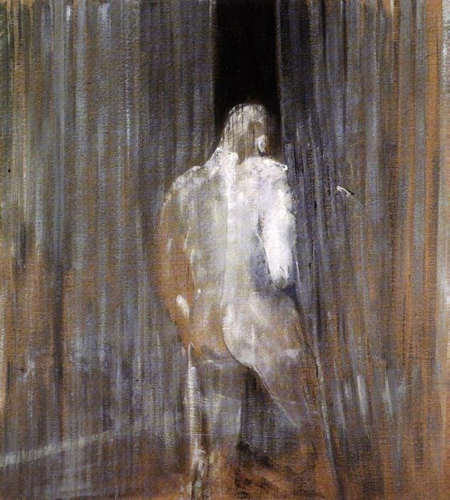
A Francis Bacon, according to an ad from Artprice in ft.com on March 31, 2008, fetches more money than a Rothko.
Here is a Bacon entitled Study from the human body
Contemporary artists also paint human anatomy. David Palmer paints human subjects engaged in movement. Jacob Collins paints human subjects more traditionally as stationary form.
A New York City dance group, the Ailey II dancers, enjoy popularity.

Body culture is rampant in the U.S. No longer just aimed at fitness, it advocates mindful movement. Amazon.com offers books such as

Is there a renewed interest in the HUMAN FORM? Will such painted human form express functional anatomy, mindful or any other kind of movement?
Posted by Jay
May 22, 2008 2:40 pm
In response to Birgit I went back to the original post in an attempt to temper the blur. Birgit has come to accept, perhaps embrace, the blurriness, while I have gone in the other direction. I tried the sharpening and blurring tools with unsatisfactory results and turned to the old standbys, poster and watercolor, in the artistic filters.
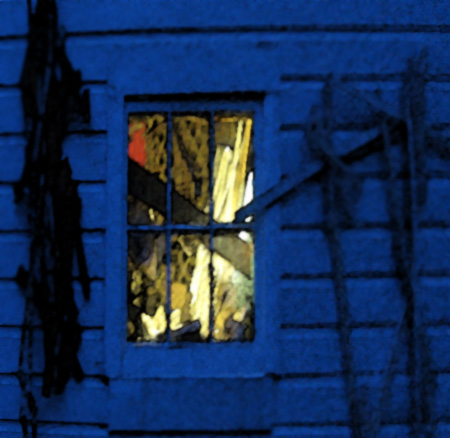
This is the image posterized. It’s alright but has lost the softness of the original.
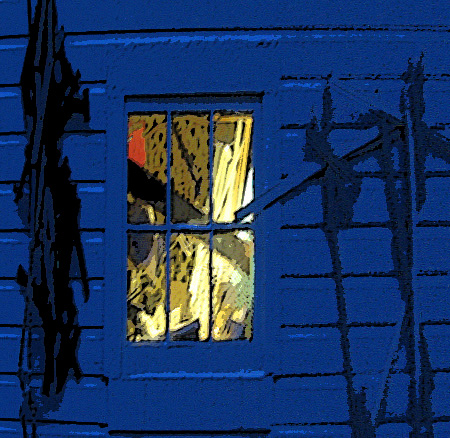
This is watercolored and has the usual silk screened look. The view through the window has gone flat.
This is it now; time to declare the first post the winner - or perhaps the least loser.
You Gloaming commentators have done a splendid job as com-mentors.
The right combination of detail, color and air seems to be at issue. In this version I have blurred the contents of the window, lightened the blues and have shown more of the right wall hanging. The left hanging cannot be retrieved without going back to the raw image. If, however, it is missed, then I’ll go back. That would be O.K. as one of my new year’s resolutions was to persevere.
?
Posted by Jay
May 21, 2008 9:34 am
In response to Steve’s comment about the red spot and the common positive about the blueness and negative about the blurriness, I took up residence last evening by the window and wall and waited. A series of exposures was required as I had but a vague memory of the original lighting conditions. Fortunately, a few came close.

I took the opportunity to make the blue a bit more theatrical and to emphasize the red spot in the window (a bag full of straps). I also cleaned up a number of distractions.
Is it better?
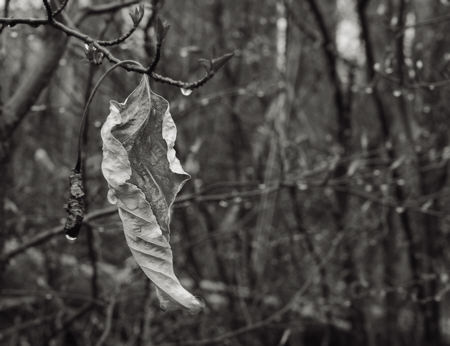
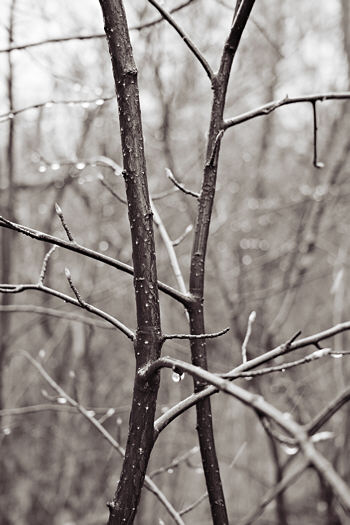
Leaves are beginning to come out here now, but branches were quite bare a week ago when I payed a visit to the strip of woods along Sourdough Trail. I’ve gone there occasionally through the winter, but much less frequently than I used to while actively engaged in that project (I never closed the books on it, but I’ve done very little in the last year). I’m thinking seriously of re-activating it. In any case, the new season seemed to call for a little experimentation.
Continue reading Focus and philosophy
You must forgive me if my language about SE McLoughlin Boulevard is a bit crude. I refer to the Boulevard, actually a long strip of sleazy or derelict buildings, warehouses, and defunct businesses, as “the armpit of Portland.” It is fairly unsightly and often smelly.
McLoughlin Boulevard was originally US Route 99E, part of the major north-south Pacific Highway through Oregon’s Willamette Valley to California. US Route 99E had its heyday just after WWII until it was eclipsed by Interstate 5, finished in 1966. Thereafter, the Boulevard, demoted into Oregon Route 99E, declined as Portland grew. The decomposition of the Boulevard, helped along by the curbing of the highway which restricted access to businesses, was accompanied by its enclosure by warehouses and industrial compounds, all gone slightly to seed. The farmland and residences that had been behind its initial length of business ventures got pretty much decimated over the years by other kinds of cheaply built warehouses and small factories.
I first learned about McLoughlin Boulevard because, when we moved to Portland 18 years ago, the Pendleton Mill End fabric store was located along it. I would take the bus to the Mill End store; to return home, I had to cross 8 lanes of heartless traffic and wait for the return bus in front of The Odysseus, a saloon and strip joint. I avoided looking at the patrons — and they avoided looking at me!
It was that kind of street — an American urban highway that makes used car lots look good.
Still, however sleezy the street has become, it still speaks to my love of urban archeology and history. Jer and I have been investigating the Springwater Corridor bicycle/pedestrian trail that has a new bridge over SE McLoughlin. The Trail runs along Johnson Creek, a major urban creek wont to flood in the wet season and stink in the dry. But between the creek and the biking trail, there is a pretty wondrous set of scenes through the Portland cityscape, including McLoughlin Boulevard.
Springwater Trail over McLouglin, Oil on board, 18 x 24″
Continue reading Painting Portland: McLoughlin Boulevard
Posted by Jay
May 14, 2008 2:06 pm
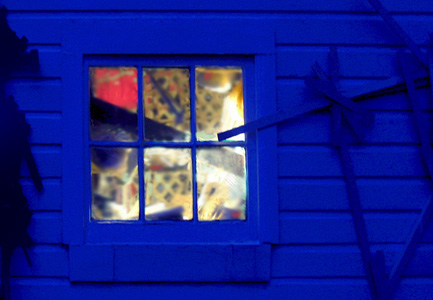
A light was burning in my workshop this last evening and there was something so Cotswoldish about the whole affair that I grabbed my camera in a race with the dwindling light.

I set the dial on aperture priority to avoid a flash exposure and the result was a little smeared. I can’t make up my mind about it. On the one hand it creates a sense of remove, but on the other, it appears simply blurry. Maybe a foggy quality would be better. What do you think?
When I started my Patina project on weathered auto paint and rock surfaces, I originally had in mind flat surfaces with intriguing designs and colors. But rocks aren’t smooth, so I soon began photographing rocks with some three-dimensionality, playing with the ambiguity between tone and color as surface properties or caused by orientation to the light.

Last week, just back from photographing a favorite rock face, a number of ideas relating to that work seemed to be coming together. Unfortunately, working with the images (just a little) since then, the ideas have muddled themselves rather than resolving. Despite some enticing ingredients, the fine soup is still mostly in my imagination. Here’s what’s stirring in the pot:
Continue reading Stone soup
Please help characterizing the genius of Henri Matisse’s painting from 1910.

Le Géranium made news because of its high price at a Sotheby’s auction on May 7, 2008.
Saving my screenshot as ‘for Web and Devices’ made the colors more brilliant. Has anyone seen the original? How bright are the colors?