
Hat, oil on 12 x 16 inch basswood panel more… »
Posts by Birgit Zipser
Studies of Sand in the Sleeping Bear Dunes
Early Morning Sun in the Hudson River
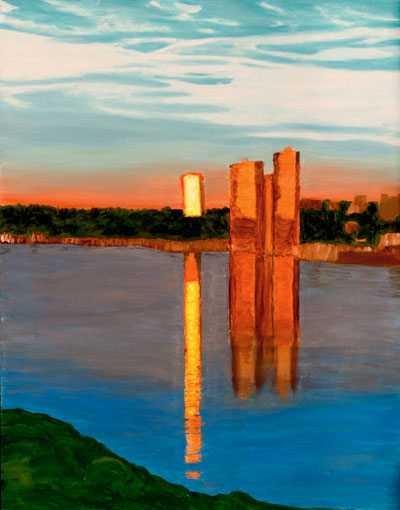
This painting captures the sunrise at the Hudson River in Manhattan. At 7:00 am, April 4th, the rays of the sun bounced off the buildings on the New Jersey side and then reflected within the Hudson itself. The early morning sun produced a different lighting than the midday sun in my Sleeping Bear Dune picture. In my Dune picture, the light across the picture is quite flat. Contrast is achieved by using bright complementary colors, red and green, blue and orange. more… »
Hot Day in the Dunes
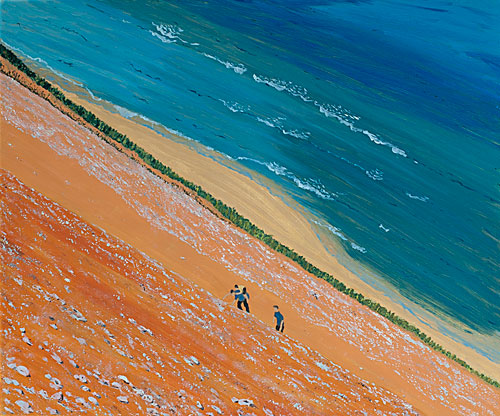
oil on basswood, 20 x 24 inches
Monet painted outdoors. A servant carried his paints and canvasses when he worked away from his house. At home, he diverted a stream to create his famous lily pond. A gardener kept its surface pristine, free of rotting leaves and insects.
Today, some painters work from photographs. Gerhard Richter painted from family photographs or obtained permission to paint from photographs in newspapers or journals. Peter Doig’s subjects, as FT.com puts it “ figures, buildings, landscapes – are stolen images (often carried around found for years on paper or in his head) knitted together into an imaginary world”.
Like other artists, I also prefer to paint from photos – recently, my own, while earlier, I made montages combining my own photos with images from the web. Enjoying hiking and photography, I now go out hunting for motifs that appeal to me. more… »
Drawing in Soho
Thinking that learning to draw the human figure might help me drawing the soft shapes of Michigan’s Sleeping Bear Dunes, I took lessons at springstudiosoho.com for the last few months. With charcoal on a 24 x36 inch pad, I drew poses that were held from 1 to 20 minutes. For the 20th anniversary of the studio, the drawing below was exhibited. Minerva Durham’s comment on taking the picture was: ‘You have moments’ which made me feel wonderful.
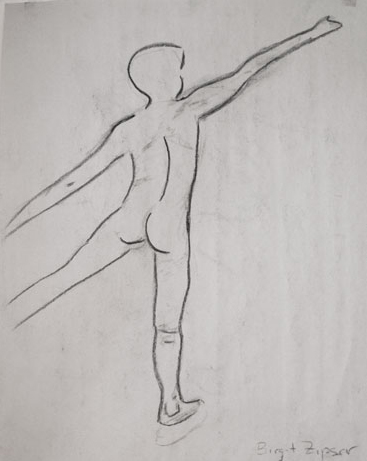
curved versus vertical
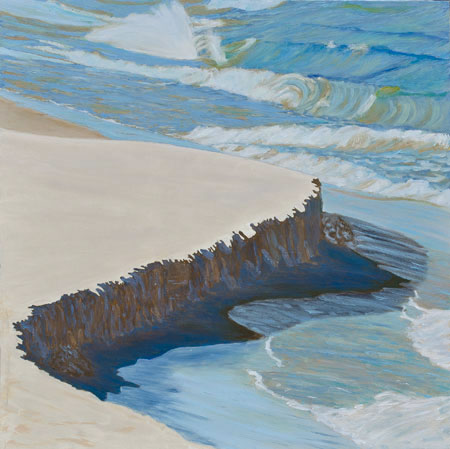
Sandy edge, 18 inch x 18 inch, oil on birchwood panel
Vertical seems to be an ephemeral property. A sandy edge molded by ice and waves will soon crumble. The jaggedness of the Great Teton Mountains will be replaced by rounded shapes demonstrated by the juxtaposed older Gros Ventre Mountains.
In much of the cosmos, there is a wealth of curved lines – the planets with their elliptical motion, our double Helix and the curvatures of our spine.
Why then is verticality inspirational with gothic and current architecture reaching into the sky?
perceptual versus conceptual viewing
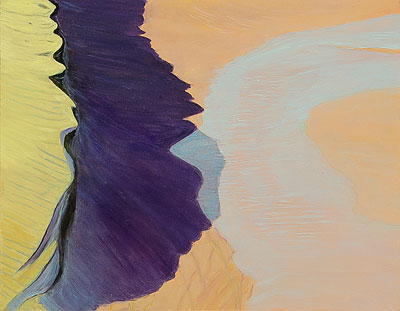
Birgit Zipser, watery fantasy, 11×14 inches, oil on panel
‘What I learned when I learned to draw’ by Adam Gopnick, The New Yorker, June 27th, discusses Jacob Collins‘ approach to drawing, which involves perceptual rather than conceptual viewing. The idea is to disengage from drawing symbols – conceptual schema of an arm or a face – and draw what you actually see. What you actually see may be a funny shape, a frog or an outline of a new African state, due to the play of light and shade on the body of the model. Thus, Gopnick was guided to learn to draw by ‘searching for strange shapes to break his symbol set’.
Jacob Collins in his “traditional realist revivalism” paints nudes, still lifes and landscapes. I may understand how the artist can draw a person modeling for him or cherries in a bowl by searching for shades and shapes rather than by using conceptual symbols. But doesn’t this approach break down when landscapes are drawn that contain water?
Water does not hold still for the slow musing approach to drawing that Adam Gopnick tells us Jacob Collins uses. My question is does Collins paint water using his symbol set of water?
Geometry and Zen-like meditative process
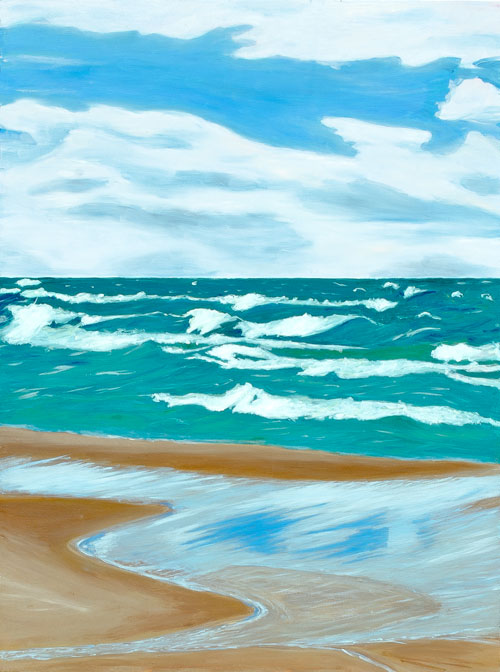
Blauer Fetzen, Birgit Zipser, oil on birch panel, 24 inches x 18 inches
The speakers of the last two talks at the Glen Arbor Art Association – Michael Letts on June 9, 2011 and Rachel Meginnes on June 23, 2011 – had things in common.
Both Michael Letts and Rachel Meginnes focus on geometrical patterns – Michael paints landscapes in abstract symbols and Rachel paints geometric shapes on cloth.
Both artists professed a zen-like attitude towards, what one may consider, tedious tasks. Michael paints ‘marks’ on his large geometrical sketches achieving a fabulous 3-D effect with shadows and highlights. Rachel, to generate the orthogonal grid underlying her painting, pulls threads out of fabric, usually cotton.
It was inspiring to listen to both discussing further development of their art – Michael Letts is experimenting with new motifs and Rachel Meginnes is developing a novel technology in fiber art.
Geometry and meditation are an ancient combination, an example are Mandalas, while the quest to developing new forms of art is an individual expression rather than one based on ancient belief systems.
