Posted by Karl Zipser on October 7th, 2007
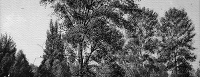
Painting From Life vs. From Photos
Do or die list for artists
Art News Blog posted a great list of survival tips for artists. The one that made that warm, resonating tone in my head was:
Inspiration is found in the studio while you are working. If you sit around waiting for inspiration before you start creating you will have about 15 paintings finished when you’re 60.
How true how true how true! The corollary: don’t let a lack of inspiration bother you if you are not actually doing art at that very moment.
What a fool I am sometimes, walking in the evening and wondering if I am on the right track with my artwork. When I am painting in the studio, I know I am. That’s the opinion that matters.
In the post at Art News Blog, Dion asks what I will ask here: do you have other artist survival wisdom to share?
Also by Karl:
How to Store Oil Paints
- Tube Trouble?
- The Greatest Invention Since the Paint Tube
How to Care for Brushes
- Turpentine Trouble?
- Storing Brushes
- Cleaning Brushes
- Shaping Brushes
- Transporting Brushes
Things to Ponder
- What is Art?
- How to Make Art Last?
- Is Art School Worthless?
- Why is it Difficult to be an Artist?
Frames and Framing
- To Frame or not to Frame?
- Internet as Frame
- In real life, the frame matters
Painting from Life vs. from Photos
- From Life by Zipser
- From Photos by Bodner
- From Life by Bartman
How to Blog
- How to Write the Perfect Blog Post?
- “Bloggers have to Earn the Right to be Read”
- How Should Artists Blog?
- Can You Create in Public?
Posted by Karl Zipser on September 21st, 2007
The problem with the blog is fixed and we are back in business :-)
Posted by Karl Zipser on September 3rd, 2007
Painting From Life vs. From Photos

I first posted this interview a year ago. Dan Bodner has continued with this work. A follow-up interview will appear soon.
To paint from a photograph is inherently different than painting from life. Some artists avoid photos, others use them, perhaps covertly, for practical reasons. But to American artist Dan Bodner, painting from photos is not merely a technique, but a way to focus on his role as an artist. I interviewed Bodner at his studio in Amsterdam.
Question: When you work from photographs, do you ever ask yourself, what is the point of making the painting, when the image already exists in the photo?
Bodner: No. A photo is a record of a moment that has passed, a dead moment. I don’t feel that I own the image as a photograph until I paint it as a painting. The photo itself always refers to the past. But a painting of the photo is a creation, which goes on living. The painting defines its own continuing moment in time.
Question: Does painting go beyond the goal of simply making an image?
Bodner: What painting is for me is part of human desire. Every kid smears his food, or shit, and that is really connected to what painting is. A kid makes a mark and has the satisfaction of knowing “I made this and it will stay there.” For an adult I think it is connected to fear of death, which is innate. And it is connected to the desire to procreate. As you get older it gets existential, of course. To take things out of you and put them into the world, there is an absolute satisfaction in that. To do this from a photo emphasizes the act of creation, bringing life to something dead.
____
In the next post more about how Dan Bodner uses photos, his subjects and his methods
Posted by Karl Zipser on August 27th, 2007
A photograph offers so many (and so obvious) advantages as a source for painting as to raise the question: why would any responsible person even consider painting a landscape outdoors?
I’ve been thinking about this while painting outside lately. I think the answer comes down to this: I need to ask, what is it that I am painting when I paint a landscape?
Is it the landscape?
Or is it my being there, my reaction to the landscape? more… »
Posted by Karl Zipser on August 20th, 2007
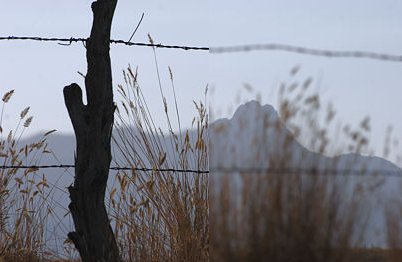
Last week Steve pointed out that a lens-based optical system like a camera or the eye can only focus at one field of depth at a time — meaning, as some sample images he presented illustrated, that other parts of the scene will be out of focus. The images Steve presented were of a landscape. In one image, some plants in the foreground were in focus, whereas a distant mountain was a blur. In the second image, the mountain was in focus, the foreground a blur. [Here I have combined them in one image.] Why, Steve asked for the original images, did painters — at least before the invention of photography — not paint the blur like this? More generally, why don’t artists paint what they see? more… »
Posted by Karl Zipser on August 19th, 2007
Sunil‘s post Art, life: Separate or unified? raised the issue of whether an artist should try to be an artist all of the time. I commented that doing art requires intense observation and sensitivity — which is obvious. What is less obvious is that observation coupled with sensitivity are another way of saying “emotional reactivity.” That is, an insignificant input — the curve of a leaf — can cause a disproportionately large emotional output (that looks beautiful!!!!!) which, coupled with the act of painting, allows the artist to make the brushstroke that the moment requires.
Emotional reactivity is essential for making art, but out of the art-making process, it can be annoying, disruptive, counter-productive. The soldier and the policeman are trained not to have emotional reactivity, but the artist needs to develop it, harness it. The challenge for the artist it to be able to switch it on and off at the right moments.
There are the simply structural solutions for getting out of the art mode: don’t go to the studio on off-days, turn the pictures to the wall. The psychological solutions are more subtle: don’t think about that difficult painting or series at the wrong moments.
What do you do to take a break from art? Is it easier to get into “art mode” or to get out of it?
Posted by Karl Zipser on August 13th, 2007
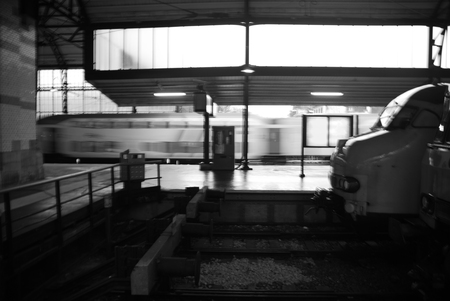
This photo of the train station in Haarlem has always caught my attention. In trying to figure out why, I noticed that the images contains blur in three flavors: blur because of movement, in the case of the passing train; blur in the case of an area out of focus, as with the distant cityscape; blur because of a translucent surface, as with the station windows.
Each of these elements of blur contributes to the impact of the image. The passing train is captured but transformed to something beyond our reach in the still reference frame. The sense of being inside the station is heightened by both the way the windows diffuse the light, and by the blur of the exterior space. The combination intensifies the feeling of being in a particular place at a particular moment, separated from the rest of the world by distance, glass, and velocity.
All of these elements of blur were unintentional. Their joint effect I only realized months after making the image, but the insight of the power of blur is something I can compose with in the future.
Do you have an example of blur in a photo which contributes to the impact of the image?
