[ View menu ]

across the arts


Light, dark, figure, ground

Posted by Steve Durbin

July 1, 2008 9:26 am

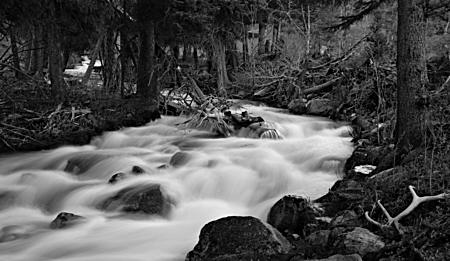
I recently noticed that I was making some images that had a reversed figure/ground relationship, in terms of lightness. That is, the main subject was light with a darker surrounding, rather than the more common dark with a lighter surrounding. For example, compare the first picture with the one below it, which I showed last week.

13682-450.jpg

Continue reading Light, dark, figure, ground

More negative

Posted by Steve Durbin

June 24, 2008 2:19 pm

As mentioned last week, I’ve been re-examining my photography in terms of some ideas from Japanese aesthetics. In practical terms, that means I’ve been going out and looking differently at subjects. For example, I’ve tried to be more aware of views involving negative space along Sourdough Trail, my main project of the moment.

13344-450.jpg

Continue reading More negative

In praise of shadows

Posted by Steve Durbin

June 17, 2008 2:44 pm

Old musings on recent photography have led to the resurrection of a completely different series I thought I’d given up on. Just last week I deleted a draft from March that I had started in excitement, but never finished because I couldn’t make the pictures work.

11613-450.jpg

The thoughts were on Japanese aesthetics, and the abandoned series was a rather minimalistic one, captured in all of 15 minutes near the start of a Yellowstone outing during which I later busted my aging ski gear, cutting the trip short (I managed to limp out with frequent falls, discovering in the process that it’s not easy getting up from soft, deep snow when your skis are higher than you are).

Continue reading In praise of shadows

Is an Academic Degree really necessary for a real painter?

Posted by Angela Ferreira

June 15, 2008 11:20 am

Raphael

Looking back through the years, I do not remember when I started painting with oils and watercolors… maybe I was about 13. To be honest mostly of I know today has come from my own experiences of try and error.

To me, making a painting was never an issue but something that happens naturally with whatever materials come to my hands. Oils are my favorites, but recently I’ve been painting in a very quick method and found out that a mixture of acrylics, oils, glitter and others mediums work better for my new style.

In the past 3 years I decided to do a Fine Art degree as a nice “add on” to my previous qualifications. To my disappointment, I have learn nothing new but of a chaotic, hypocrite and delusional world from the Art teachers.

If you an artist with already some success and experience I recommend you to aim higher and not to go back to an educational institution. You see, despite your good intentions you setting yourself back and giving your own murder sentence to the chances of being ‘stepped on’ and muffled by the tutors, who also called themselves artists. You must have no previous artistic experience because no matter how you try to please and befriend this so called “artist teachers” you will always be seen as a threat rather than a student.

Unfortunately we live in a world that demands all this qualifications to be taken seriously. I have learned from my own mistakes, maybe because I was a bit naïve, full of dreams and hopes that a new qualification would push my career further, but realize that I brought this to myself to the point I had nothing but verbal abuse, bullying, harassment, intimidation and discrimination from lecturers. In the end I felt from as high I dreamed and have gain nothing but a new pretty BA words in my cv and an awful demoralizing experience I must rather forget!

Waiting Godot

More new painting in my redesigned website www.magicpaintings.com

Collegiality and Independence: Ruminations on being a visual artist

Posted by June Underwood

June 13, 2008 1:35 pm

The other day I was turned down as an applicant to a local art co-op. I was applying as a painter, not a textile artist, had made the first cut, and was asked in for an interview. After the interview, the group decided I should “try again next year.”

Aside from the obvious reasons for the rejection (the quality of the work itself and splits of taste within the co-op group), I realized that I had gone to the interview unprepared for what I found.

The Co-op saw the interview as an application for an exhibit or a job; I saw it as an act of collegiality and a conversation.

Here’s a review of the process and my thinking about it.

I was told to bring some of my “most recent work” (which I interpreted as “most raw”), so I pulled out a pleine aire, a few days old.

quiznosubsprinevillew.jpg

Quiznos Subs, Prineville, Oregon

Continue reading Collegiality and Independence: Ruminations on being a visual artist

Settling for inferior art

Posted by Steve Durbin

May 29, 2008 7:15 am

This post began life as a musing on Robert Irwin’s not permitting reproductions of his (abstract) paintings, detailed in a statement in the catalog of his recent show in San Diego. The catalog, of course, is loaded with photographs, including ones of his early paintings, though many could be considered installation views rather than “reproductions.” (As far as I can tell, Irwin has less objection to photographs of his more recent work, despite its contextual and perceptual nature, seemingly much less representable via photography.)

robertirwin-untitled.jpg

Continue reading Settling for inferior art

Focus and philosophy

Posted by Steve Durbin

May 20, 2008 10:49 am

Leaves are beginning to come out here now, but branches were quite bare a week ago when I payed a visit to the strip of woods along Sourdough Trail. I’ve gone there occasionally through the winter, but much less frequently than I used to while actively engaged in that project (I never closed the books on it, but I’ve done very little in the last year). I’m thinking seriously of re-activating it. In any case, the new season seemed to call for a little experimentation.

13046-twigs-f56.jpg

Continue reading Focus and philosophy

Comparing Media: Intaglio, Quilting, and Language

Posted by June Underwood

May 3, 2008 6:35 pm

In a recent critique session of quilted art, conducted by two “fine” artists, I found myself having a “eureka” moment. Then, a few days ago, Jay and Melanie’s discussion of Jay’s intaglio technique on board and foamcore (published prior to this post) pushed some of my insights a bit further. All this was added into a melange of thinking I’ve been doing about where I am in relation to quilted art and painted art.

The eureka moment came through the phrase used by one of the fine art critics: the phrase was “working the surface.” “Working the surface” in the traditional fine arts means adding, deleting, scraping, underpainting and overpainting, sanding, gouging — all the kinds of things one can do that either uncover and/or add to a planar surface. It seems clear to me that Jay’s process of working his boards and foamcore are fine examples of “working the surface.”

With quilted art, “working the surface” seems to show up in two ways. One is what is called “surface design,” which basically alters the flat plane, by dyeing it, laying rust on it, discharging (bleaching) it, monoprinting on it, and even digging into it, tearing and unraveling the threadwork. This work sometimes adds texture (especially with elements applied to the surface (applique) or taken away from it (”cutwork” or just plain gouging holes). These kinds of working of the plane are singular, patterned for the effect in a particular work, not meant to be turned into a commercial design for fabric (the original use of “surface design” had a strong commercial element.) The other part of working the surface with textiles is the work of embroidery and quilted lines that make for a frieze effect; when stitches are pushed through the two layers of fabric and the in-between batting or wadding, the stitched line makes an indentation, beside which the surface becomes raised by the pushed-aside materials.

I have never heard the phrase, “working the surface” applied to quilted art before, but when I heard that and then saw the intricacies of Jay’s working of his surfaces, I realized that the language may give me new insights into what can be done with quilted art.

At the critique, the guest “critics” (very kind observant folks) looked at two pieces I had brought, comparing them.

The first was one you’ve seen before: Mrs. Willard Waltzes with the Wisteria, 76 x 61″, 2003, hand dyed and painted cotton, embroiderie perse with computer-generated prints, and dyed overlays.

mrswwaltzesw.jpg

mrswwaltzesdetw.jpg detail

Continue reading Comparing Media: Intaglio, Quilting, and Language

Art, Intelligence, Words and Bears

Posted by Steve Durbin

April 29, 2008 8:52 am

I’ve often been asked whether there is any relation between my interest in art and my work in artificial intelligence (AI). At a practical level, where my work is aimed at making computers more “intelligent,” I’d say the connection is tenuous at best. But at a more philosophical level, AI is essentially cognitive science, which like art is intimately concerned with human perception. Questions about how visual perception works, from retinal stimulation to conceptual understanding and emotional response, are not only central to cognitive science, but probably its best-studied example. I think learning about the psychology of perception can be of value to artists, though certainly many care for it not at all, even if, through training or intuition, they are using its teachings anyway. I think a more explicit knowledge becomes especially useful in applied areas, such as how to design a pleasing and useful object of some sort, or how to alter a graphic or put words with it to achieve some desired effect.

Continue reading Art, Intelligence, Words and Bears

Critiques: Some Thoughts

Posted by June Underwood

April 17, 2008 11:17 pm

critique01_db.jpgArchitecture Students Present their designs at the Savannah College of Art and Design

On the Ragged Cloth Cafe blog, I wrote about the nature of critiques, mostly summarizing James Elkins’ Why Art Cannot Be Taught; I won’t go into his ideas — you can read a summary on Ragged Cloth if you are interested — but I have been evolving my own thoughts on the subject.

Last Tuesday, in a painting class, the instructor failed to show. We were scheduled for a long critique session, and, being self-sufficient and interested in each other’s art, we continued with the critique ourselves. The critiques in this class had always been group affairs, ones in which the instructor led but did not direct the conversation. So we could easily emulate his processes.

Elkins’ speaks of critiques as fraught with dangers, having multiple ways to can go awry, and he loves the fascinating explications of human nature and thought in action which critiques provide (which is also why they are fraught with dangers).

Some of the danger, as I see it, lies in the fact that while the artist wants information that will help improve her work (and also is hoping to impress the viewers with her artistic abilities and insights), the “panelists” — students or professionals in the field — are almost always struggling to explain what they are seeing. If the panelists (in our case, the other students) are to be successful, they must have insights into the work they are looking at, and then find ways to articulate those insights so that the artist will benefit. It’s a struggle on both sides, since the artist has to be totally alert to the thoughts of the panelists — sorting out, when comments seem confused, whether the speaker are struggling to find her idea, struggling with expressing the idea, or struggling with explaining the idea in terms that will benefit the artist.

And when comments are not confused and the panelist clearly states an opinion or question or makes a comment, the artist has to sort out whether the comment comes out of a concern which the panelist has with his own work or obsession or whether it is truly applicable to the art that is being presented. Other kinds of interface problems can occur — the panelists may get off course and meander into digressions; they may find themselves hostile or overly sympathetic, and so forth.

All this is outside the sometimes awful experience of attack critiques, those legendary events that leave the artist a quivering heap of jelly. I think they arise not out of art or articulation or ideas, but an entirely different culture and one that I haven’t encountered.

Nevertheless, critiques, as I know them, are a substantial and important part of my art education.

In this critique, I limited myself to three works, a “straight” naive/realistic painting of a nearby street scene, a more complex and abstracted view of a warehouse area from above, and a semi-abstract “forest” scene.

hawthorne20thw.jpg

Hawthorne & SE 20th, Mid April, 12 x 16,” oil on board

warehousewithhouse.jpg

McLoughlin Warehouse District, Mid April. 12 x 16,” oil on board

forestabstractfixedw.jpg

Forest Scene, mid-April, 12 x 16,” oil on board

I was interested in people’s responses to three very different kinds of paintings, all done within a couple weeks of one another. I was particularly interested in this group’s comments, because they are very articulate about what they see. I am somewhat intimidated by their ability to explain what they see, what they like, and how they read a canvas. So I am learning as I listen to them, not just about my art, but about talking about art in understandable ways.

The responses to the three pieces were that they enjoyed the corny street scene, that the colors in the warehouse piece were good (the reproduction here doesn’t do them justice) and that the composition in that one was excellent (they liked the water tower, just as they liked the old lady crossing 2oth Street), and finally that the last was puzzling, interesting, weird, Hansel-and-Gretel-ish,or maybe smelt of Hieronymous Bosch. At any rate, the last, for them, seemed to be coming out of some inner state, whereas the other two were evidences of external scenes. There were other comments but these are the ones that I remember most clearly.

But what the group really wanted to know was where I was going in terms of this last piece. Was this a direction I intended to pursue? What would I be painting next?

I talked for a while, and then realized that the the group consists primarily of abstracting landscape painters — people who take their references from landscape and then work those references into abstractions. Here’s David Trowbridge’s work. David is an accomplished artist, currently exhibiting in downtown Portland, whose work I admire. It is fairly representative of the working process and product of most of the group members.

davidsheffield_xi.jpg
David Trowbridge, Sheffield XI, acrylic and spray paint on plywood, 35.5 x 48″

So when I debriefed myself about the nature of the critique, I had to consider that the abstract attracted the panelist’s attention most because they themselves did art like that. And the questions about where I was going from there were both out of thinking this might be a new path for me, but also a function of knowing that the class was coming close to its conclusion. We were all going to have to decide “where we were going.” I did ask directly and firmly, at least twice at the conclusion of the session, what suggestions they would have for me. They had none.

So my question is, what kinds of critiques have you had that left you with interesting debriefings? Why were the critiques useful? What unanswered questions were there? Do you believe in critiques — if so, what are their limitations?

Data-driven art

Posted by Steve Durbin

March 30, 2008 12:06 pm

An article in Wired magazine, Frame That Spam! Data-Crunching Artists Transform the World of Information, introduces several artists who transform found data into artistic creations. Their craft lies in the choice of data source to operate on, and the construction of an algorithm that manipulates the data to give results that are aethestically pleasing and/or conceptually interesting.

The art could be three-dimensional, as with the creations of Alex Dragulescu, though his objects are, as far as I can tell, not actually constructed, but merely rendered as images.

dragulescu-pt_pseudo.jpg

dragulescu-pt_malwarez.jpg

dragulescu-pt_extrusions.jpg

Continue reading Data-driven art

Imperfection

Posted by Steve Durbin

March 18, 2008 5:11 am

Francis Bacon wrote: “There is no excellent beauty that hath not some strangeness in the proportion.” Just recently, by one of those common coincidences, I’ve seen this idea compellingly expressed in different contexts, though both related to art. One is the passage below from a Laurie Fendrich interview, which I had occasion to quote in a comment elsewhere.

The beauty in abstraction comes when abstract painters create marks, shapes, forms, and colors that tap into unseen but universal, psychologically beautiful forms and shapes. The marks and colors, since they range so widely in painting, bring to abstract paintings the poignancy of the individuality of each human being. I said I’m almost a complete Platonist, but I’m not a complete Platonist. I think deviation, or falling away from perfect form, is what makes something profoundly beautiful. Perfect beauty is different from profound beauty; the latter is always partly tragic and has something wrong with it, always, and without exception. The “something wrong” part is the handedness, or the individual way a painter paints, which points to the fleetingness of our lives. But it’s really simpler—beauty either is or isn’t, once a painting is done. If it knocks the socks off someone who sees it, and that someone is a deep and sensitive person, that’s the test. Period.

Continue reading Imperfection