You must forgive me if my language about SE McLoughlin Boulevard is a bit crude. I refer to the Boulevard, actually a long strip of sleazy or derelict buildings, warehouses, and defunct businesses, as “the armpit of Portland.” It is fairly unsightly and often smelly.
McLoughlin Boulevard was originally US Route 99E, part of the major north-south Pacific Highway through Oregon’s Willamette Valley to California. US Route 99E had its heyday just after WWII until it was eclipsed by Interstate 5, finished in 1966. Thereafter, the Boulevard, demoted into Oregon Route 99E, declined as Portland grew. The decomposition of the Boulevard, helped along by the curbing of the highway which restricted access to businesses, was accompanied by its enclosure by warehouses and industrial compounds, all gone slightly to seed. The farmland and residences that had been behind its initial length of business ventures got pretty much decimated over the years by other kinds of cheaply built warehouses and small factories.
I first learned about McLoughlin Boulevard because, when we moved to Portland 18 years ago, the Pendleton Mill End fabric store was located along it. I would take the bus to the Mill End store; to return home, I had to cross 8 lanes of heartless traffic and wait for the return bus in front of The Odysseus, a saloon and strip joint. I avoided looking at the patrons — and they avoided looking at me!
It was that kind of street — an American urban highway that makes used car lots look good.
Still, however sleezy the street has become, it still speaks to my love of urban archeology and history. Jer and I have been investigating the Springwater Corridor bicycle/pedestrian trail that has a new bridge over SE McLoughlin. The Trail runs along Johnson Creek, a major urban creek wont to flood in the wet season and stink in the dry. But between the creek and the biking trail, there is a pretty wondrous set of scenes through the Portland cityscape, including McLoughlin Boulevard.
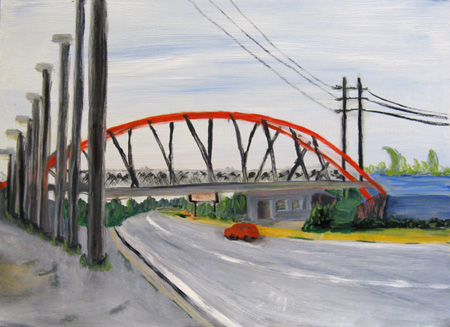
Springwater Trail over McLouglin, Oil on board, 18 x 24″
Continue reading Painting Portland: McLoughlin Boulevard
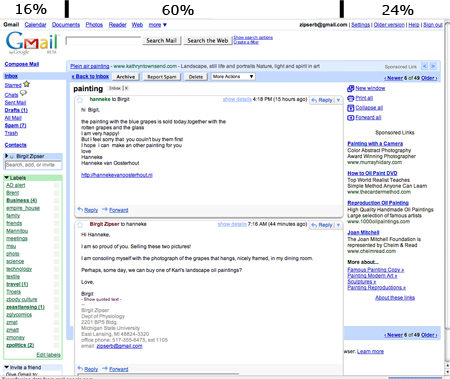
‘The right aspect of a web page has a stronger impact on our mind than the left aspect’ is a notion adopted by the advertising world, as I recently learned from one of Steve’s comments.This made me look at the real estate on the web.
For safety, I recently switched to gmail because I lost all my archived email from my apple mail box after innocently agreeing to update the mail box.
Let us look at one of my gmail threads:

Continue reading Real Estate on the Web
February 27, 2008 5:17 pm
as we are told in yesterday’s headline of the Columbia Daily Spectator reporting on the opening of an HBO documentary reminding us of the long gestation of Christo and Jeanne-Claude’s Saffron Gates in Central Park, New York City?
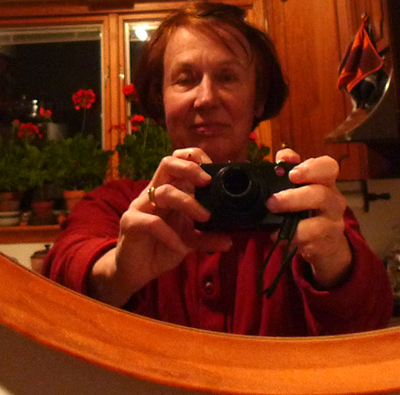
Or does Saffron spell enthusiasm? Here is my snapshot of Saffron cloth billowing in the wind on a snow-free day, February 2005.

Continue reading Does Saffron Spell Dissent
November 13, 2007 1:45 am

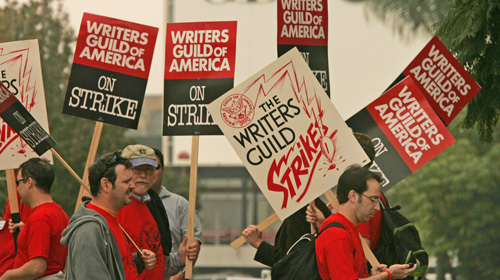
I assume most of you have heard about the WGA (Writers Guild of America) strike. I’m not sure how much attention it gets in other parts of the country (or the world, for that matter), but here in Los Angeles it’s a big story. This is after all an entertainment industry town, and the effects of the strike can be felt in every part of our local economy. My wife is a writer and a WGA member, as are many of our friends.
The strike has come about because of a disagreement between the corporations who own the movie and tv studios and the writers who create their content over how much, if at all, the writers should be compensated for their creative work. The writers contend that they should be getting a slightly larger share from the sale of DVDs of the movies they wrote. From the sale of a $28.95 DVD, the writer of the movie currently gets 4 cents, or as comedian Tim Kazurinsky points out, that ’s 4 cents out of 2,895 cents. The writers are asking for 8 cents.
But a bigger issue, and possibly the main one, is that the networks and studios want to pay the writers nothing, that’s ZERO $, for tv shows and movies that they (the corporations) post on their web sites. The corporations claim that these streaming videos are “promotional”, and that they shouldn’t have to compensate the writers for posting them. But these “promotional” shows have commercials, just like any regular tv show, and are a huge source of income for the studios. They just want to keep it all for themselves.
As Mark Harris notes in his Entertainment Weekly Online column, “Why the Striking Writers Are Right”:
“The problem with this position is that writers deserve a share of revenue for material they help to create. Not a share only if the revenue is really, really a lot. A share, period. If it turns out that streaming video is a goldmine, then both sides will get a lot of money. If it turns out not to be, they’ll get less. Corporations are fond of reminding their employees that they’re all a ‘’family'’ during tough times. But when families sit down to dinner, Dad doesn’t get to say, ‘’I'm gonna eat until I decide I’m full, and then we’ll see if there’s anything left for the rest of you.'’ The right of a writer to earn money from work that continues to generate revenue cannot be dependent on how comfy studio and network heads are with the fullness of their own coffers.”
The studios are responding to the strike by showing reruns, and more reality and talk shows. But many of the more popular talk shows themselves will have to be reruns, since people like David Letterman and Jay Leno don’t come up with all those clever lines off the tops of their heads. They are created by a staff of, you guessed it, writers. To their credit, both Leno and Letterman are supporting the writers’ position in this dispute.
For the personal reasons mentioned above, and also on principle, as an artist, I’m siding with the writers as well. It seems obvious to me that the people who profit from the success of a creative product should include the artists who actually created it, not just the executives who made the phone calls and brokered the deals. I don’t watch a whole lot of tv to begin with, but until this strike is over I’m not planning on watching any. I’m going to vote with my remote, and say no to corporate greed. I hope many other people do the same.
==============
Here are a couple of videos about the strike that you might find interesting:
Tim Kazurinsky on WGN
the writers of The Office


Sandy Wenderhold is the CEO of Sansyl, a major adult media company based near Amsterdam. I interviewed her via email.
Karl: An influential New York art dealer remarked here on Art & Perception that art about sex — “painted pornography” — sells especially well in galleries. Is that surprising to you?
Sandy: Sex is the biggest thing people react on. You have a lot of people that love football or fishing or whatever. But almost everybody reacts on sex, so it is logical that it is a big thing in the art world. Continue reading Interview with porn CEO Sandy Wenderhold

A blog like Art & Perception is, in some ways, a substitute for the local café. The ability to discuss art with people around the world compensates, at least in part, for the loss of the immediacy of face-to-face contact. But it’s not a complete substitute. Direct interaction is still important for many reasons, and consequently there is a need for ways to facilitate it by letting people know about opportunities to meet each other, to learn, and to see art.
Few of us are so plugged in to our local art scene that we are aware of everything that’s going on in terms of shows, openings, talks, social events, etc. The newspaper may list major events, typically those for which an ardent volunteer or a motivated gallery has written a press release. In the case of my hometown of Bozeman, Montana, there are several places on the web that have listings, but judging from what is there, I suspect they are little known or used. Most of what is happening is invisible to the public. Sometimes that’s desired, though certainly not always.
But more important than the events themselves is the community that could potentially form around them. The past quickly slips into oblivion, and there is no convenient forum for the remembering, discussing, reviewing, proposing that might be engendered.
Continue reading Local art blog
September 6, 2007 6:36 am
I posted sometime back on living the art life and how it would be great to have one’s personality be in tune with art such that the art and person blossom to their fullest… I was thinking about the art life a lot after reading reports on art done by people of questionable backgrounds (some of whose victims are now demanding that the artworks be rescinded and not be considered works of art). Continue reading Art, life: Separate or unified - II

It’s that hair-pulling but hopefully insightful time when I have to write an Artist’s Statement. I’ve done this before for particular projects or shows, but this is the first time I’ve tried to write a general statement about myself as an artist. The purpose is to provide information to interested visitors at the gallery I’ve recently joined. So my audience is the general public, or at least that part which would visit an art gallery. I feel that’s quite a different audience from other artists (like you all), in turn different from a narrower group, such as photographers working in black and white.
I take the statement very seriously as a way not only to communicate, but for me to consider what is really important, perhaps defining, about my artistic endeavor. The tone of it is critical. I don’t want to be too “artsy” or intellectual, nor do I want to condescend. I want it to be straightforward, but at the same time I want it to entice and suggest rather than answer all questions. It needs to have a personal voice, to sound like something I would say, and ideally not like something anyone else would say. This is what I’ve got so far:
Continue reading Statement time (final update)
I had a very successful Photo Lucida with my contra dance project. The consensus after 4 days of reviews, with some of the top people in the photography fine-art field, is that the project has legs and great potential. Now I need to name it.
Alec Soth has a post today on book titles. He loves pondering them, feels they define and sum up the nature of a work, and that they can make or break the success of a book.
I am considerably less gifted in this realm, despite my usual felicity with words. I am struggling to come up with an all-encompassing, pithy and memorable title for my contra dance project.
“Contra Dance in America: A Photographic Journey” is accurate, but really boring. My other working title, “Unconfined Joy,” is from the over-quoted Lord Byron poem, which goes,
On with the dance! let joy be unconfined;
No sleep till morn, when Youth and Pleasure meet
To chase the glowing hours with flying feet.
~George Gordon, Lord Byron, Childe Harold’s Pilgrimage
Any ideas out there? Here’s the link to my “yes-it-really-needs-updating” dance page. You can also look through the blog posts from Photo Lucida.

Each gallery has its own program — some cross between the work that it shows and a concept of what the gallery is supposed to be about. As Edward Winkleman explains on his blog, artists must know about and study these programs. The dealer in general takes a dim view of the artist who, with no clue of what the program is about, walks in the gallery door and asks the dealer to have a look at his or her work.
The reason is simple. The program is not really about the artists, even though it consists of the artists’ work. The program is about the dealer’s vision. “I am the program,” says Winkleman in the context of his own gallery. [NOTE, Edward was kind enough to point out that I get the context of his statement incorrect.] The gallery program represents the real and conceptual manifestation of the dealer’s aesthetic goals. If the artist has no idea of what those goals are, it tells the dealer that the artist does not take him or her seriously — a bad start to the artist-dealer relationship.
What this means, according to Winkleman, is that artists need to do a lot of research into the gallery scene they want to break into. This takes time, because a gallery does not present its entire program at once.
Where possible, the artist should engage the dealer in an informed dialog about the program. Yes, about the program, not about the artist’s own work. It is only after the artist has demonstrated a genuine interest in, and respect for, the program that it makes sense to broach the topic of having the dealer look at what the artist does. This initial dialog is a process that will take some time and should not be rushed. The key is, have the dealer get to know you and to hopefully to like you.
Should you bring your actual work into a gallery? Never, never, never, says Winkleman. When the time is right, initiate a discussion about your own work via email, attach digital files for images, or provide a link to a website. Don’t send slides unless the dealer asks for them.
Can the artist fool the dealer with a phony interest in the program? To try to do so shows a misunderstanding of the whole system, according to Winkleman; if the artist is a good fit for the gallery, there will be no need to fake an interest; the mutual admiration will be there.
In sum, the artist needs to devote a serious effort to landing in the right gallery. As Winklemans explains:
if you send your images cold, you end up in a heap of other artists, many just as good as you, and in that context (with equally good work available) the decision to work with this or that artist includes other considerations. If you have a dialog with the gallerist already, you have a leg up over the competition.
So there you have it, how to deal with dealers.
What all of this left me wondering is, how much are our views of art influenced by interaction with the people who made the art? Would the dealers be better off screening themselves from artists’ personalities, looking at those digital images with no names attached, before deciding which to consider for their programs?
If this is the way the system works, how do you feel about it, as an artist? Do you feel inspired to go out and study the programs? How do you feel about being part of a program? Is it better to be a dealer than an artist? Is the dealer a form of artist, after all?
The Arts section of today’s The New York Times examines the strange history and odd future of an artist considered to be one of the geniuses of the 20th Century and possibly the greatest of the Abstract Expressionists. Ironically, he remains–by design–virtually unknown to the general public and this despite the fact that he may have been even more prolific than Picasso.

For those of you unfamiliar with Clyfford Still, he is most certainly the ultimate manifestation of an artist’s contempt for commercialism, museums, galleries and collectors. He is famous for denouncing the galleries and museums of the art world as Nazi gas chambers. After a brief period of selling and displaying some of his work, Still retreated to a remote farm in Maryland and spent the remaining decades of his life painting furiously, cursing critics and the commercial art world and hiding his work. In a one page will he specified that his body of work could never be sold, never be separated, never be shown next to another artist’s work and could only be shown to the pubic in a Clyfford Still museum that would be built by an American city and would exclusively house his entire collection.

Continue reading Clyfford Still’s Ultimate Joke?