[ Content | Sidebar ]

Archives for art education

Holding the Knowledge

I have just finished an intensive (and intense) 5-day workshop in plein air landscape painting. Later, I may indulge myself and talk about the entire process and the 3 locations we painted at, but for this post I’d like to pose a question which comes out of just one location. The question I’m posing is how does one transfer the knowledge gained in doing one piece of art to her general practice? More specifically, how can I hang onto the insights that my instructor helped me gain and use them when I’m working on my own?

The specifics: On Wednesday we painted at the Willamette River waterfront, in a piece of waste ground, just to one side of the Interstate 405 (Fremont) Bridge as it rises over the river. One humongous stanchion was no more than 10 feet from my painting spot. The roar of the traffic was absolutely constant; it was only maddening if you tried to talk to someone. The field was dusty but large, the sun quite warm, the wind constant, and although there were city amenities beyond us on all sides, a chain link fence and heavily trafficed road cut us off. It was a total enveloping environment, not necessarily unpleasant if you sank into it.

That was Wednesday. On Thursday and Friday, we moved the art school’s painting studio and worked on projects based on one of the plein air pieces. I chose to enlarge upon images and ideas that I gathered from the Under-the-Underpass experiences.

apfremont2.JPG

Fremont Bridge 1, photo, June 2008

more… »

Is an Academic Degree really necessary for a real painter?

Raphael

Looking back through the years, I do not remember when I started painting with oils and watercolors… maybe I was about 13. To be honest mostly of I know today has come from my own experiences of try and error.

To me, making a painting was never an issue but something that happens naturally with whatever materials come to my hands. Oils are my favorites, but recently I’ve been painting in a very quick method and found out that a mixture of acrylics, oils, glitter and others mediums work better for my new style.

In the past 3 years I decided to do a Fine Art degree as a nice “add on” to my previous qualifications. To my disappointment, I have learn nothing new but of a chaotic, hypocrite and delusional world from the Art teachers.

If you an artist with already some success and experience I recommend you to aim higher and not to go back to an educational institution. You see, despite your good intentions you setting yourself back and giving your own murder sentence to the chances of being ‘stepped on’ and muffled by the tutors, who also called themselves artists. You must have no previous artistic experience because no matter how you try to please and befriend this so called “artist teachers” you will always be seen as a threat rather than a student.

Unfortunately we live in a world that demands all this qualifications to be taken seriously. I have learned from my own mistakes, maybe because I was a bit naïve, full of dreams and hopes that a new qualification would push my career further, but realize that I brought this to myself to the point I had nothing but verbal abuse, bullying, harassment, intimidation and discrimination from lecturers. In the end I felt from as high I dreamed and have gain nothing but a new pretty BA words in my cv and an awful demoralizing experience I must rather forget!

Waiting Godot

More new painting in my redesigned website www.magicpaintings.com

Critiques: Some Thoughts

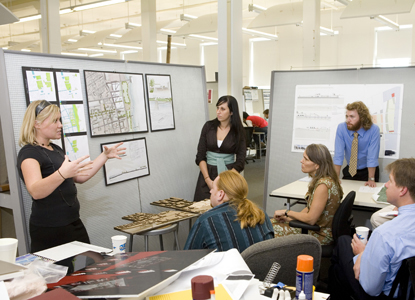
critique01_db.jpgArchitecture Students Present their designs at the Savannah College of Art and Design

On the Ragged Cloth Cafe blog, I wrote about the nature of critiques, mostly summarizing James Elkins’ Why Art Cannot Be Taught; I won’t go into his ideas — you can read a summary on Ragged Cloth if you are interested — but I have been evolving my own thoughts on the subject.

Last Tuesday, in a painting class, the instructor failed to show. We were scheduled for a long critique session, and, being self-sufficient and interested in each other’s art, we continued with the critique ourselves. The critiques in this class had always been group affairs, ones in which the instructor led but did not direct the conversation. So we could easily emulate his processes.

Elkins’ speaks of critiques as fraught with dangers, having multiple ways to can go awry, and he loves the fascinating explications of human nature and thought in action which critiques provide (which is also why they are fraught with dangers).

Some of the danger, as I see it, lies in the fact that while the artist wants information that will help improve her work (and also is hoping to impress the viewers with her artistic abilities and insights), the “panelists” — students or professionals in the field — are almost always struggling to explain what they are seeing. If the panelists (in our case, the other students) are to be successful, they must have insights into the work they are looking at, and then find ways to articulate those insights so that the artist will benefit. It’s a struggle on both sides, since the artist has to be totally alert to the thoughts of the panelists — sorting out, when comments seem confused, whether the speaker are struggling to find her idea, struggling with expressing the idea, or struggling with explaining the idea in terms that will benefit the artist.

And when comments are not confused and the panelist clearly states an opinion or question or makes a comment, the artist has to sort out whether the comment comes out of a concern which the panelist has with his own work or obsession or whether it is truly applicable to the art that is being presented. Other kinds of interface problems can occur — the panelists may get off course and meander into digressions; they may find themselves hostile or overly sympathetic, and so forth.

All this is outside the sometimes awful experience of attack critiques, those legendary events that leave the artist a quivering heap of jelly. I think they arise not out of art or articulation or ideas, but an entirely different culture and one that I haven’t encountered.

Nevertheless, critiques, as I know them, are a substantial and important part of my art education.

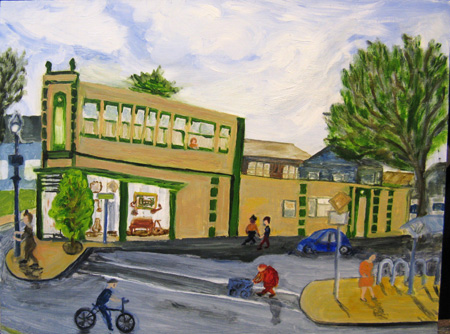
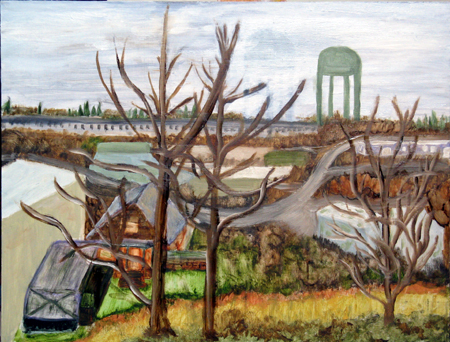
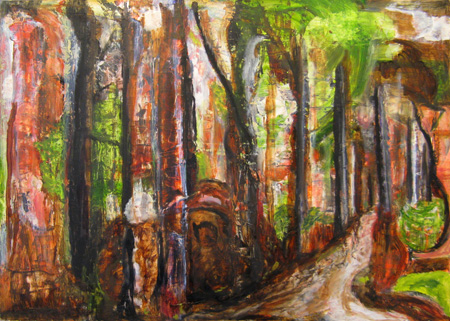
In this critique, I limited myself to three works, a “straight” naive/realistic painting of a nearby street scene, a more complex and abstracted view of a warehouse area from above, and a semi-abstract “forest” scene.
hawthorne20thw.jpg

Hawthorne & SE 20th, Mid April, 12 x 16,” oil on board
warehousewithhouse.jpg

McLoughlin Warehouse District, Mid April. 12 x 16,” oil on board
forestabstractfixedw.jpg

Forest Scene, mid-April, 12 x 16,” oil on board

I was interested in people’s responses to three very different kinds of paintings, all done within a couple weeks of one another. I was particularly interested in this group’s comments, because they are very articulate about what they see. I am somewhat intimidated by their ability to explain what they see, what they like, and how they read a canvas. So I am learning as I listen to them, not just about my art, but about talking about art in understandable ways.

The responses to the three pieces were that they enjoyed the corny street scene, that the colors in the warehouse piece were good (the reproduction here doesn’t do them justice) and that the composition in that one was excellent (they liked the water tower, just as they liked the old lady crossing 2oth Street), and finally that the last was puzzling, interesting, weird, Hansel-and-Gretel-ish,or maybe smelt of Hieronymous Bosch. At any rate, the last, for them, seemed to be coming out of some inner state, whereas the other two were evidences of external scenes. There were other comments but these are the ones that I remember most clearly.

But what the group really wanted to know was where I was going in terms of this last piece. Was this a direction I intended to pursue? What would I be painting next?

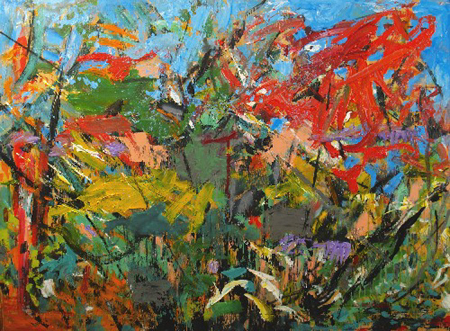
I talked for a while, and then realized that the the group consists primarily of abstracting landscape painters — people who take their references from landscape and then work those references into abstractions. Here’s David Trowbridge’s work. David is an accomplished artist, currently exhibiting in downtown Portland, whose work I admire. It is fairly representative of the working process and product of most of the group members.
davidsheffield_xi.jpg
David Trowbridge, Sheffield XI, acrylic and spray paint on plywood, 35.5 x 48″

So when I debriefed myself about the nature of the critique, I had to consider that the abstract attracted the panelist’s attention most because they themselves did art like that. And the questions about where I was going from there were both out of thinking this might be a new path for me, but also a function of knowing that the class was coming close to its conclusion. We were all going to have to decide “where we were going.” I did ask directly and firmly, at least twice at the conclusion of the session, what suggestions they would have for me. They had none.

So my question is, what kinds of critiques have you had that left you with interesting debriefings? Why were the critiques useful? What unanswered questions were there? Do you believe in critiques — if so, what are their limitations?

expression - artistic or not.

difference.jpg

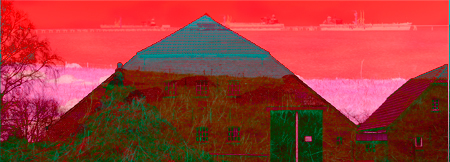
Recently, I spent my leisure time documenting where I lived as a child. As part of my day job, during that time, I used adobe photoshop to pseudocolor grey tone RBG images by cutting color channels in the ‘difference layer’ mode. Trying that trick on two of the Frisia pictures, I came up with the image above.

This, by comparison to the originals, garish image strikes a cord with me. I feel that it epitomizes my memory or feelings about North German Frisia and the coast line - brick farm houses with a hip roof line and oil tankers on a pier in the North Sea.

more… »

How I Stop and Start Something New

DaydreamerThis is the end product of a demo I posted on another site. The process I used was to do a series of acrylic washes until I thought I knew the person I was looking for in this painting. Then started to build in oil, leaving some of the acrylic visible. I kept from moving away from my original idea by avoiding the urge to make everything perfect. I thought about making the hand smaller or detailing the neck line of his T-Shirt, but it remained just a thought. I had the feeling that I was done and it was time to move on to something new.

Art, Education, and Ambition

Well. It seems we have had a few quiet days here on A&P, so I thought I’d fill in the silence with a little thunder.

If you could see my face, you’d smile.

First, please enjoy this image of Rembrandt’s portrait of Jan Six. At this level of greatness, one must say, as did mmm, DeKooning? Stella? “He is on one mountain; I am on another.”

So I will not say “The greatest portrait in history,” but certainly an Everest. Sorry about the bad scan. It seems that all the better images on the net had that same irritating line about two-thirds of the way from the left.

jan-six-sm.jpg
Rembrandt van Rijn, Jan Six, 1654, Oil on canvas, 112 x 102 cm, Six Collection, Amsterdam

A recent comment asked whether any artist today could paint like Rembrandt, Titian, or Raphael.

My answer was that there were many.

But I’d like to add to that. There are not as many as there could be, or should be.

I did not say that I could paint like any of those guys, but I almost did.

Because I can.

more… »

Why we are here

Now that I am over much of my computer issues and can focus on art I came across a couple of photos (hidden on my PC) that I had forgotten about. Over the last ten years or more I’ve had an opportunity to be taught creativity by pre-school young people. When I am around a bunch of kids, I learn all over again that art like life is to serious to take seriously. There is so much joy in watching kids paint flying dogs for Valentine’s Day or green hearts for Mother’s Day

When ever I get an invitation to work with young people, I say sure, why not, I’ll be there. Then I experience an unimaginable fear as if I were meeting the Queen and I wonder why I did I say yes. The answers comes within two seconds after meeting the kids.