[ View menu ]

artform


Holding the Knowledge

Posted by June Underwood

June 28, 2008 1:52 pm

I have just finished an intensive (and intense) 5-day workshop in plein air landscape painting. Later, I may indulge myself and talk about the entire process and the 3 locations we painted at, but for this post I’d like to pose a question which comes out of just one location. The question I’m posing is how does one transfer the knowledge gained in doing one piece of art to her general practice? More specifically, how can I hang onto the insights that my instructor helped me gain and use them when I’m working on my own?

The specifics: On Wednesday we painted at the Willamette River waterfront, in a piece of waste ground, just to one side of the Interstate 405 (Fremont) Bridge as it rises over the river. One humongous stanchion was no more than 10 feet from my painting spot. The roar of the traffic was absolutely constant; it was only maddening if you tried to talk to someone. The field was dusty but large, the sun quite warm, the wind constant, and although there were city amenities beyond us on all sides, a chain link fence and heavily trafficed road cut us off. It was a total enveloping environment, not necessarily unpleasant if you sank into it.

That was Wednesday. On Thursday and Friday, we moved the art school’s painting studio and worked on projects based on one of the plein air pieces. I chose to enlarge upon images and ideas that I gathered from the Under-the-Underpass experiences.

apfremont2.JPG

Fremont Bridge 1, photo, June 2008

Continue reading Holding the Knowledge

More negative

Posted by Steve Durbin

June 24, 2008 2:19 pm

As mentioned last week, I’ve been re-examining my photography in terms of some ideas from Japanese aesthetics. In practical terms, that means I’ve been going out and looking differently at subjects. For example, I’ve tried to be more aware of views involving negative space along Sourdough Trail, my main project of the moment.

13344-450.jpg

Continue reading More negative

summer shadows

Posted by Birgit Zipser

June 20, 2008 6:07 am

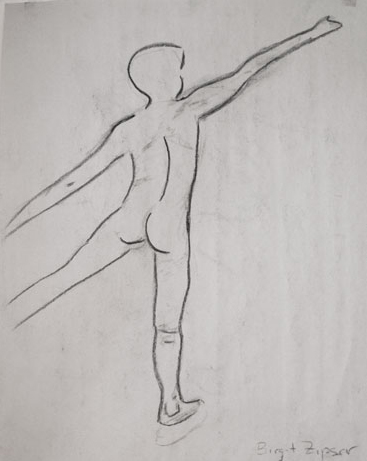
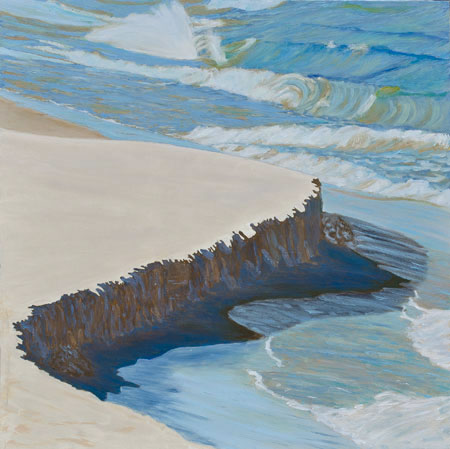
Pursuing my two favorite motifs, water and the anatomy of movement, I started making composites, extracting from one image and pasting onto another.

shadow.jpg

Showing the first version of this composite to a mentor, he questioned me about shadows.

Continue reading summer shadows

In praise of shadows

Posted by Steve Durbin

June 17, 2008 2:44 pm

Old musings on recent photography have led to the resurrection of a completely different series I thought I’d given up on. Just last week I deleted a draft from March that I had started in excitement, but never finished because I couldn’t make the pictures work.

11613-450.jpg

The thoughts were on Japanese aesthetics, and the abandoned series was a rather minimalistic one, captured in all of 15 minutes near the start of a Yellowstone outing during which I later busted my aging ski gear, cutting the trip short (I managed to limp out with frequent falls, discovering in the process that it’s not easy getting up from soft, deep snow when your skis are higher than you are).

Continue reading In praise of shadows

Is an Academic Degree really necessary for a real painter?

Posted by Angela Ferreira

June 15, 2008 11:20 am

Raphael

Looking back through the years, I do not remember when I started painting with oils and watercolors… maybe I was about 13. To be honest mostly of I know today has come from my own experiences of try and error.

To me, making a painting was never an issue but something that happens naturally with whatever materials come to my hands. Oils are my favorites, but recently I’ve been painting in a very quick method and found out that a mixture of acrylics, oils, glitter and others mediums work better for my new style.

In the past 3 years I decided to do a Fine Art degree as a nice “add on” to my previous qualifications. To my disappointment, I have learn nothing new but of a chaotic, hypocrite and delusional world from the Art teachers.

If you an artist with already some success and experience I recommend you to aim higher and not to go back to an educational institution. You see, despite your good intentions you setting yourself back and giving your own murder sentence to the chances of being ‘stepped on’ and muffled by the tutors, who also called themselves artists. You must have no previous artistic experience because no matter how you try to please and befriend this so called “artist teachers” you will always be seen as a threat rather than a student.

Unfortunately we live in a world that demands all this qualifications to be taken seriously. I have learned from my own mistakes, maybe because I was a bit naïve, full of dreams and hopes that a new qualification would push my career further, but realize that I brought this to myself to the point I had nothing but verbal abuse, bullying, harassment, intimidation and discrimination from lecturers. In the end I felt from as high I dreamed and have gain nothing but a new pretty BA words in my cv and an awful demoralizing experience I must rather forget!

Waiting Godot

More new painting in my redesigned website www.magicpaintings.com

Sourdough Trail: a project blog

Posted by Steve Durbin

May 25, 2008 3:15 pm

It appears I’ll be making good on my recent threat to re-activate my dormant Sourdough Trail project. But never fear, I do not intend to flood A&P with posts on that topic. In fact, because, through A&P, I’ve realized how blogs can be useful, I’ve decided to create a new one specifically focused on my project. I’m in no way attempting to create a popular or active site; I simply think the blog structure is appropriate to the nature of what I’m doing, namely a variation on the psychogeography project discussed here a few months ago (and which I still hope to carry out this year). This one has similar concerns, but will be in a familiar rather than a new setting, and will be over a longer time scale, months rather than days. In essence, I want to observe how my sense of that particular place evolves and how it relates to the photography I do there. But if you want to know more, visit Along Sourdough Trail.

13051-450.jpg

Continue reading Sourdough Trail: a project blog

Human Form

Posted by Birgit Zipser

May 23, 2008 6:51 am

A Francis Bacon, according to an ad from Artprice in ft.com on March 31, 2008, fetches more money than a Rothko.

Here is a Bacon entitled Study from the human bodybacon.jpg

Contemporary artists also paint human anatomy. David Palmer paints human subjects engaged in movement. Jacob Collins paints human subjects more traditionally as stationary form.

A New York City dance group, the Ailey II dancers, enjoy popularity.

aileyii_dancers.jpg

Body culture is rampant in the U.S. No longer just aimed at fitness, it advocates mindful movement. Amazon.com offers books such as

bodyculture.jpg

Is there a renewed interest in the HUMAN FORM? Will such painted human form express functional anatomy, mindful or any other kind of movement?

Focus and philosophy

Posted by Steve Durbin

May 20, 2008 10:49 am

Leaves are beginning to come out here now, but branches were quite bare a week ago when I payed a visit to the strip of woods along Sourdough Trail. I’ve gone there occasionally through the winter, but much less frequently than I used to while actively engaged in that project (I never closed the books on it, but I’ve done very little in the last year). I’m thinking seriously of re-activating it. In any case, the new season seemed to call for a little experimentation.

13046-twigs-f56.jpg

Continue reading Focus and philosophy

Painting Portland: McLoughlin Boulevard

Posted by June Underwood

May 16, 2008 9:50 pm

You must forgive me if my language about SE McLoughlin Boulevard is a bit crude. I refer to the Boulevard, actually a long strip of sleazy or derelict buildings, warehouses, and defunct businesses, as “the armpit of Portland.” It is fairly unsightly and often smelly.

McLoughlin Boulevard was originally US Route 99E, part of the major north-south Pacific Highway through Oregon’s Willamette Valley to California. US Route 99E had its heyday just after WWII until it was eclipsed by Interstate 5, finished in 1966. Thereafter, the Boulevard, demoted into Oregon Route 99E, declined as Portland grew. The decomposition of the Boulevard, helped along by the curbing of the highway which restricted access to businesses, was accompanied by its enclosure by warehouses and industrial compounds, all gone slightly to seed. The farmland and residences that had been behind its initial length of business ventures got pretty much decimated over the years by other kinds of cheaply built warehouses and small factories.

I first learned about McLoughlin Boulevard because, when we moved to Portland 18 years ago, the Pendleton Mill End fabric store was located along it. I would take the bus to the Mill End store; to return home, I had to cross 8 lanes of heartless traffic and wait for the return bus in front of The Odysseus, a saloon and strip joint. I avoided looking at the patrons — and they avoided looking at me!

It was that kind of street — an American urban highway that makes used car lots look good.

Still, however sleezy the street has become, it still speaks to my love of urban archeology and history. Jer and I have been investigating the Springwater Corridor bicycle/pedestrian trail that has a new bridge over SE McLoughlin. The Trail runs along Johnson Creek, a major urban creek wont to flood in the wet season and stink in the dry. But between the creek and the biking trail, there is a pretty wondrous set of scenes through the Portland cityscape, including McLoughlin Boulevard.

mcloughlinebikeoverpassw.jpg Springwater Trail over McLouglin, Oil on board, 18 x 24″

Continue reading Painting Portland: McLoughlin Boulevard

Stone soup

Posted by Steve Durbin

May 13, 2008 10:06 pm

When I started my Patina project on weathered auto paint and rock surfaces, I originally had in mind flat surfaces with intriguing designs and colors. But rocks aren’t smooth, so I soon began photographing rocks with some three-dimensionality, playing with the ambiguity between tone and color as surface properties or caused by orientation to the light.

12818b-450.jpg

Last week, just back from photographing a favorite rock face, a number of ideas relating to that work seemed to be coming together. Unfortunately, working with the images (just a little) since then, the ideas have muddled themselves rather than resolving. Despite some enticing ingredients, the fine soup is still mostly in my imagination. Here’s what’s stirring in the pot:

Continue reading Stone soup

What to do? Recycling, renovating, newly constructing?

Posted by Birgit Zipser

May 9, 2008 5:41 am

squirrel.jpg

Continue reading What to do? Recycling, renovating, newly constructing?

He colors me, he colors me not, …

Posted by Steve Durbin

May 5, 2008 1:23 am

Often our lives are made more difficult by greater choice. In photography, the choice of color vs. monochrome was not necessarily easier in the past, but at least it had to be made by the time film was in the camera. With digital capture, you can change your mind at any time. Some photographers, as far as I can tell, use only color; a far smaller number are all about black and white. Some, like myself, dither. Not to complain, but this is a constant issue in ways it wouldn’t have been before. Reminded of it by both the previous post and recent experience, I here present the latest dithers. Prepare yourself: I’ll be asking for opinions…

12340-450.jpg

Continue reading He colors me, he colors me not, …