Archives for sculpture
Photography on sculpture
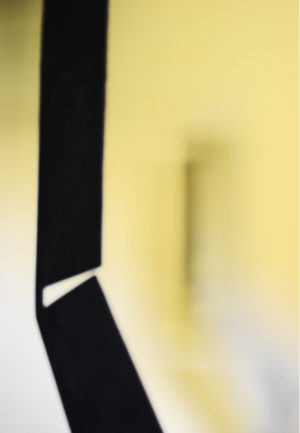
Jerry Rankin is a Montana artist who seems able to come up with completely new ideas in every project he undertakes. Only a few of these from his career are available on his web site. Recently he created two sculptures, variants of a theme, that have no precedent in anything he’s done before. Of thin, flat, black steel, they are very simple in design, being straight-edged boomerang-like shapes with one or two slots, respectively, cut into them. Yet they are intriguingly rich in perceptual surprises. I had the opportunity to borrow the cardboard maquettes, thinking I might try to illustrate these effects. Instead, I discovered an unforeseen aspect of how these objects relate to their surroundings.
Now Bison, Now Bull
My sojourn has kept me away from these pages a little, but something a bit parallel has come up.
Outside of Johnson City is a sculpture of a bull, beckoning the wayfarer to a park that time did not allow us to visit. It is something of an opposite to the West Yellowstone bison in that the bull is a reinterpretation of the internal structure of such a beast, rather in the spirit of the horses that we have discussed. There is a lot of motorcycle glam in this work, which means that attention has been paid to chromed surfaces – but not so much in a spirit of depiction. Facture, fit and finish in this piece is at an industrial level.
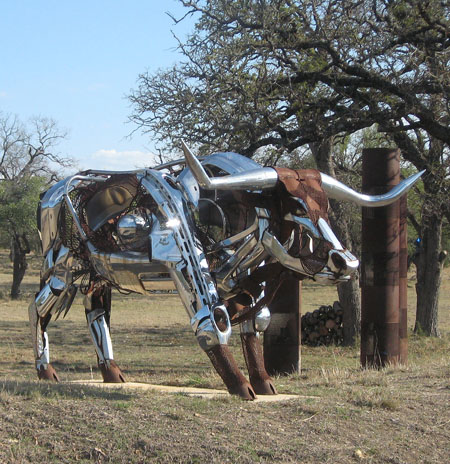
In this case it’s a question of integrating pieces parts into a convincing representation, finding the bull in the Hog.
campus tastes
Sculptures on the campus of Michigan State University cater to different tastes.
I am taking lessons in Throwing Off My Chains. 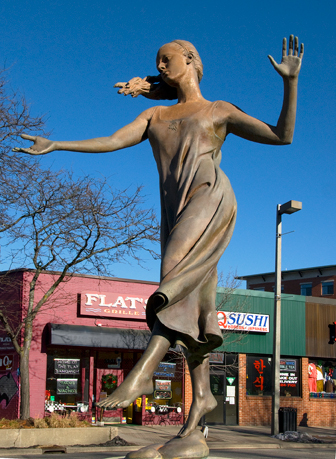 (Andromeda by Anthony Frudakis)
Art & Imagination
Painting From Life vs. From Photos
Cennino Cennini devotes his Il Libro dell’ Arte (late 14th c.) to a practical explanation of the materials and techniques of painting. And yet Cennino also writes of painting as an occupation that deserves “to be crowned with poetry”, because the painter has the ability to compose from the imagination, “presenting to plain sight what does not actually exist.”
 It might seem there is a mismatch between focusing on the physical aspects of the work, and at the same time emphasizing the role of imagination in creating art. But this combination of the mundane and the fanciful is appropriate for a simple reason: an artist creating from the world of the mind must nonetheless work in the world of the materials. The physical nature of those materials, and the way the artist uses them, will inevitably influence how the inner world of the mind is discovered and expressed.
Contemporary artist Hanneke van den Bergh recognizes and makes use of this interplay of the imaginary and the physical in her clay sculpture. She explains “I like to make the heads by moving a little lump of clay until I can just see the face. I like this quality of the imaginary form beginning to emerge from the raw material.” Van den Bergh does not attempt to disguise the properties of her materials. In the example shown here, Danae III, she leaves visible the coils with which she constructs the main form. The contrast of the repeating pattern of coils with the rhythm of the body contributes to the expressive effect of the work. “By avoiding too much detail,” she says, “I maintain the contrast between material — the physical — and the imaginary.”
Serious vs. Decorative: a Ladder’s Story (by Jay Hoffman)
I have thought about ladders, and over the last four or five years I have made some.
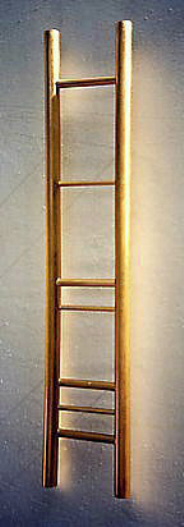
The whole thing may have arisen from cleaning the gutters or some other patchwork chore related to holding the house together. What emerged from my ascents and descents, bruises and strains was an awareness of the ladder as a sculptural framework that regulates motion, and to some extent, emotion. I might have felt aspiration as I toed tentatively yet deliberately upward, toward the peeling patch of paint under the eaves. I might then have felt exasperation as I discovered that I hadn’t brought the scraper with me and now had to gingerly make my way back to the ground.
There’s nothing like having one’s nose up against a rung to encourage contemplation, especially when it’s going to be there for a while. I pondered ladder-ness as a sculptural premise. Big, little, red, green, yellow? How much detail? Would a ladder sculpture be enhanced by the inclusion of cleats, rods and other such? Was there an acceptable level of abstraction? What would be the point?
Chains (Jay Hoffman – guest post)
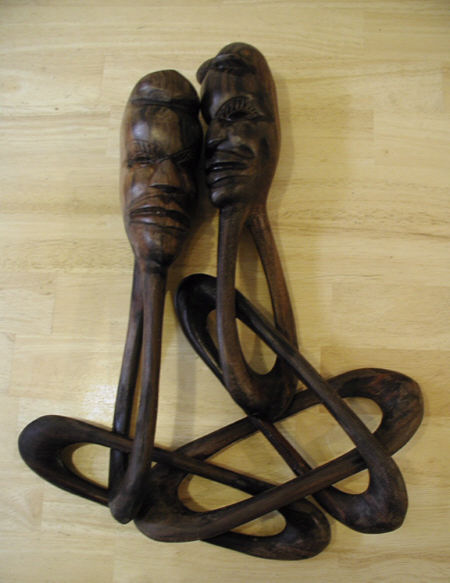
Picked up a piece of airport art at a garage sale. I believe that the lady said it was from Kenya. It is a chain, carved from a single piece of wood with a stylized head at each end.