[ Content | Sidebar ]

Archives for paper

Comparing Media: Intaglio, Quilting, and Language

In a recent critique session of quilted art, conducted by two “fine” artists, I found myself having a “eureka” moment. Then, a few days ago, Jay and Melanie’s discussion of Jay’s intaglio technique on board and foamcore (published prior to this post) pushed some of my insights a bit further. All this was added into a melange of thinking I’ve been doing about where I am in relation to quilted art and painted art.

The eureka moment came through the phrase used by one of the fine art critics: the phrase was “working the surface.” “Working the surface” in the traditional fine arts means adding, deleting, scraping, underpainting and overpainting, sanding, gouging — all the kinds of things one can do that either uncover and/or add to a planar surface. It seems clear to me that Jay’s process of working his boards and foamcore are fine examples of “working the surface.”

With quilted art, “working the surface” seems to show up in two ways. One is what is called “surface design,” which basically alters the flat plane, by dyeing it, laying rust on it, discharging (bleaching) it, monoprinting on it, and even digging into it, tearing and unraveling the threadwork. This work sometimes adds texture (especially with elements applied to the surface (applique) or taken away from it (”cutwork” or just plain gouging holes). These kinds of working of the plane are singular, patterned for the effect in a particular work, not meant to be turned into a commercial design for fabric (the original use of “surface design” had a strong commercial element.) The other part of working the surface with textiles is the work of embroidery and quilted lines that make for a frieze effect; when stitches are pushed through the two layers of fabric and the in-between batting or wadding, the stitched line makes an indentation, beside which the surface becomes raised by the pushed-aside materials.

I have never heard the phrase, “working the surface” applied to quilted art before, but when I heard that and then saw the intricacies of Jay’s working of his surfaces, I realized that the language may give me new insights into what can be done with quilted art.

At the critique, the guest “critics” (very kind observant folks) looked at two pieces I had brought, comparing them.

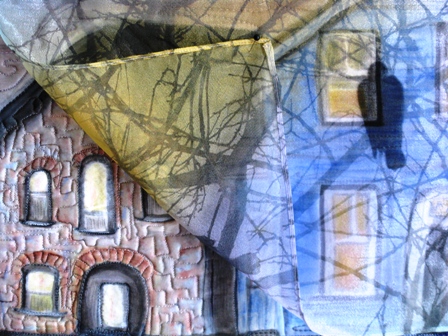
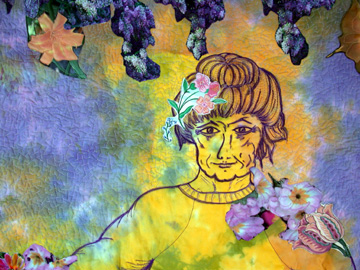
The first was one you’ve seen before: Mrs. Willard Waltzes with the Wisteria, 76 x 61″, 2003, hand dyed and painted cotton, embroiderie perse with computer-generated prints, and dyed overlays.
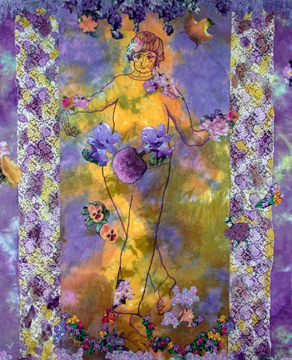
mrswwaltzesw.jpg

mrswwaltzesdetw.jpg detail

more… »

Making paper one’s own: tinting

treeonbluetintedpaper_c-300.jpg

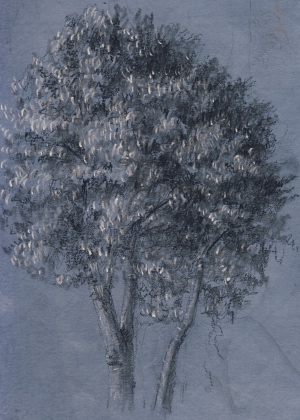
Tinting paper is the fastest and least expensive ways to ‘make’ paper. One begins with a ready-made sheet, but then makes it one’s own. more… »

Big Red C

A controversial sculpture by “book artist” and Cornell University Art Department head Buzz Spector. The C-shaped structure is made up of over 800 books, all of them authored by Cornell faculty, students or alumni. The piece was originally installed in downtown Manhattan (pictured above); recently, it was reconstructed here in Ithaca, New York. More information, pictures, and an installation video can be found here.

Any thoughts?

Artists I Like: Syau-Cheng Lai


more… »

Drawings and Studies

Are quick drawings and paintings artworks or just studies? Are they value at all?

A lot of drawings of old masters have an immense value nowadays but looking at contemporary artists drawings, are they such important?

Why don’t contemporary artists exhibit mostly their drawings and experiments, just their final masterpieces?

Self portrait Scrying

Scrying - pencil and chalk, quick drawing on paper

Drawing from imagination

Drawing from imagination, pencil on paper

Spiritual

Spiritual, Mixed media on paper

Artists I Like: Josh Dorman


I first came upon Dorman’s work in a show at New York’s CUE Foundation and was thrilled. More work and information here.

On Making Paper

When drawing, it is common that most of the drawing surface is left in its original state. In this way drawing is different from many forms of painting. Thus when drawing on paper, most of what is visible is the paper itself.

Also unlike many forms of painting, drawing is a place to play with initial ideas, first thoughts. To play with fragile ideas when sketching is to live in a world of imagination, but the physical paper that the artist uses is a necessary link to reality.

For these reasons, the type of paper that an artist uses can be of great importance, both for the final appearance of a drawing, and for how the artist develops his ideas.

If the paper does not look good, for some reason, it is more difficult to make an attractive finished drawing. For a painter, this in itself is not such a disaster, because he can use the information in the drawing to make a painting which will be attractive as a final product. The problem is that if the paper is not interesting to the artist, it can inhibit his initial creative work. This is particularly the case when drawing from imagination, when there is nothing else to look at except the paper (and what is in the mind, of course).

Unfortunately, it is not always easy to find ready-made paper that is suitable. For this reason, the artist often can benefit by taking the matter into his own hands.

One traditional way to do this, described in detail by Cennino Cennini in th 14th century, is to paint, or “tint” papers using some form of water-based medium. As he explains, “you may make your tints inclined toward pink, or violet, or green; or bluish, or greenish gray, that is, drab colors; or flesh colored, or any way you please”.

Tinting paper is the fastest and least expensive ways to “make” paper. One begins with ready-made paper, but then makes it one’s own.

I have had a lot of good results with tinted paper. By changing a white sheet into a blue one, it becomes possible to draw or paint with both white and black, to develop both lights and shadows, and let the paper act as the middle tone. And a tinted sheet is interesting to look at because the tint is never perfectly even. In fact, every tinted sheet is a simple painting in its own right, before it is used for drawing.

However, tinting paper does not enable one to recreate many of handmade papers used in the past, which are special not only because of their color, but because of their texture.

Texture in a paper comes from a variety of factors. Texture can come from the mold on which the paper was formed. It can come from the felts used to transfer the paper from the mold. The texture is also modified by the way the paper is pressed and dried. In other words, the texture of a paper depends on all the steps by which it was transformed from wet pulp into dried sheet. And then we must not forget the nature of the pulp itself, because the way this was made, and the source of the pulp (wood or rags of different cloths, or other plant fibers) all have an impact on the final outcome. When we consider that there are so many factors that determine what a paper is like, and when we consider that nearly every factor is different for modern papers as compared to papers of, say, the Renaissance, it is hardly surprising that a person would become frustrated if they went to an art shop and said, “Please sell me paper similar to what Michelangelo used for his drawings.” To recreate Michelangelo’s papers would require recreating all aspects of the paper making process, from worn-out linen rags to pressed sheets. And exact nature of these steps is not known to us.

Why is the texture of a paper important? This topic will be dealt with in more detail in a forthcoming essay on drawing.

The short answer is that with every drawing medium (except perhaps pen and ink), the texture of the paper determines how the drawing material becomes distributed on the paper. That is to say, the paper has a great deal to say about what a drawing will look like. An artist, making the same hand motions, would produce two different types of pictures if he used two papers with different textures. Some of the most subtle effects of drawing depend on this factor, although it is something that cannot be reproduced well in photographs. Paper texture, and its effects on drawing, are best appreciated in person.

It is probably inevitable that someone interested in the drawing techniques of a master like Michelangelo would become a keen student of his papers. This because it is not possible to understand how Michelangelo’s drawings came to look the way they did without having access to paper of approximately the same characteristics.